Everything is on Fire (and That’s Okay)

It’s been over three weeks since I’ve written anything that is both personal and publishable. I keep opening the page, seeing the white box and the blinking cursor and drawing  a blank.

How do I put down what it means to systematically dismantle a life?

Not in an overly-dramatic way. Unlike my early twenties, it lacks the flair of simply setting the thing on fire and watching the flames dance in the sky. No, this has been a slow, methodical sort of burn. It’s the kind you chose to set aflame to save everything else.

It’s understanding that you need to set down your armor– there is no fight to win now. It’s removing and reimagining the parts of yourself you were so sure you knew, then realized had become foreign when you looked in the mirror. It’s knowing that you can’t use tape and glue anymore, you simply have to appreciate what was built and move on. It’s seeing that everything is on fire, but maybe that’s okay. Sometimes you have to let things burn so new things can grow.

What does it mean to rebuild a body?

How do I explain what it signified to stand alone in my room and hear only my own heartbeat? Is there a name for the tension that exists at the corner of “absolutely terrified” and “utterly excited”? I haven’t yet found language to explain what it means to know that the next few steps of your life will be frightening and difficult, but that you don’t regret them for a moment. It’s unstitching the parts of yourself you were sure were dead, only to find there is still life there and that it is blooming in spades.

There is a unique mixture of grief, fear, joy, terror, and wonder that comes from running your hands down your own body, grabbing the flesh of your hips beneath your own hands and being able to whisper, “This is mine now, only mine now,” in small, sanctified breaths; the prayer of your own newfound path ritually running through your mind.

How do you talk about rediscovery?

IMG_9688Not in the pop-queen-country-belle-diva sort of way, but within the small, undefined moments you had forgotten too. The moments where you realized  you were at the mercy of only your own whims; the simple, everyday decisions where you only have to ask, “What do I want?” I am searching for the couplets that could explain the simple pleasures of small choices. I am seeking stanzas that explain the joy of newfound agency.

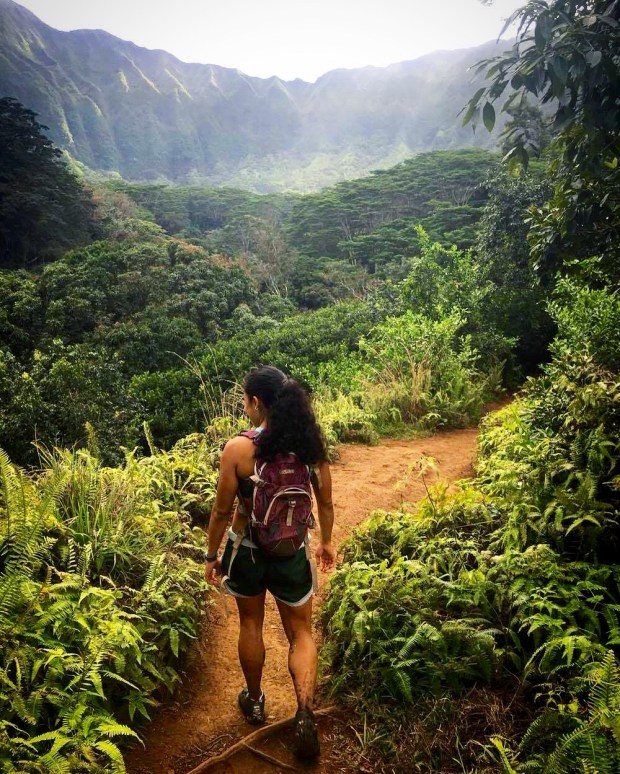
The discovery is a montage, flashes of light shot through my heart: bursting into laughter on a hike, catching my breath in open ocean,  a heavy sigh of satisfied relief at the end of a long day; all the images reveal the mini-epiphany of, “Oh! That’s who I am!” and are full of a sense of wonder I thought I had lost long ago.

Is there a word for the moment between falling and flying?

I haven’t found one yet, something that properly captures the silver second where the sheer ridiculousness of what you are doing becomes perfectly clear. It’s elation and fear. It’s passionate and sensual and make-your-stomach-drop terrifying. It’s the silence in your ears before going down the big hill on a roller coaster; it’s sharp intake of breath before you hit the water from the cliff you just jumped off of.

It’s the knowledge that you cannot go back, that what lies forward is completely unknown, but that the horizon out there is full so much potential you can’t help but just start giggling like a kid seeing the ocean for the first time.

It is wild and unfettered and chaotic and perfect.


The Miracle Is That We Are Beloved

The worst part of death is the terrible silence. It is absolute– a void so empty it is rich in its darkness.

Be it of a loved one, a relationship, or a period of our life, there is always still the silence. The pause after the final breath. The moment when any denial we had about what was happening is stripped away. We can only look down at our hands and know, ‘This is my reality now.’ I heard that silence when I hung up the phone with my grandfather after telling him goodbye, knowing I wouldn’t be able to see him before he passed. I felt it when I returned home from an ex’s, with three years of my life reduced to a few garbage bags in a now empty-feeling apartment. There is nothing we can do but look down at our hands and realize that our previous reality has shattered, and that there is a looming darkness we can only face.

It is easy to feel unworthy in those moments. Everything we held dear has been stripped from us, it seems, and we realize just how fragile we are, how human and imperfect we are as we stumble through life. It is easy to look in the mirror, see nothing but the pain and darkness of that death and feel like we will never find the love or joy or happiness we are certain has left forever with death.

And yet.

Growing up, I had a priest who once reminded us that the renewal of God’s love at Easter didn’t, you know, have to take place on Easter. “If not today,” Fr. Fred told us, “Easter will come.” Even if it was not that Sunday morning, we were reminded that at the end of it all God’s love renews, heals, saves. Even after we have beaten, spit on, and ridiculed Christ, God still decides we are worthy of His love and forgiveness. 

I am reminded of this now, on an Easter Sunday where I am in the process of rebuilding. The darkness we face after a death isn’t a completely false one. Often times, it is an important reminder of our own humanity and imperfections, of the places we faltered and failed.

The darkness isn’t the lie; the lie is that we will never find that joy again.

I know that the miracle of God’s love is not that the world is perfect or that everything is good. The miracle is that, with those imperfections, we are still beloved. The miracle is that even when we are sure we are horrible and hopeless creatures, God reminds us that we are still worthy of love and grace. If we allow them, we still have people and moments that move us to uproarious laughter and countless joy.

This morning, I send a friend of mine a quick Easter message saying, “Rejoice! His is Risen!” He replied in kind and mentioned how blessed we were that we looked inside the tomb and see that is empty.

There, too, is the miracle. The story of Easter does not run away from the notion of death itself. Christ is still crucified on Good Friday and mourned for those three days. We all have parts of ourselves that die as we seek renewal. God’s love doesn’t make death disappear. The resurrection is not a wiping-the-slate-clean reaction of naivety. When Christ looked down and showed us His hands after the resurrection, they weren’t magically devoid of scars. Christ still bore the wounds of His past and crucifixion, even after He rose.

Easter is not about easy fixes or magic healings. It is when we acknowledge both death and the imperfections that came before it but do not stay in the darkness with the decaying forms of our past. The tomb is empty. We don’t have to cling onto those parts of ourselves anymore. Instead, we decide to walk out of the darkness with Christ and rise up better than before.

So, as this Easter comes, I am eager to walk forward in the miracle of God’s love. I look down at my hands and see the reality that they are still weathered and broken from the last part of my life.

This is my reality now, and that is okay. It is good. It is blessed. I have no need to dwell in these past pieces of my life. Instead, I stand up and walk forward out of the tomb and towards light.

FullSizeRender.jpg

A Letter to My Wayward Self.

Over the past few months, I’ve been having my students write papers about love. In doing so, it made me both read and reflect on my own experiences with love and growing up– especially in my early twenties. This is where that led me.


A letter to my wayward self.

My dear girl,

I have no idea where you are running to, but I promise you none of the directions you are heading towards are “home.”

I know: you are horrible at the long game. There is no patience in your bloodstream, no chill hidden anywhere in your bones. You are all chicken skin and red hot veins. Your muscles are overrun with fast-twitch fibers. You go far beyond “starry-eyed”— your pupils dilate again and again as your mind wanders in explosive bursts with fury, unprepared for what happens in the moments after when the star has burned out and things are dark again.

You are spontaneous decisions and seeking the next high. Yours is a rabbit-heart that beats furiously, always asking questions: when? who? why how what where where where where? always searching. You race—no, bounce and sometimes tumble— down trails, so assured that the next turn will lead you to find home. You are certain that this rock or that tree is a sign, that the next moment will finally find the thing you want most: an anchor, a resting place, a haven that just might soothe the pitter-patter that runs from your heart, through your veins and into every other part of you.

The problem is, “home” is a vague X on a map without a key. There is no description or clue as to what it is. So you keep thinking you’ve found it: in the hands of one boy, in the furtive glances of a different man, the fervor of a blurred dance floor, the bottom of an empty wine glass. You hop from all these things, assured that each sip or kiss or beat is a sign that you are almost where you need to be.

It’s a confusing concept, but I promise you none of these things are where “home” is. Don’t confuse the feeling you get when you catch his eyes meeting yours with the experience of being appreciated fully in the gaze of someone who loves you. Don’t mistake a flurry of kisses for a downpour of actual caring. Don’t assume the pain-numbing warmth at the end of a long sip is the same as the soothing release of healing when you actually take care of yourself.

“Home” is not found in the temporary bliss of mind-numbingly good kisses. Don’t get me wrong— you can still have mind-numbingly good kisses, but they are merely decoration on the outside. “Home” is built by weathered boards that have been worked on and sanded. They are stained with difficult decisions and tears. Their nails are the choices you make, hammered in with mutual respect. They are painted with the laughter of jokes built over years of shared comfort. Home will wrap you in its arms when you walk into it looking like something the cat dragged in. Home will stay standing when you tear the furniture apart in rage. Home will still protect you when you can do nothing but sit there in silence.

I wish I could tell you things turn out okay.

The problem is, it’s hard to know when you have found a forever-home. Sometimes we outgrow a place, decide we need to do what’s best, move on. Or we realize the foundation isn’t solid. Or we take a job in Hawai‘i and move thousands of miles away.

Here’s the thing you will need to learn: home can never be some summit that you have to venture to. Home should never be a place that can only be entered when terms and conditions apply. Home can never truly be yours if it only exists within the happiness of another’s.

The only place you will truly find it is when you stop, close your eyes, and breathe. You will feel the ground beneath your feet, the beat of your heart in your own ears, the muscles behind your eyes relax. Then, you will realize that home was never some external site to begin with. You will realize the only real home is the quiet, still place where you both know and love yourself, exactly as you are.

And in that moment, you will finally be found.IMG_8512.JPG


The Small Sprigs of Hope

This post starts with a life update, since it’s been a while.

This past week was Halloween. Normally, Halloween is a bit upsetting. It’s usually got a lot of crappy, racist/sexist/culturally appropriative costumes that make me squirm or make me angry. This year, though, Halloween was pretty great.

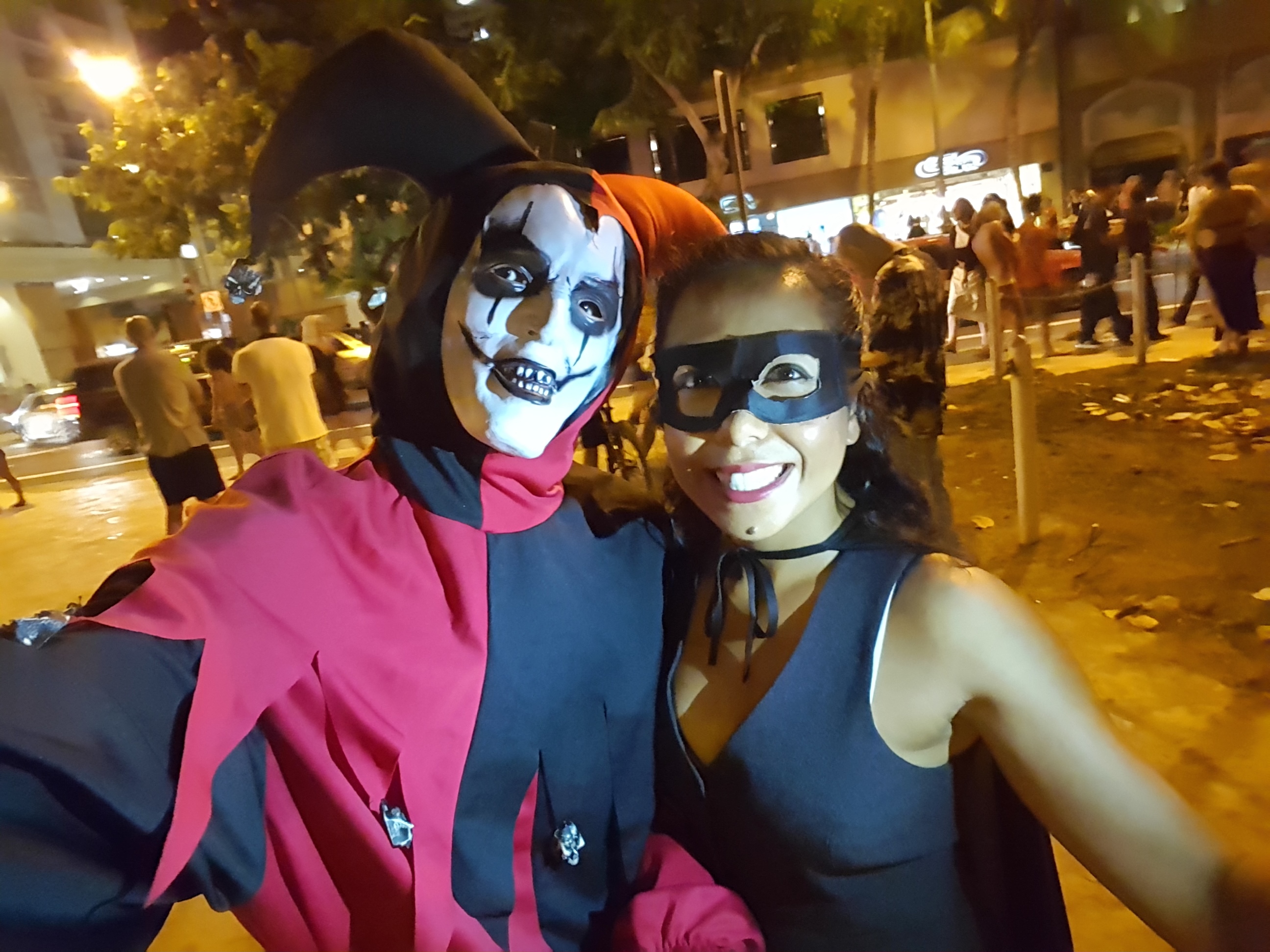
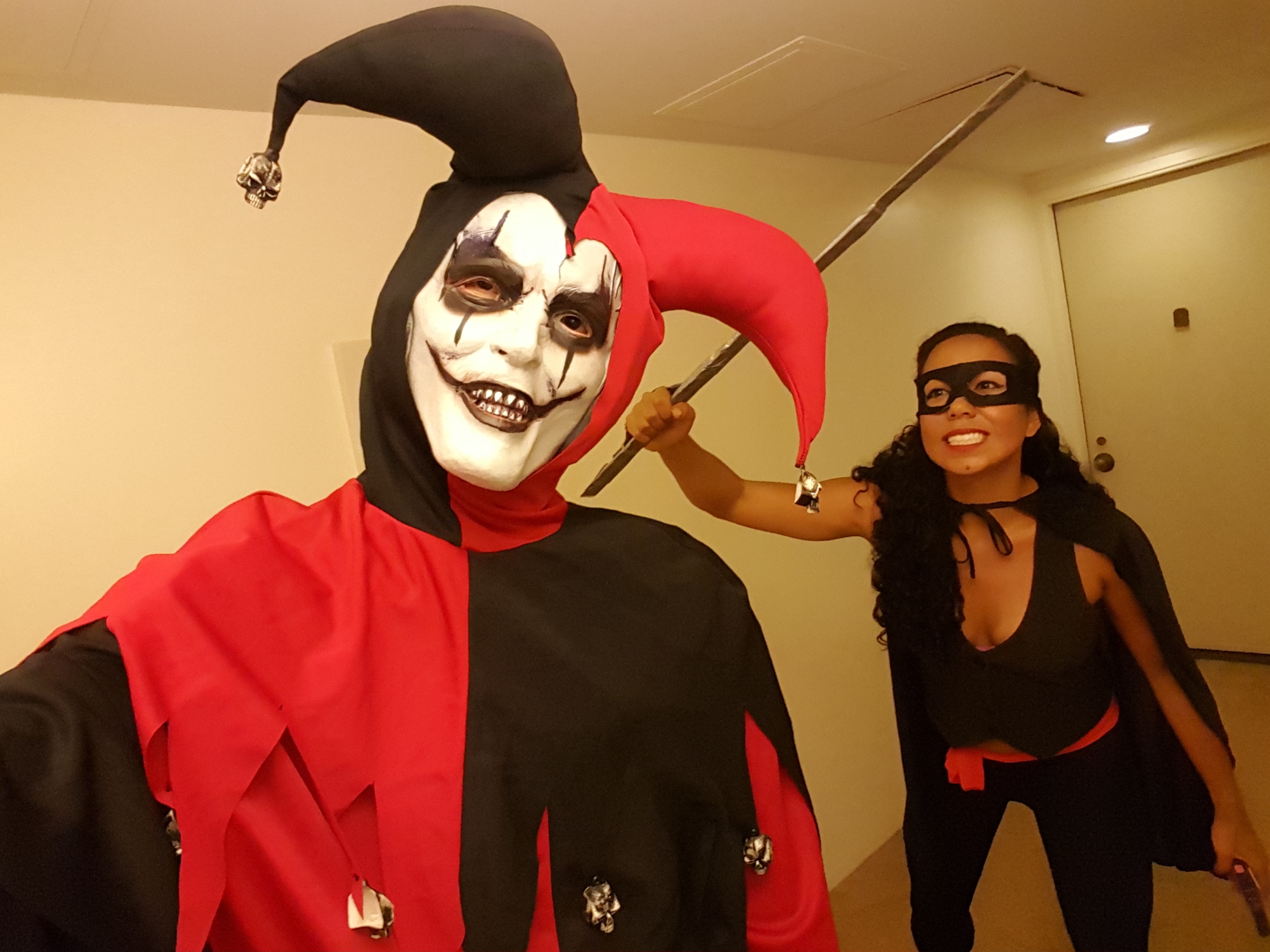
halloween1halloween2

My students were adorable; every costume was fun and not offensive. Huzzah! The only Día de Muertos display came from our Spanish teacher, who dressed as La Catrina and taught kids not already in her class about the actual holiday.

Later that night, my guy and I went out in Waikiki which, while crazy, was actually a pretty great time.

Then, of course, I just had to go on facebook.

Which, you know, wasn’t so bad at first! After understanding what facebook is for me, I’ve come to either just accept things or hit that “unfollow” button, so I can sort of disengage (which I imagine others have done to me). I don’t want an echo chamber, but I think ensuring my space and time are what I need is also healthy.

Then, I stumbled onto the page of someone I had unfollowed already. I should’ve known better because the first few posts already had me like

and then reading the comments I was all I sighed and felt some part of my psyche beginning to suit up. I felt compelled to call them out (and perhaps complicit if I didn’t). Everything I was seeing was so against what I believe to be right, and I have spent so much time in the online world having these discussions, that I instinctually began readying myself to join in a sprint of having this conversation.

Then, I stepped back for a second and thought,

Did I really even know this person? Did I actually care about their opinion or if they changed? If I had unfollowed them in the first place, why was I about to jump into the pit of ridiculous argument with no real outcome? Was it worth my time, energy and frustration?

So, I did something different.

There was something so freeing about this moment. Part of it was that, as I’m growing up, it’s good to realize that I don’t need to deal with everyone. Some people just need to be let go.

The other, though, is that I found a small sliver of hope where I often struggle. I normally see conversations about appropriation or privilege and cringe. I feel angry and, mostly, helpless.

Lately, though, there’s been a shift within me. The more I see people having these conversations, those of echos of hope have started to reach me. Even more importantly, though, is that the more I have these conversations with my students, the more confident I feel that we’re pushing each other towards actual change. 

Last week, as my 7th graders read The House on Mango Street, they got a brief lesson on White flight. Today they’re exploring gender identity and expectations. My 9th graders are deep into To Kill a Mockingbird, and already making connections about bias, perception, and racism. They are pushing me to think more deeply. They are asking the questions, and even if we don’t agree, I’m so proud of them for thinking about it.

So, that’s fine, person on Facebook. Let your fragility allow you to be complacent as a half-way “ally.” Accept cultural appropriation and enjoy the commercialization of my people this Halloween.

For now.

I’m not stressing. On a larger scale, I am feeling more assured in Dr. King’s words about that long arc bending towards justice.  I am believing, more and more, that tides will turn. I am hopeful for the day when what you perceive as “small potatoes” will get called out as signs of larger beliefs we don’t accept anymore. So, someone else can teach you another day.

Who knows? Maybe it’ll be one of my students.

#WhyIWrite – Survivors and Monsters

It’s been a hell of a week, but one that seems to be ending on a happy note. Our school’s WASC visit went well, and I’m happy it’s Friday.

I’ve been fairly quiet on social media, simply because I’ve felt bone-tired most of the week. It’s that time of year where both the students and teachers are crawling through to Thanksgiving break, just doing our best to find the moments for joy and laughter when the gloomy clouds of the October/November Doldrums break.

I did catch the #WhyIWrite tag (which José Vilson wrote about eloquently from the perspective of an educator). I know I have that piece sitting somewhere inside me, but I’m not in a space where I can dig it out.

It did make me think of two reasons, though.


The first is that writing, in many ways, is an act of survival. Like lots of people (especially, let’s be real, women of color), I have overlooked, ignored, or been unable to recognize a number of different, small traumas in order to live in white dominant culture. Speech changed, clothing changed, body image shifted. Writing has helped me parse through some of those mixed feelings on paper. It helps me find the space to be angry, be confusedraise my voice and also make a safe-haven for it that can be reflected on. Without being able to put those things in one space– to cut, copy, paste, realign and find new ways to put it out there– I don’t know that I’d be able to deal with it.

The second reason, though, is to turn the mirror back on myself. Given the above existence, my own penchant for drama would make it easy for me to always see myself as the victim, the heroine, the protagonist of the story.

The problem is, life doesn’t work that way, and I’m not always the heroine. The white space of a blank page can be unforgiving and pushes me to ask questions of myself I may not normally pose. When I write, it forces me to turn back to a situation and ask, “What happened here?” At times, I come as the reflective survivor, returning to an emotional place to work through it and eventually heal.

Sometimes, though, I am returning to the scene of the crime.

I am not perfect, and when I ask, “What happened here?” I am often forced to reconcile my own shortcomings. I am made to see the places when I have hurt others, silenced voices, or simply been a less-than-stellar human being.

If writing is rewriting, then writing is also the opportunity to hit rewind and play, again and again, on the memories we have and the stories we tell. It is easy to read a situation the first time and see ourselves as the noble dragon slayer, overcoming and persevering through a tough moment.

Occasionally, we realize that we were not the slayer, but that some part of us is the creature to be slayed. We understand that it is not our job to play victim or heroine to someone else’s monster, but that sometimes, we realize that we are the monster instead.

Exactly Where I Need To Be: On 28

Well hello, there, 28. You’re three or so hours away on Hawai‘i time, but I’ve had some red wine and a delicious calzone, so let’s do this right now.

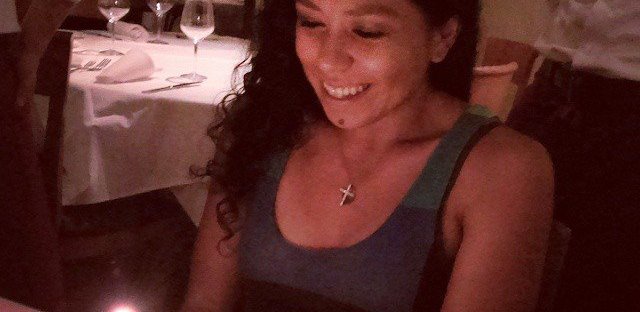
bday

Last year’s celebration

Normally, I come into my birthday very reflective. Last year, I wrote about wanting to accept things as they are.  I like to think I did that.

This year, as I move into the last few years of my twenties, I realize that… I’m empty. Not in a bad way– October is the first full, meaty month of fall. The time of harvest, reaping the benefits of what was sown in hot summer months. My birth month is one of patience, balance, and hard work. The pregnant pause of the year. It’s not the beginning of fall, nor is it the holiday season. That’s okay. I like living in the pauses.

I normally lament how rushed and tired I feel around my birthday, but this year, I am choosing to celebrate it. I see now that my exhaustion, my emptiness, isn’t a sign of lacking. This year, and hopefully from now on, it is a sign of preparation for the new. We cannot fill a cup that is already full.

I come to a new year of life completely spent: I have tried to give my words, my voice, my work to my classroom and loved ones. I have tried to ensure that I don’t refuse new lessons because I am so full of old ones that may no longer serve me. Instead of  feeling full and satisfied, I quite like the idea of coming into a new year on earth empty and open: there is a hunger in my belly that is still not satisfied. I am excited to spend another year filling it again.

So, 28. Here I am. I am blessed with amazing family, friends, partnership. I understand now, more than ever, what the work feels like (I am always adapting to what it looks like). I am eager to see what comes next.

I’m moving away from making highfalutin plans for 28. Instead, I am excited to spend this year working, listening, and reveling in the joy and stability my life, love, and work has brought me thus far. If I learned anything this year, it’s that I am best served by reading my life like the waves: there are times to savor the momentary calm, wait within pause as a set comes in, and there are times to ride the waves into something marvelous.

Here’s to reading the ocean. Here’s to trusting my gut. Here’s to 28.


PS: I am still blogging over at EdWeek. I hope you come and check it out. 🙂

Run Your Race: Reflections After the Kaua‘i Marathon

I don’t usually write race reports, but I’m giving this a shot! It’s also included with a reflective post, so it’s less streamlined, meaty, and free-form than what I might normally post. Just to keep it clear:
Intro
Reflections
Stats and Race Report


An Intro

I landed on Kaua‘i expecting the worst.

Obviously, the island is gorgeous. It was muggy, but jumping into the car with my parents was a breath of fresh air I desperately needed. If I had shown up just to spend a weekend with them, it would have been a sense of peace, of coming home.

But there was this race to run. A marathon with a reputation: picturesque and full of aloha, but with heat and elevation that would demand your respect and push you to your limit.

So, I showed up with one goal: finish. Just get the darn race done. I was already nursing an aching left hamstring and twitchy knee. I had failed to get in a twenty-miler. This wasn’t a body built to win. I was here to enjoy the view and say I did it. If I survived, it’d be a miracle.

I’m happy to report that I survived and, surprisingly, did much better than I thought. By far the best part was having my parents at the end.


Reflection

I had a lot to think about this race. With school getting into swing, working on a number of projects, starting up The Intersection, and navigating some other life-work-things, there’s a lot of… stuff.

The Kaua‘i Marathon came at just the right time for it. Interestingly, I ran this race with almost no music playing. The only time my headphones bumped was mile 24 to 25 (a beast of a hill at the end). Besides that, I was in my own head, figuring things out and coaching myself through a very difficult race.

I usually use mantras when I run. During my first marathon, I ended up with a pacer who coached us all to chant, “I am strong, I have energy, I can do this.” I also used one from a friend, “smart, strong, focused,” to stay on track.

This marathon, I had three that have stuck with me and become part of a larger reflection I had after the run.

  • The first was “run your race.” I used this a lot at the beginning, and I’ve said it and heard it said to student runners. It’s a good reminder not to compare what you’re doing to the runner next to you, especially in an endurance race. When we see people passing us or surging, it’s natural to want to try and catch up. Sometimes, we have to fight that urge.
  • The next was a recitation of The Paradoxical Commandments, and whatever variation my run-addled brain came up with. When my adrenaline gets surging, it’s easy for me to create a competitive, even nasty internal monologue to push myself forward. I didn’t do that this race. While reflecting on some personal events in my life recently, the phrase “love them anyway” kept popping into my head.
  • Finally, for some reason, each time I went up a hill I kept repeating, “It might get some, but it won’t get me” (“It,” I’m assuming here, is the hill. Or the desire to walk up the hill? I really can’t remember.).

So, here’s what I’ve been thinking about: If we know who we are and trust in our abilities, there’s no reason to seek approval or validation from anyone else on the course who hasn’t earned that privilege. I wrote about this recently, but I’m beginning to trust myself a little more and have a better sense of what it means to follow my own instinct and integrity.

The Kaua‘i Marathon put these ideas into physical practice: I had to settle in and run my race. It would have been easy to give in to the desire to be angry or frustrated while in pain during the race– lots of people do. By refusing to give in, I  stayed true to myself and was able to stay positive throughout the race. I ran nearly all of it with a smile on my face (something spectators lovingly noticed, which pushed me to keep doing it!). That’s the kind of person I want to be and be remembered as.

When we choose to put ourselves out there online (or in any space), there’s a natural tendency to seek validation or acceptance. Many of us share our voices because we hope someone else as felt what we have, or appreciates what we have to say. When that doesn’t happen, it can be very tempting to beat ourselves up or change who we are (or the persona we put out there) in order to be easily categorized and, therefore, appreciated.

At the end of the day, though, the best we can do in any situation is seek joy and truth in being wholly and completely ourselves. As silly, angry, bubbly or blunt as that may be, as unlikeable as those people sometimes are, at a certain point all we can do is run our races, love and move past those who don’t like it, and try not to get pulled away from our own course. 


Stats and Race Report

Warning: This is long and was mostly a nice exercise for me to reflect on the technical aspects of running this race.

So! I finished:

  • 29th overall (out of 255)
  • 9th female overall (out of 20)
  • 2nd in my division (F25-29, out of 11)

Honestly, Kaua‘i was one of the toughest marathons I’ve ever faced. I really had no idea how difficult it would be until I was in the middle of it, fighting through.

My parents and I got to the race at 4:45 AM, a little over an hour ahead. Like I’ve mentioned, having them there was a huge upside to this race, and they walked with me to the start line as I tried to get calm. I was worried I had entered this race day all wrong: my body still hurt, I had eaten late last night and was worried my stomach would be tricky, and I didn’t know if I had properly trained for this.

Still, the darn thing had to get done. I crammed a quarter bagel with PB into my mouth, tried to use the restroom, and said good-bye to my parents.

The race started beautifully, with an ‘oli celebrating and thanking the island for hosting us. I was struck by how marvelously small (and well-run!) the marathon is. With only about 1,500 participants for the half and full race (and only 300 for the full marathon!), the setting was far more intimate and grassroots– and completely unlike the mayhem and glitter of the LA marathon.

We were sent off, and the first few miles were spent just trying to get into my body. My left hamstring began feeling tweaky immediately, but I did my best to breathe through it and not let it rattle me. The sun came up around mile three, and the only thing I kept noticing was how beautiful and green the scenery was.

At mile five, we entered the tunnel of trees. I had driven this part with my parents and remembered my dad’s wise word to “mind the potholes!” A few folks didn’t and tripped. There really aren’t words for how lush, spiritual, and breathtaking running quietly through these trees was. The only thing I noticed was the breath of my competitors, the sounds of beating feet, and the wind in the leaves.

Around this point, though, is when I noticed people beginning to drop. Surprisingly early, even for half-marathoners, but I have no doubt the heat played a role in that. This was my initial reminder to breath and run my race. The first six miles were all a gradual incline, which had seemed terrifying. They actually weren’t that bad. I like hills, and the slow climb up let me find a rhythm to move forward

The race then leads through a net-downhill. First, through some gorgeous farm land, then through a residential neighborhood where locals very sweetly cheered us on and clapped for us. I really started to find my groove here. I was smiling, thanking volunteers each time I grabbed water and was surprised that I hadn’t felt compelled to listen to music yet.

Around mile 8, I also popped my first Gu. I know, about 40 min late. I normally train without water or fuel in case I need to run during a zombie apocalypse or actually forget gels. This also helps make sure that my races are always better than my practice runs (I’m not recommending that to anyone, though. You should always stay properly fed and hydrated).

Mile 11 is where the course splits between the half-marathon and the full marathon. I joked with the volunteer and asked if I could change my mind. He laughed and said to stick to my race.

I understand why I needed the reminder. As soon as you make the right turn and decide to run the full marathon, the course slaps you in the face with a brutal half mile climb that was best run as a “slog.” It’s empty, and so there’s no one else on the course but you, the other runners, and everyone’s collective pain. This is where, mentally, mantras became huge.

After a half mile to recharge with a flat and an aid station, the course beats you up again with another hill! It was mentally so hard to push past this point, but I kept deciding that I would not get bogged down by the hills (though I did walk a few times). I eat hills for breakfast, I thought as I padded up. This is where I started passing some folks.

At the half-marathon mark, we enter a gorgeous, cool flat. A timer marked us on the course, and after yelling out my half time (2:01), one of the race directors shouted, “You’re thirteenth female overall!”

I was taken aback. I had never been anywhere near top ten in the overall female division of any race. “Seriously?!” I called back.

“Yes!” he laughed, “so keep moving!”

I thanked him and kept pushing forward. I felt positive and wanted to stay with that feeling and not get caught up in competing.

At mile 14, we hit another admittedly beautiful hill, and the woman in front of me was in sight. I was determined not to surge. She was walking, so I decided to just keep my pace and see what happened. I was able to catch up, and she congratulated me as I did, saying, “you’re running strong. Great work.”

I was so thankful for her kindness in that moment. I returned the sentiment and kept moving.

I don’t remember much about miles 15 through 18, except that it was hilly, brutal, and beautiful. That, and the spectators and volunteers truly make this course fantastic. They played music, had signs, clapped for us, set up how made aid stations, music, and were so full of generosity and love. One aid station played “Eye of the Tiger” as they strummed air guitars and took my photo.

Another interesting note: because the race is so sparse (300 total participants!), there were long stretches where I was running alone or was the only person at an aid station. This made it feel awesome and personal though occasionally made me worried I had gone off course!

After reaching the top of Kalaheo, I was able to catch my breath a bit and start back down hill. The course meets back up with itself here, and I began to run into folks at the fifteen-mile mark of their race. Many congratulated us as we ran by and encouraged us to keep it up, or told me to keep smiling. I did the same and was reminded how strong and open the running community can be.

At mile twenty-one, I went past the half-marathon timers. They took my time again, and told me I was now eleventh overall female. I was thrilled but knew I needed to not let my excitement force me to burn out in the last five miles.

Another big hill followed, and another racer and I exchanged encouragement as I pushed past him. Hills really are where I come into my own as a runner, and I’m glad I trained on them so much these past few months.

I don’t remember much until mile 24 when the last big hill happened. This is one of the first years I really studied the course and its elevation, so I knew this was the final hill. The tenth place woman was in sight, and as we came into the aid station at the top of the hill, I gulped down water and knew I had to get moving if I wanted to at least keep my place. With the last two miles ahead, I decided now was the time to let myself get a little competitive.

We coasted down towards the finish line, and I eventually caught up with the woman ahead of me. She congratulated me, but I told her we still had a few miles to go. She pulled ahead, and I knew her pace was just fast enough to edge me out. I decided I was okay with that. As we hit mile 26, people cheered us on and I yelled for both her and I to finish strong.

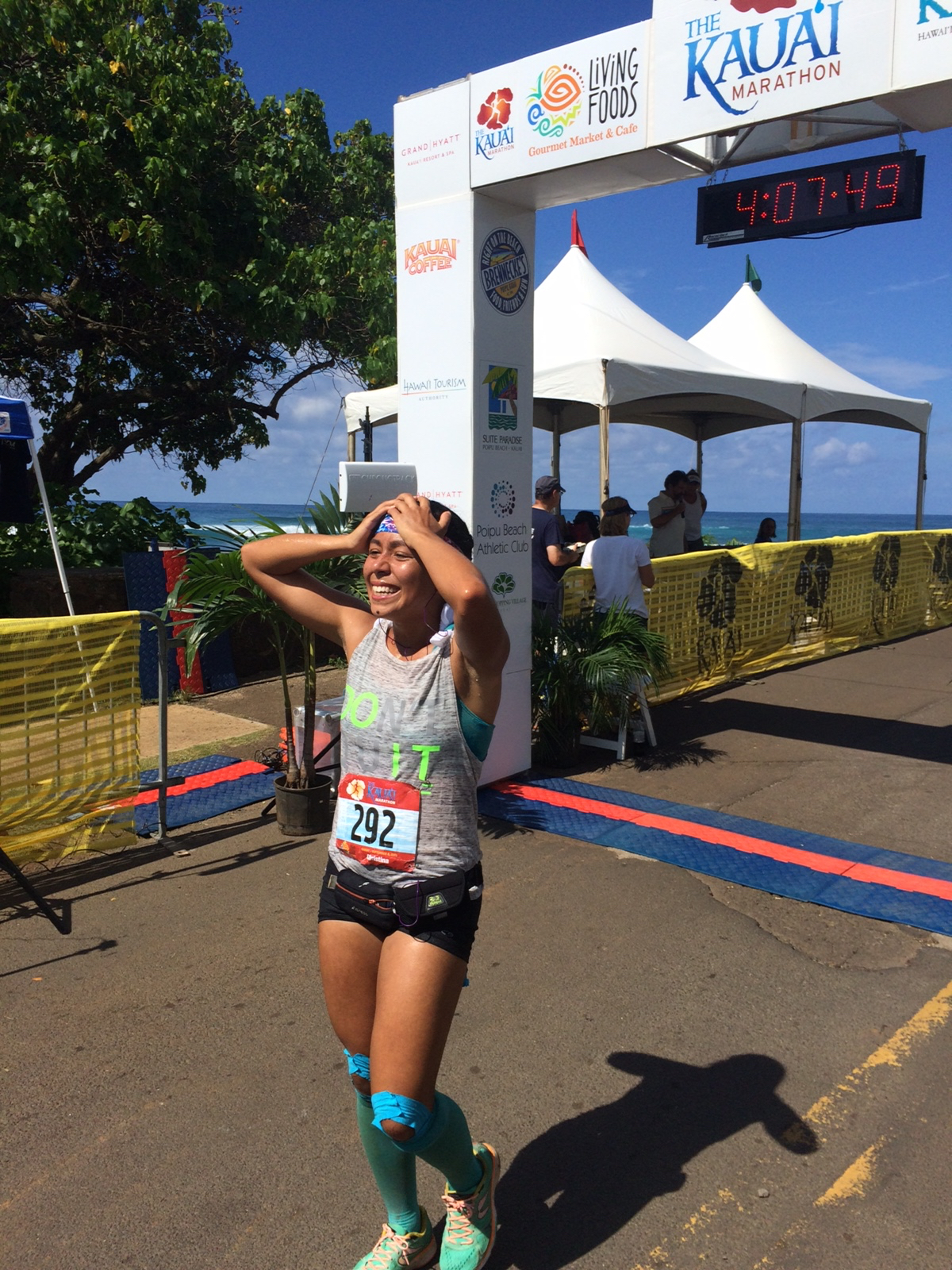
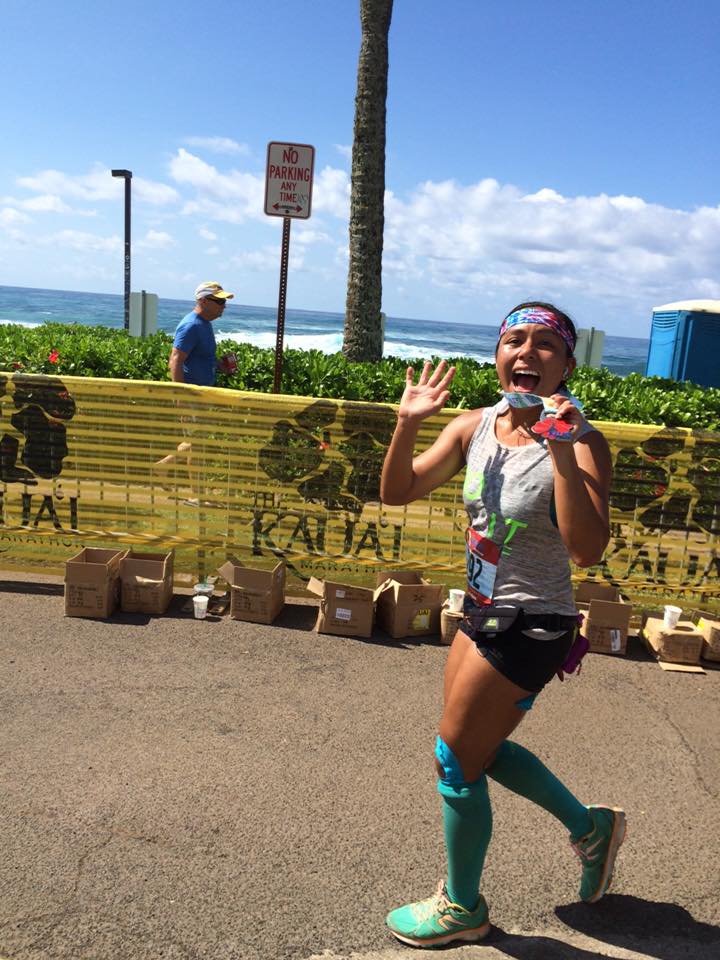
The end in sight, I began to try and kick as much as my body would let me. I had spent everything on this course, though, and it was only seeing my mom and dad frantically waving at the end that brought me speeding in with a smile on my face.

marathon 11060035_10205004916303950_1717202903062313972_n

After, I looked up and saw that I had come in at 4:07. Only 3 minutes over my PR! I was ecstatic, and really believe that keeping a positive outlook got me there.

Overall, this race went well. No stomach issues, fueled consistently every 4-5 miles, stayed hydrated and cool, and followed my normal strategy of a conservative first half and a faster second. This time, the training paid off.


*phew* Okay, that was longer, but way more fun than I thought it would be to write. I may need to try and do this again.

#AmWriting, and Running, and Writing…

My students are writing right now and so am I.

Mostly, I’m writing much more because I’m excited to announce the Education Week has brought me on as one of their bloggers! The Intersection will discuss race, culture, and topics like that as it intersects (get it? *rimshot*) with education.

Beyond that, I’m running the Kauai Marathon on Sunday. I feel very unprepared, but we’ll see what happens.

Oops! Kids are done and so am I.

Everything Is Upside Down and That’s Okay

“You’ve always been fine but… this is the first time it seems like you really have your shit together.” My boyfriend was leaning on the counter, looking up at me and smiling.

I smiled back, not only because it’s nice when people you love validate you, but because it’s immensely satisfying when your own consciousness is mirrored back to you.


Here’s a thing about growing up (and being a teacher makes it weird, since I know twenty-seven isn’t actually “grown” at all, but consistently being around twelve-year-olds will do that to you): you either accept that everything is imperfect and going to change or you go nuts. There’s no easy way to say it, and frankly to do anything but embrace it would be a waste. 

I finished up my Teacher Leadership Initiative final project this past week, and in doing so reflected not just on my practice, but on my PLC (personal learning community). A lot of my community has been online: first, it was running and marathon training people, then TFA folks when I worked at the org, and then I was lucky enough to find EduColor and all the amazing people that I’ve met along the way.

I like to think of myself as “easily mentored,” but it’s probably more accurate to say that I just enjoy being a “fan” of things– especially people. I am quick to become an acolyte for my current favorite group or person, and just try and soak up some of their awesome. I like this about myself. I generally think people are good, and want to celebrate that as often as I can.

That also comes with a side order of self-consciousness: I value the opinion of people I like very much. I want to be liked by the people I like. While IDGAF about lots of folks, once I’m here for someone, my brain sets up a little test balloon of concern about them consistently bobbing around my mind: am I being too much? Is ____ annoyed with me? Should I do less/more of _______ so as not to upset _____? 

As you can imagine, it’s a lot of balloons, and quite a bit of mental juggling.

Here’s the thing I’m going to have to learn over and over again, though: people are not perfect, relationships change, and sometimes we’re just not going to vibe with someone. That’s okay. That’s good. Appreciating and wanting to be mentored by someone doesn’t mean you’re going to agree with them all the time. There also might be a time when they flow out of your life, and maybe the best thing is to appreciate the time they gave you and let it go.


I was reading Jose Vilson (one of many people who I consider a mentor)’s piece about #BlackLivesMatter and education. Beyond being an amazing, essential read…

(seriously, go read it. Now. I’ll wait. Done? Excellent.)

Anyway. One of the many things I love about the piece is that it reminds us how important it is to consistently question why we’re doing something. As teachers, I think we forget that far too often (both for ourselves and our students), but I know I want my students to question the “why” of every thing and every one, including me, as often as they can.

Moreover, the piece made me not just think about ensuring “The Work” is centered on our students, but it made me realize that it’s important to make sure all my relationships are centered properly as well.

In my professional world, that means students and communities of color. In my personal life, it might mean something else (shared experience, love, values, space, etc). But if growing up means embracing nuance and accepting imperfection, it means that well-centered relationships aren’t always going to feel the same. The chemistry with which I interact with people is invariably going to change, but as long as we both know why we’re in this, then I think it’s going to be okay.

It also means, though, that it’s time to let some of those balloons go. Not because I don’t still tremendously value my mentors, friends, and colleagues, but because I’d like to think that if we’re in this for the right reasons, we should center on that more than just each other. There’s a line between being a caring and empathetic individual, and just doing things to please others, and I’ve been tap-dancing on it for far too long.


As I’ve headed into my fourth year of teaching, there’s a lot of exciting things happening. It’s nice to get more work doing things I love and enjoy (instead of, perhaps, handing out flyers in Waikiki).

There is also, at least for now, an accepted confidence that even when things turn upside down, I have a pretty good idea of who I am and what I’m about. For now. If anything, the acceptance that everything will probably get upended at some point has given me a weird feeling that I am more able to roll with those punches and hopefully recenter and still love myself when I have to regain my footing.

So even if the room flips and everything scatter everywhere, I know where my center is. I’ll hold onto it for as long as I can, so that when chaos inevitably occurs, I’ll be able to find that place and seek joy in the flux.

Am I An Asshole?

or Trying to Self-Author My Story

(feeling tl;dr?)

“I was looking through your resume and saw you have a website! Why did you decide to do that? What do you… do on it?” My manager for a social justice pilot I’m in asked as she got to know me

I felt a trickle of sweat roll down my neck. My stomach clenched a little, and the flurry of self- doubt and deprecation began to scroll through my mind:
how could I think I needed a website? she must think I’m such an asshole. It’s so dumb. I’m not even a good writer. I don’t deserve that site. I don’t deserve it.

I sighed, and took a big breath, and repeated a mantra I’ve been trying to remember in times of doubt: Take. Up. Space.


So I told her a story. I talked about how fellow educolor member Bill Fitzgerald messaged me, saying he noticed that my name was available as a domain. I had considered it briefly, but didn’t know if I deserved a site. He responded, “Your writing and ideas need a broader audience, and you deserve a home for them that you control.

His words stuck with me. Clearly, I shouldn’t need anyone to validate me (and Bill is excellent at owning his privilege), but that doesn’t mean that it doesn’t help.

The biggest obstacle is fear of looking like a braggart or an asshole. The first word that actually comes up is that I shouldn’t “mayabang,” or “boast” in Tagalog. It’s ancestral– not because my parents weren’t very verbal and constant with their praise and affection, but because that’s not who we are. Women in general are often told not to be too “high and mighty” about our achievements, lest we appear bitchy. The idea that I ever show pride about the things I’ve done has a weird, gross, undercurrent of things-you-can-feel-but-never show.

Which is difficult, because Western leadership often values the exact opposite. Where does that leave me?

I don’t think that taking up space means assimilating to the cult of personality, but I do think it means accepting and navigating the squicky things that come with creating that space– and ultimately, doing it. Again, if I think my voice matters, I also have a right to protect and control spaces I create. 

If there’s a place between “OMG CHECK OUT HOW AWESOME I AM BRUH” and not sharing– the “Hey! Here’s a thing I wrote that I’m proud of!” space– I should try and find it.

Because, here’s the thing: I am proud of my work. I am proud of the stuff I’m doing and think that it occasionally deserves being shouted out. 

Does that make me an asshole? Even just writing that felt weird, and I’ve written and deleted this post a few times, but I think it may be time to stop pretending I only self-deprecate and don’t take pride in what I do. If I didn’t, why would I continue doing it?

If I believe that women, especially WoC writers, should control, create and self-author their own space, I should walk the walk and try and do it myself if it’s what I want. 


So, I bought a domain, which you’re on now. I share and write a lot about race and social justice issues, especially in education. I sometimes often share that on facebook. I think that has come to be… strange for some of the people I’m friends with. Not all of my family agrees with me (which is 100% fine), and I’m sure a lot of my friends and family are a bit oversaturated. Sometimes, I am too.

Normally, I’m a big believer in the Donna Meagle school of Social Media:

but I know things are different on facebook. I don’t want to lose connection with family and friends who want to mutually share in each other’s joy of cute animals, babies, and vacations. That space should exist too, even for me. 

I don’t mean no one should put hard news on facebook. Plenty of us do. It’s more an exercise for me in finding balance– something I sorely lack.

So, tl;dr

Part of creating space is knowing when to give it. So, with the help of other great mentors (Alex, JLV, Doug), I’m doing something a bit crazy for me and created a facebook space to talk all things social justice, race, and education writing. As I begin to freelance a little more, I hope it will also be helpful.

It could be great. It also might go horribly. I really have no idea. I was worried I would look like an asshole doing it. JLV loving came back, “Then you’re an asshole. Over it?”

And I think I am. If only to try new things, maybe I need to do things that at least push me outside my comfort zone. If “being an asshole” means “fighting for self-authored space,” I just might be fine with that. At the end of the day…

and there’s nothing I can do.