The day hadn’t started at all like I planned. Jetlag still permeated my body, and I’d woken up later than I wanted after less sleep than I would have liked.
Still, at the behest of my advisor, I walked to a local museum instead of locking myself in my hotel room to study. I sleepily made the one-mile walk to the Denver Museum of Contemporary Art, only to realize that the museum and exhibit my advisor had recommended were actually a mile in the other direction. I’d already paid for the ticket, though, so it seemed worth a look around before heading on my way.
I wasn’t sure what I expected to get from walking around the museum. I’d never considered myself very good at appreciating art. I know that seasoned museum-goers would tell me that that’s not the point. My friend Tim, who frequently goes to museums, has written beautifully about the unexpected and marvelous human experiences he has had while wandering and appreciating what he sees. I want to be open to that magic, but as much as I like attempting to understand artwork, it very rarely amounts to anything more than a pleasant experience.
So, when I walked up to the third floor, I didn’t think much of my decision to see a fabric installation by artist Ana María Hernando. I walked in with no expectations. But what I certainly didn’t expect was to turn the corner, gasp, audibly sigh, “Oh,” and burst into tears in front of a very confused college-aged museum docent.
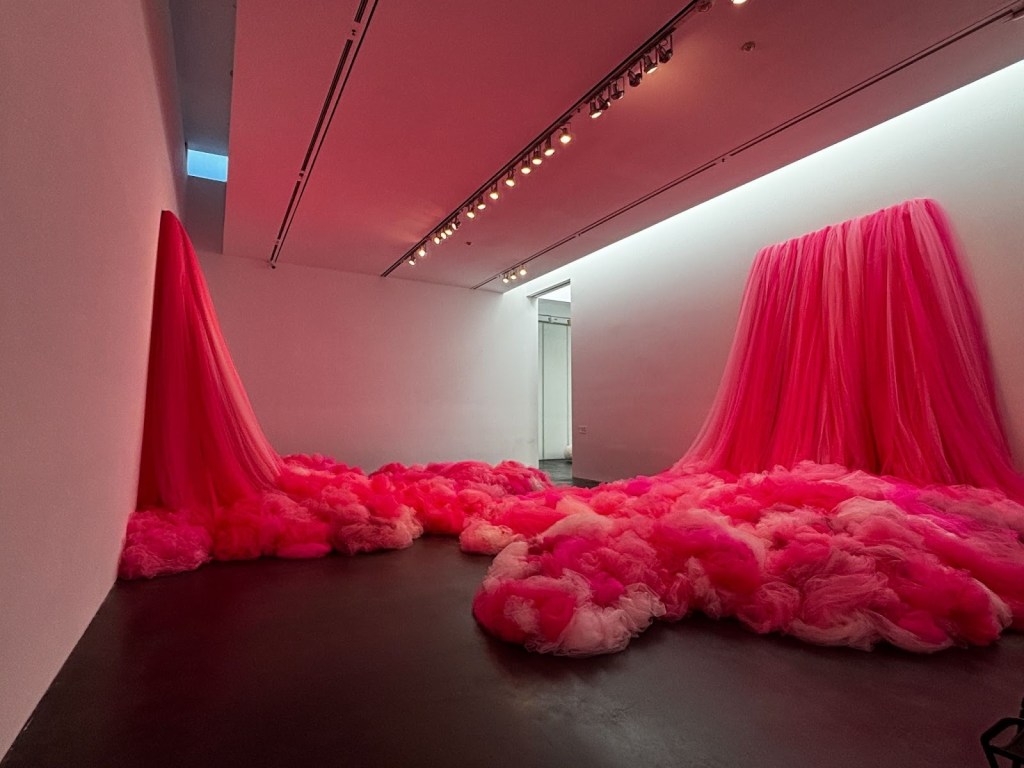
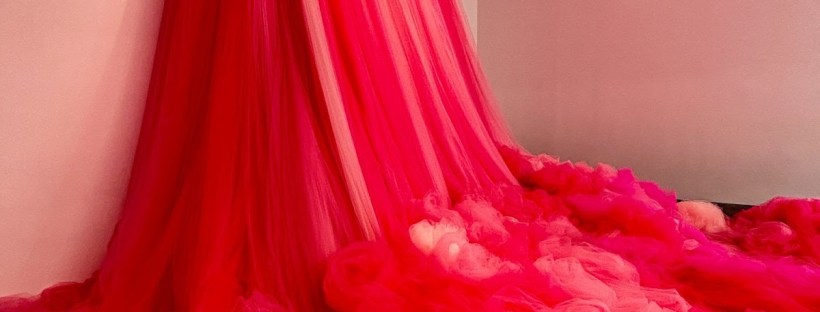
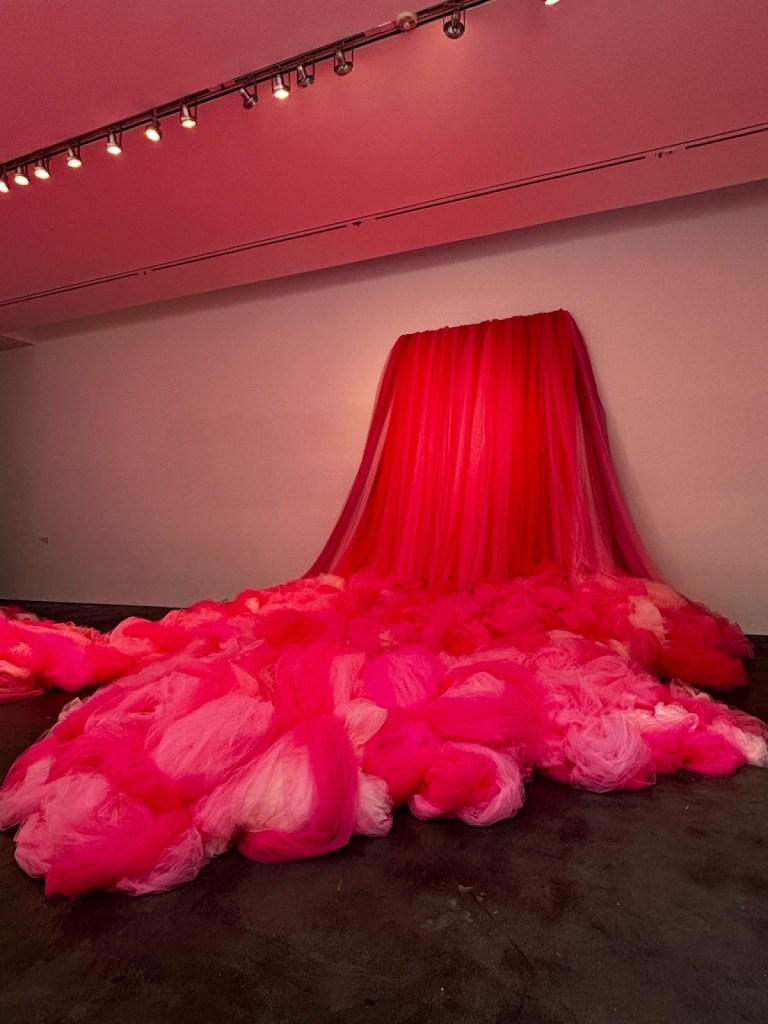
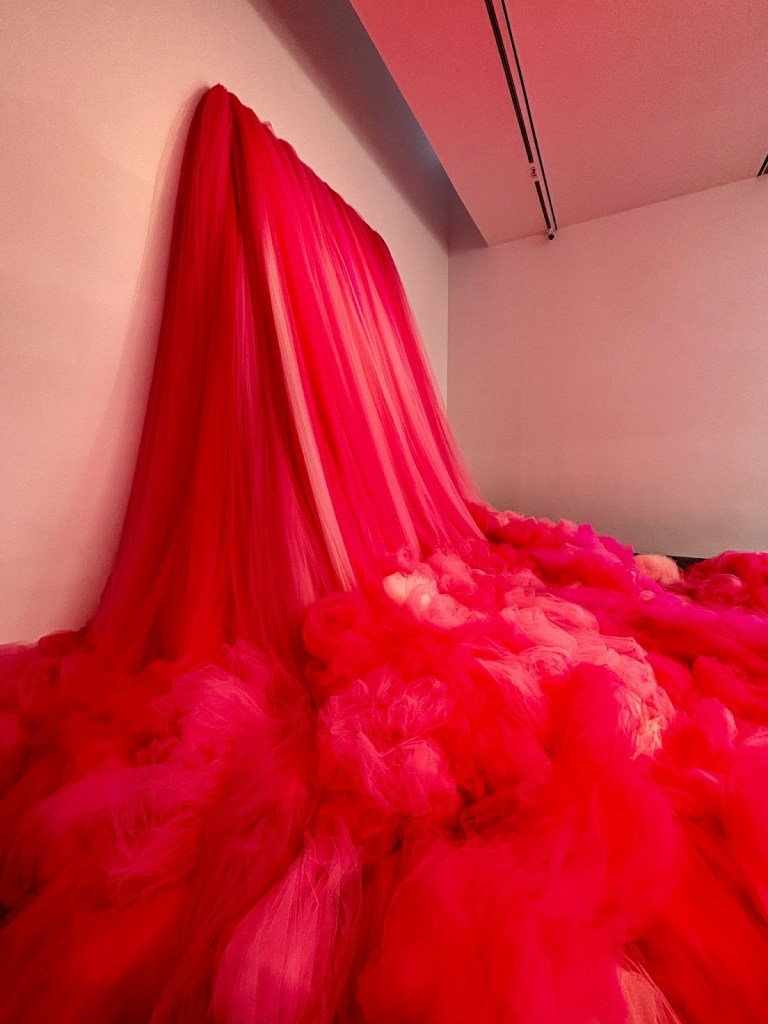
Hernando’s art is large in scale and arresting the moment you enter the space. Streams of bright pink tulle flow from the ceiling, illuminated by natural skylights and carefully placed track lighting. The piece, entitled Seguimos cantando (Waterfalls), immediately evokes awe: the tulle filters and reflects the light in the room, creating a warm, all-encompassing, vibrant atmosphere. The piece’s grandeur is not only striking but also decadent and indulgent: not necessarily because it is “rich” or heavy, but because the sheer scope of the airy fabric’s use takes up space in a way that elicits a deep sense of joy and wonder. Stepping into such bright, pink, indulgent effervescence raised something difficult to name— and it hits me in the chest. As soon as I saw the exhibit, I began to cry (the sweet and likely mortified museum docent quietly exited the room to give me space). As I collected myself, I immediately thought, This is the girlhood I want.
“Girlhood” is a term circulating with new energy in the millennial-female-cultural zeitgeist lately—mostly in association with women supporting each other: everything from cheerleading competitions, hyping up your friends, to the communal joy that something like the Taylor Swift “Eras” Tour made newly speakable. “Girlhood” is less about the period of youthful naiveté girls experience, and more about a belief and series of values rooted in traditional notions of “femininity”— community, care, love, empathy, joy— before we are taught to compete with each other. Girlhood, in that sense, is a celebration of the happiness found in femininity when we allow ourselves to embody all the best parts of it.
I love and appreciate this notion of girlhood, but it took me a moment to understand what, exactly, in those cascading yards of pink tulle, had broken something open in me. This art piece represented a different facet of the term that speaks to something sitting heavily on me these past few years.
The piece is, yes, pink, bright, airy, poufy: everything that we would associate with being “girly.” Yet, the piece’s scale and depth— it is not simply a few long pieces of tulle, but a cascading, abundant, opulent amount of fabric draped and layered together— also make it formidable and grand. Its scale is not only beautiful, but also questions the often implied notion of “too-muchness” often associated with these fabrics and colors. Too much tulle can easily be called “costumey,” “gaudy,” or “flamboyant.” Tulle and the color pink are often things we are encouraged, as women, to wear or use only sparingly, lest we be considered dressed inappropriately or immaturely. The “rule” is so deeply internalized, it barely registers; it just feels like good taste, like knowing better.
Hernando’s art, though, challenged me to ask why. Why are these things considered “too much”? Why is cascading, airy, pretty fabric meant to elicit feelings of joy, air, breath, love; why would that be “too much”? More importantly, why was I so afraid of the parts of myself that loved what I saw— the pretty, airy, bubbly, emotional parts of me— and that they would be seen as “too much”? What if, instead, the richness and expansiveness of those feelings were powerful and purposeful?
I’m at a, frankly, weird point of transition in my life. I’m not delusional: I understand that I’m decidedly not a girl anymore. I’m staring down 40 in the face, and bringing with me a career (or two), a marriage, and two young children. The particulars of my life often revolve around the care and keeping of others, including those who also care for and keep me.
And I don’t regret any of that. There’s a certain empowerment and wisdom that comes from the practicality gained by becoming a “woman” instead of a “girl.” Womanhood has been incredibly freeing: a better sense of the actual stakes in life (often lower than assumed), how to care less, how to let go, how to move forward, how to focus energy where it is best needed, and how to release what doesn’t go as planned.
Still, as I walked through Hernando’s exhibit, I could not help but consider the girl I had been and maybe, in some ways, still am.
I often teach Sandra Cisneros’s “Eleven” to my freshman students, as Cisneros’s metaphor about age living inside of us is a powerful one for them to consider as they move into high school and cross the threshold into “young adulthood.” I eagerly remind them that the transition does not mean they lose the more childlike parts of themselves, nor are those parts of themselves something they should try to give away. Instead, I ask them to consider all the past lives that continue to exist inside of them.
Somewhere along the way, though, as I walked through the exhibit, I wondered if I had listened to my own advice. Had I honored not just the woman I was becoming, the mother I try to be, or the scholar I hope to grow into, but the girl I had been and once was? The one who twirled in her bedroom and sang along to *NSYNC songs. The one who imagined herself the main character of every story. The girl who sang too loudly at church, had too much emotion when she played the piano, and cared too much about what was happening around her.
I had worked so hard to leave that part of my life behind; the “annoying,” “obnoxious,” “too loud,” theatre kid I had been. Like so many girls, those parts of myself had been folded and tucked under other parts, pressed flat, hidden away. Those corners had carefully and meticulously been creased: the pieces moved and shuffled to present the image of what a dedicated, hardworking, focused, good wife, mother, and woman should look like. The origami holds its shape by force. It is precise. It does not spill.
And again, I don’t regret the transformation. The origami creation I am slowly folding into, as it bends, opens, and maneuvers around itself and figures out where to fall next, is beautiful in so many ways.
But as I stood in the exhibit, overwhelmed by my own joy and emotion, I saw that the waterfall was everything the origami had been folding away. I wondered about the parts of my girlhood that have been tucked away or possibly lost. The parts that do not necessarily know when they can find release, or find a safe place to untuck, uncrease, expand, and become spacious in ways that allow me to experience the full expansiveness of who I hope I still am.
Hernandos’ piece is titled Seguimos cantando (Waterfalls), in an exhibit called Seguir cantando (Keep Singing). The exhibit title comes from the refrain of the song, “Como La Cigarra” by María Elena Walsh. The title is meant to invoke an “inspirational charge to persist through joy amidst adversity” (more info).
The piece’s title, though, is Seguimos cantando (Waterfalls), which is a present-tense phrase: “we keep singing” or “we continue singing.” The title is not in the command form, the future tense, or the conditional, though; it is a recognition of present and existing hope and resilience in tough times. Hernando calls on a commonly used statement of current and ongoing truth: we keep singing. The waterfall that Hernando invokes with the title and piece itself both juxtaposes and imbricates the airy joy of girlhood with the powerful persistence of being a woman. The two are not mutually exclusive, but the expanse of softness and light is a commanding force to be reckoned with in its own right.
Seguimos cantando. We keep singing, with joy, love, depth, hope, awe, wonder, and force. As I stood in the center of the piece, looking up at the top of the waterfall, I released a long, trembling, but cathartic sigh. The swirls of fabric, curling along each other, were a call to remember that perhaps, I too, could live the both/and, the too-much, the fluid and tenderhearted, alongside the practical and empowered.
Seguimos cantando. The phrase also implies that the song is not over. We keep singing; there is no clear endpoint. The song keeps going, changing, evolving, being sung. The celebration is not at the end of the song, but in the creation and present-tense experience of it. It is in the continued action. I keep singing, keep looking, and in the process, I hold onto the hope that there is a space for me to untuck, unfold, open, expand, and embody all these myriad and multifaceted parts of myself. Maybe I already have that space, but I am not allowing myself to inhabit it in all the ways I could.
But that’s okay. Seguimos cantando. Sí, sigo cantando, pero también seguimos cantando. We keep singing and, in the shared song, I keep discovering my own voice.
 Christina Torres