The Stories We Tell Ourselves

I am still trying to write a thing. I don’t know how it’s going.


Here’s the thing: I like telling stories.

That doesn’t make me special. I’m a sometimes-writer and full-time English teacher. I have spent years fitting events into narrative structures: dynamic characters, dramatic tension, nuanced relationships wind through conflict and still end with a neat resolution. My world, most days, is spent somehow trying to craft something that fits into a narrative.

I thought this was just craft, something I did on paper. Then, someone noted a small, white lie in my work, saying, “You like making things fit your story.” It wasn’t mean, they were just making an observation. At that moment, it clicked.

It wasn’t mean, they were just making an observation. At that moment, it clicked.

I have been telling myself stories for years.

Nearly every relationship I’ve had is subjected to hours in the tumble-dry cycle of day-dreams. I take the smallest tidbits, find the narrative and fill it with so much hot air it floats away with the rest of my imagination.

My narrative habit has been curling its way through my brain, around my heart, and into my actions since childhood. A gossamer string, my desire to adapt my perception of reality– then manipulate that reality to my perception– has been woven into my life since long before I could understand it.

It’s in adolescent journal entries describing, in excruciating detail, the real meaning behind my crush putting his hand briefly on the back of my chair as he talked to someone else. It’s being sure that, when his “ocean blue eyes, like a stormy sea” (a line, no doubt, purloined from some bad fanfic I had read on the internet) locked with mine, it was because he was seeing something deeper in me. It’s embedded into the fabric of time I’d spend skulking around corners at school, hoping to “accidentally” run into some guy.

When, somehow, I would convince that crush to actually date me– with obvious flirtation, with praises and pretty words– I was still creating storylines for them that would, eventually, end.

Storyline: A young Mormon missionary falls in love with a Catholic girl. He proposes. She says yes. He goes on his mission and when he returns, they find a way to work through their religious issues and have a happy life.

In reality, six months after he left, the heady high of my first kiss and first love had worn off. I was sixteen when he gave me a ring. I was seventeen when I sent my missionary a Dear-John-email (we weren’t allowed to call or see them in person, or I swear I would have). He begged me to accept his God into my heart. I ignored his messages. I returned his ring. 

He’s married now, I think. He blocked me on Facebook.

I did this a few more times in high school:

Storyline: The midwestern track star who tutored me in math dates the unathletic drama kid after they meet in orchestra. Very High School Musical, before that was a thing.

He broke up with me when he realized our time was up. I threw a fit and sobbed some dramatics, though deep down I agreed.

Storyline: The fellow thespian, who I badgered to go out with me my senior year. We went to the same church, sang in choir together. It made sense.

In reality, we were both biding our time, play-acting what we thought love looked like. we fought, we made peace and we parted ways. 

This, of course, is natural for many high schoolers. As a teacher now, I see myself in so many sixteen-year-olds skulking around corners, hoping to bump into someone. 

What is more difficult to realize is that I didn’t leave the practice behind in my school like I thought I did. I see now that I have been weaving webs of stories and heartaches long past my graduation.


It is a weird, almost-archeological act to look back on old writing.  Yes, many of us find and keep memorabilia from past lovers (photo booth strips, ticket stubs, a napkin they wiped their mouth with after a first kiss and other moony tangibles of the like).

Words are different. Journals, emails, and even now text messages create archives that speak not just to the existence of a relationship, but our mindset while we were in the relationship. Much like past love letters my parents have, first-person stories of just how besotted (or frustrated) we have been with someone exist for years to come.

Unlike the previous generation, however, artifacts of my relationships are not hidden in a Tupperware box in my closet. They are strains of my old-self buried in my email account. They are left-over rice grains in the drafts folder of old blogs—just when I think I’ve cleaned them all up, one sticks to the bottom of my foot months later. Try as I might to delete someone (and trust me, I try), bits and pieces of past relationships are consistently available at my fingertips.

I look over old emails and the words still feel strangely foreign. The person in them doesn’t sound like me at all. Who was this “us” we created? It appears so strongly here—casual banter and mutual knowledge, names appearing as always-conjoined or pronouns notating the “we” and “us”. Don’t worry about us! We’ll meet you there.

It is strangely dissociative, and I’m filled with a sudden urge to figure out the mystery of the woman I have been these past few months who feels so distant now.

After a stable three-year relationship, I had a moving-too-fast fling. Maybe I was desperately seeking to fill the space left by my break up. Maybe I was overly romantic and allowed myself to get swept into someone else’s fantasy. Maybe I just went temporarily insane.

Some texts remain. Like the emails, I feel so removed from the woman in those words. She is more like a character in a story I have written than any semblance of my actual self.

I read the texts in her voice:

Meet you @ home in 20 min. Who was this girl who gave allowed a near-stranger to call her apartment “home”?

That’s ok, I just wanted to make sure you got home ok 🙂 Who let hours-long absences go because of a breezy “I love you.”

Who was this woman, and how was she ultimately betrayed?

He once joked that at least he would be an interesting story for me to write, but he ultimately failed there too. Our relationship ended with so much banality: he cheated on me. A tale as old as time that any good writer could have seen coming from a mile away, but I was so willing to accept his stories that I completely lost myself in them.

I read the messages, and then I realize that I was also telling myself stories the entire time: that I was okay with this “relationship,” that I had been okay with the break up before it, that the two weren’t connected. Even the past emails were, in some ways, stories: I was a girl planning a to meet somewhere with a man who didn’t particularly like travel; we were breezily headed somewhere that, in fact, we were not.

These past words feel foreign because they are merely images of the character I was in that part of my story. They are no mystery at all; they are merely chapters in my life now closed. 

The question is not, though, how to move onto the next chapter. The question is how long I will be able to keep weaving stories for myself, or if I will ever pause, look around at myself and my reality, and see and accept things as they are.

Here’s the problem: I’ve been weaving stories for so long, I can’t help but wonder what that even means. Even now, as I look at what I’ve written, it’s difficult to figure out what is “truth” and what is “story-truth.” I read the words and wonder how many of the choices I’ve made in my life happened because it was what I wanted, or because that’s what I thought, as the writer, should happen next. How many plot-line roller coasters have I strapped myself into, thinking I saw denouement at the end?

Storyline: A woman sits in her apartment trying to write. She is trying to figure out how the story should end. She sits, looks at the screen, sees the blinking cursor. She knows there is no one to ask for help writing the end. She also knows that, as much as she wants to, she does not know how to end the story.

She looks at the screen. She sees the blinking cursor. She waits.
Lay Down Your Sword

In a series of letters to myself.


Baby,

How long do you plan to keep fighting?

I see you, shoulders hunched and brow knitted. You of the ever-muddy shoes and never-polished sword. You are a study in unnecessary persistence.

You scrutinize a face in the mirror that doesn’t always feel like your own because you’ve been running away from it for too long. You claim to have a distaste for confrontation, but you spend every day looking at your reflection to pick out which battle you will fight today. Will it be the head or the heart? Which part of your persona will you proclaim as in need of a fix? For all your cries of non-violence, you have been the most aggressive pursuer of your own perceived inner-demons.

You see yourself piecemeal, picking apart all the stories you’ve written onto your body– the shiny patches left from the times you let yourself be burnt, the scars from when you were convinced that bloodletting was the only way to heal. Like some kind of forensic gravedigger, you see the past written into your skin and try and resurrect these stories so you can carefully dissect them and look for all the clues you think led to your failure.

In each story, you are sure you are reading some kind of a map, where “x” marks some ethereal, better version of yourself. You take up your sword and try and carve out the parts of yourself you are convinced no longer serve you: the naivete, the romantic, the poet. You write and publish praise about being big-hearted only to find yourself consistently trying to scrape that heart off your sleeve, to hide it under an iron suit. You are so sure that it is so overbearing and ridiculous, no one wants to see it but you.

So instead you try and cut away the parts you are so sure no one else wants to deal with, to make space for something you hope someone else will give you. The problem is that if you keep splitting yourself into only the pieces you deem “lovable” or “acceptable” you will soon find that there is nothing left at all. 

Stop fighting, love.

We all have demons. We all want to be better. But to try and rip away the parts of yourself that someone else taught you were weak only weakens you as a whole.

Put down the sword. Take off the armor. Feel the new lightness in your body once you stopped carrying a cross only you have built and only you obliged yourself to. See the scars and let them heal back to the complete version of yourself.

Now is the time to set down the old stories; they were never maps to begin with. They are just memories. History is an important lesson, but it is no match for the beauty of the unseen horizon.

So stop fighting now. Unknit your brow. Raise your chin and look now towards that skyline. See yourself there, just as you do in the mirror: completely whole and perfect in the imperfections.

As I was editing this, this album came on. Perfect music and discussion to accompany this piece. 

Love, Boundless and Unflinching: On Father’s Day

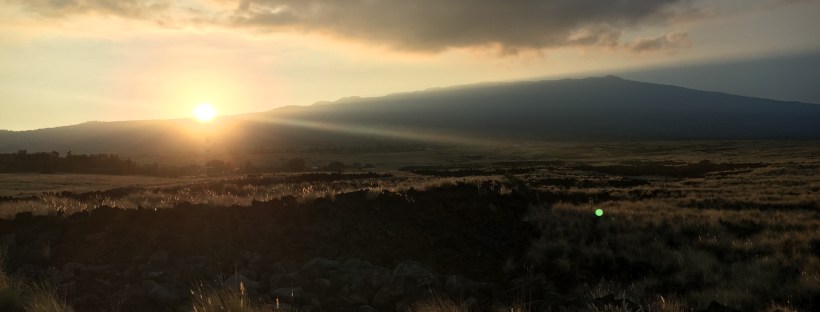
We are walking toward the crater. The wind is whipping and it’s cold— still a surprise in Hawai’i, even though I understand the science behind it.It is Christmas and, without thinking, I instinctively reach forward and grab my father’s hand.

The memory isn’t an unusual one for me, though later when I think bout it I suppose it could be. It isn’t some distant wisp of a moment from my childhood. It’s from this past Christmas. At 28, I still occasionally reach out and grab my father’s hand.

When I think about the myriad of reasons my father is special, this is one. Yes, all people show affection differently, but it less so the actual physical affection my father gives and more the unflinching openness with which he gives it. Ever since I was a little girl, I knew that I could grab my father’s hand, rest my head on his shoulder, or go in for a hug and that my action—and, I suppose, my love— would be reciprocated without question.

I once had a coworker ask me what made my relationship with my parents special, or what I thought they had done right. I don’t know that I saw it as a kid, but it strikes me clear as day now: my parents loved us without question. It was not only unconditional, which I think most parents feel, but it was obvious in its completeness.

My father, especially with all the tropes that exist about Latino fathers having rule after rule for their daughters, never once gave me a reason to think I was anything but loved. There was never a doubt that the hand would hold mine, the shoulder would carry my head, or the arms would wrap around me when I asked for them.

This is the kind of love that breeds very brave souls, I think. It is the kind of love that sends me into the world, perhaps to my father’s vexation, with a big-hearted sense of vulnerability.  It gives me the strength to always reach out to others, instinctively take their hand, and love without bounds. Not only did it model what limitless love looked like, but it also taught us that we could love others and, regardless of their reaction, know that we would be unquestioningly loved by someone anyway. So many of us go out into the world seeking to be loved or cared for. There is a great sense of freedom that comes with the knowledge that no matter what happens to me, I am still a child beloved by their father.

Recently, I was reading the Prayer of St. Francis, and was struck by the following line: “O Master grant that I may never seek… to be loved as to love with all my soul.” This is the type of love my dad (aptly named “Francisco”) lives: a love without need for reciprocation or repayment, a love that exists as the air does— on principal alone.

So, thanks, Dad, for living a boundless and unflinching love each day. Happy Father’s Day. I know I can say always without question: I love you.

The Breath Before

I don’t often write fiction. I don’t think I do it particularly well, but I’ve been reading a lot of Junot Diaz this weekend and I guess I wanted to see what would happen. Here’s an excerpt. 


You are sitting with your back against a white, wood-paneled wall. The sun is streaming in. It is Winter, yet somehow still bright out. It is early morning and the cold seeps through the cement of your crappy apartment near the subway and all the way through to the wood of your wall. The cold is soothing on your back. It is 6:25 in the morning, and you are unsure if what is happening to you right now is real.

Moments before, you had snuck to his phone and looked through. A cardinal sin, yes. But you have a gut feeling. That’s how you justify it. Or maybe your life-long desire to Nancy Drew your way out of situations has reared its ugly head again. Or maybe you were just curious. Maybe all three.

Anyway, you do it, and after snooping through some text messages, you find photos. Lots of photos. And videos. Some girl whose face you don’t know, but in that moment it doesn’t matter. Later, you will wonder if she was in on it, if she knew, but, in the end that won’t matter either. She didn’t promise you anything. All you know is that the photos are there and the photos mean it’s the end and the photos rip you down the middle.

Now, you are sitting against the wood wall, trying to understand what your life looks like in this moment.

Later, after you have kicked him out of your small studio, you will realize you need to be at the lab in twenty minutes. In a daze you will find clothes and your coat. You won’t know how you got there, but the doors will swoosh open. You will duck past the interns waiting to be briefed by you. “Hi, Doc!” one will call out as you give a small, tight-lipped smile back. Later, he will remark to his friends that you seemed off that morning.

You will find your way into the office. Dan, your lab partner, will turn to ask why you’re late. He will see your face and know. He’ll wrap his arms around you and you will allow yourself a single sob. A convulsed release of the air and pain that have been sitting in your chest since 6:22 that morning when you saw the photos. He’ll give you a squeeze, then you’ll release yourself from his embrace, smile, and say, “Here we go,” before you turn to do your goddamn job.

That’s for later, though. Right now, you are sitting in your room, your back against a cold, white, wood-paneled wall. You look at his body splayed across your bed, his feet hanging off. You pull at your lower lip, your nervous tick he always picks on.

When you found the photos, your stomach tightened, you caught your breath. Suddenly, for a second, you saw only white, before it faded away and the photos and the videos were there again, as clear as day. It was as though your brain has taken a screen cap of that image, so that later when you are deciding what to do, it would throw the memory of this moment back front and center. Your ears start ringing. It will not stop until you make it into Dan’s arms later that morning. You drop to your knees, before getting up, putting on the first dress you can find and sit on the bed.

You find yourself there now, your back pressed against the wall for stability.

Later, after you have woken him and told him what you know and told him to leave, he will sit there, his eyes red and wet. He will apologize, but he will know better than to ask for another chance. He will tell you he still loves you, and how sorry he is before you finally get him out the door. It will take nearly an hour.

That hasn’t happened yet, though. That will be the memory you sit with later that night over a glass of whiskey that you are crying into: the image of him on the edge of your bed for the last time.

Right now, you are sitting at the other edge of your bed, you back against the cold, white, wood wall. You pull at your lip and furrow your brow. You wonder for a second if you could simply erase the image. If you could make things easy. If you could continue unabashed and unabated.

You know you cannot.

You take a breath. In. Out. You take another breath in and reach over to shake his leg.

“I need you to wake up now.”

We Are The Adventurers: Thoughts on May the 4th

We have always been a family of dreamers.

My brother and I like to joke that growing up in our house set us up to be nerds. From a  young age, images of space, aliens, and other worlds were as much a part of my life as the introduction music to Reading Rainbow (and when the show visited the set of Star Trek: TNG, I nearly wept with joy).

My father loved science fiction, and I would often walk downstairs to find him watching an episode of The X-Files or Star Trek (TNG, then Voyager later). Sometimes, he would even pop in 2001: A Space Odyssey just for fun.

So, it should come as no surprise that Star Wars was, like many, a seminal part of my childhood. Empire Strikes Back was actually my parents’ second date. I can’t even remember the first time  I watched it. We had (and still have) a VHS gold box edition of the original trilogy that my brother and I would put on anytime our parents worked late or we were just looking for something to do. Our first “pets,” two tadpoles fished out of a grimy stream, were named “Luke” and “Leia.”

When I think, now, of why science fiction was such an important part of my upbringing it was because there was consistently a sense that magic was possible in our household. Growing up one of the few Latino-Filipino families in our upper-middle-class suburb, it would have been easy for our parents to err on the side of pragmatism. They had worked hard to ensure that my brother and I didn’t want for anything, and I have no doubt they wanted us to be successful and be able to take care of ourselves financially as well.

What they also did, though, was ensure that a drive for success never outweighed our ability to dream. When I wrote Star Wars fan fiction (no, you can’t see it, because I burned it) or we spent hours playing and collecting Star Wars cards, my parents never scolded us for wasting our time. When we poured over books to learn the mechanical and tactical differences between an X-Wing and  TIE fighter, they didn’t tell us to do something “better.”  When we devoured Star Wars novels to continue the stories in our head, they didn’t grab the pulp novels out of our hands, shoving “real” literature into them. They asked what we liked about the books.

My parents encouraged our imaginations, enabled our passions, and gave us space to think about other galaxies and imagine what it would be like to pilot the Millenium Falcon. When we watched Return of the Jedi together, my mom said she could understand the Ewoks (and since Lucas borrowed heavily from Tagalog, she could), and my brother and I looked at her with wonder in our eyes.

We were allowed to be weird, mind-adventurers because we lived in a household that fully supported not just the existence of magic, but also the discussion of what could be out there that was much, much bigger than us. 

So, when I hear John Williams’s opening credits, I still feel that sense of childhood wonder. My heart squeezes a little, and I can’t help but feel a smile spread across my face. Sure, in some ways it’s because I’m excited to see the familiar faces of Luke, Leia, Han, and Chewie come on screen.

Even more affecting, though, is the memory of my magical family. When I hear the opening credits of Star Wars, I instantly remember the feeling of my family curled up in the living room watching with wonder, dreaming together, and imagining what it would be like to live in a galaxy far, far away.

Are You Any Better Off?

Stop. Breathe. Again.

Good.

I am looking out on the ocean at Diamond Head, wiggling my toes in the sand. It is near sunset, and the tide has come up to my ankles. I look down towards surfers leaving the water and couples taking sunset-selfies. This is a nice beach. I think to myself.


Four years ago to the day, I stood on a beach one bright May morning not far from Diamond Head and thought the exact same thing, this is a nice beach. It was my first morning in Hawai‘i, and I had woken up early to go for a run. I explored my new surroundings, amazed that I had actually made the jump and moved here.

When I came to Honolulu in 2012, I had a whole host of reasons why I chose to leave Southern California:

  • I had never lived more than an hour from where I grew up, now was the time to leave.
  • I had never “adventured” after college the way I had wanted to.
  • I was young and figured,”if not now, when?”
  • It was time to ~let go of my stuff~

All of these things were true, in some form or another. Still, none of them were at the true root of why I left: at the time, I hated who I had become.

I don’t mean that in a terribly self-deprecating way, but I had made choices that were actively against the kind of woman I wanted to be. I stayed in relationships that left me feeling hurt, disrespected and jealous. I was selfish and deceitful, with the justification that I “deserved” certain moments of happiness in my life. I drank too much. I partied too hard. I was reacting moment-to-moment only seeking the next high of happiness or excitement because I was a “twentysomething” and that was my right, dammit.

So, I ran. It’s what I’m best at, after all. I didn’t ghost; I found a job and made plans and tried to make a place for myself, but I packed up my life and ran as far as I could. I stood on that beach, the morning of May 1st, 2012, hoping– as cheesy as it was– that it was also the dawn of some, elusive, better version of myself.

Four years later, to the day,  I am standing on a beach looking out at the ocean, facing that question head-on: Am I better off now than I was four years ago?


The tide tickles my calves as it comes up further. A breeze wraps itself around me and reminds me of the mantra I used a moment ago. I close my eyes.

Stop.

I think about the girl I was at twenty-four. I moved here and grew. What I didn’t fully realize was how much growth can and will sting. That it still involved choices I would come to shake my head at. Becoming “better” doesn’t protect you from getting hurt sometimes. It also doesn’t prevent you from hurting others. What I see now is that the depth we can hurt each other is matched only by our depth to love each other as well.

Breathe.

Four years later, I have a longer lens with which to look back on my life. Amid the tense and exciting moments, I take stock of the pauses, the silence. Sometimes all we need is a moment to move past our initial, irrational response.

On the cusp of reactionary implosion, our brain can kick in if we let it. It can read the situation, triage, and clarify what needs to happen next to move past this. The silence isn’t complacency. It’s the time where our mind took a moment to cement in the lesson or the story or the power we would need. It stores it deep inside ourselves, a reserve of strength and wisdom saved for the next time we need it.

Again.

The way we learn is cyclical. We come to understand something, we face it in a different context, and all we can hope is that we handle it with a little more grace than we did before

If anything, the scars we had from the last time should serve as a map we can read as we navigate through this current struggle. ‘I have been here before,’ we remind ourselves, ‘I will come out on the other side. I know what I need to do to get through this.’ We begin the familiar rituals we do to heal. We try to learn. We try to get better. We don’t always succeed, but maybe, just maybe, this time, it’s a little easier.

Good. 

I open my eyes. I look back at the ocean. I have run Diamond Head many times, but rarely stop to come down to the beach and take a moment to breathe. I look at my legs and feet in the water.

I see the scars on my body, I see the parts of myself that have already stretched like new skin over healing hurts. I see where I have grown. I see the wounds and the dark parts of myself that still need to heal. Maybe the difference, now, is that I see the shape and color of the work that will go into that growth.

In some ways, not much has changed. And yet, everything has changed.


An initial version of this included the following passage from Cheryl Strayed’s Wild, and I felt compelled to share it still. It’s one of my favorite books. I highly recommend it. 

But as I wrote his name now, I knew I was doing it for the last time. I didn’t want to hurt for him anymore, to wonder whether in leaving him I’d made a mistake, to torment myself with all the ways I’d wronged him.

What if I forgave myself? I thought. What if I forgave myself even though I’d done something I shouldn’t  have? What if I was a liar and a cheat and there was no excuse for what I’d done other than because it was what I wanted and needed to do? What if I was sorry, but if I could go back in time I wouldn’t do anything differently than I had done? What if I’d actually wanted to fuck every one of those men? What if heroin taught me something? What if yes was the right answer instead of no? What if what made me do all those things everyone thought I shouldn’t have done was what also had got me here? What if I was never redeemed? What if I already was?

– Strayed, Cheryl (2012-03-20). Wild: From Lost to Found on the Pacific Crest Trail (Oprah’s Book Club 2.0 1) (p. 258). Knopf Doubleday Publishing Group. Kindle Edition.

The Lies I Unlearned When I Chose Love

Little known fact about me: my parents and older brother call me “baby,” ensuring I will be some Filipina child’s “Tita Baby” some day. 

Anyway, this is a letter to myself– now, myself in the past, and myself going forward.


Baby,

The world will tell you that you need to guard  your heart and only give love to people  that “deserve” it.

Maybe they’re right.

And they wouldn’t be the first. “If love be rough with you,” a poetic but hot-headed man once said, “then be rough with love.”

Another man once wrote, though, that if you lead a loving life, it is natural— if not essential— that you will fall in love. You will tumble head first into vats of it. Love will be gooey, messy and unpredictable. It will get in your eyes and under your nails, and you will find it dried behind your ears days after you thought you had finally scrubbed yourself clean of it.

And that’s beautiful, but it’s terrifying. It will scald you. It will go up your nose and make you cough in that painful way that rips open your throat. It screws up your clothes, staining in a way and no amount of bleach will get it out. This love shit will seriously fuck you up.

But stop running from it, baby. Stop running from love because you’re scared that you’ll never be able to scrub it away. You’re right. You won’t. It will leave a permanent mark. It’ll burn you in ways you weren’t ready for.

But stop running.

Here’s the lie you must let go: the belief that love only looks like one thing. To choose love is to understand that love comes to us in so many forms.

Love is not just kisses and rainbows. Love is bigger than presents and the person who holds you when you cry. Love is not only the arms of someone else. It is not always soft. It is not always simple. It is not always laid out and easy to reach. Sometimes you think you’re there only to learn that love is at the top of an impossibly long, climb.

Sometimes, love is the brutal, honest truth laid out on the table, looking at all the parts of that truth and making the choice. It sees all the shaky, scary bits and says, “Yes. I’m in.

Sometimes you have that conversation with a partner.

Sometimes with a friend.

Sometimes with yourself.

Still, that’s not the only way love manifests. It’s the text chain with a friend reminding you of your own strength. It’s the head tilt and the quiet question, “Are you okay? What do you need?” It’s the kid who puts everything on the field for you and for them. It’s the moment you hear your own heartbeat and feel joy.

Here’s the other lie: they have been trying to convince you that your heart will only produce so much love. They are convinced that you will meet your quota. That someone will see your secret stash of it and steal it and not give you any in return. That will happen. It will fucking hurt like hell. It will make you feel frustrated and sad.

But it won’t mean you don’t have any more love to give.

So, even when it’s difficult, choose love. Even when you know you might get hurt, run towards love.

Well, don’t run. Walk. Stroll. Take your time. Know what it really means to give and receive it. Sit with the knowledge that you will hurt other people. Love doesn’t guarantee constant happiness, but it does create joy.

But choose love. Walk towards it even when it annoys the shit out of you. Choose love even when it is ripping you at the seams. There is a fine line between DEconstruction and REconstruction, and the two are not mutually exclusive.

You will get burnt. You will be betrayed. You will realize that what you thought was love was actually something else, or that it became something else. You will cry and feel sadness and be hurt.

But you are no fool. Don’t believe that choosing love makes you naive or a dupe. You are not unworthy. Just because love transforms or leaves or isn’t enough doesn’t mean you were weak or wrong. Your ability to give love was never a weakness. In reality, it’s the greatest strength you possess.

So, stop running FROM something, and move towards love. When you see it at the top of an impossibly long rope, climb it and ring the bell for youself. Even if you fall after, you got there in the first place, the echoed ringing a reminder of how powerful you really are.

2016-01-19 10.25.47-1.jpg

Everything is on Fire (and That’s Okay)

It’s been over three weeks since I’ve written anything that is both personal and publishable. I keep opening the page, seeing the white box and the blinking cursor and drawing  a blank.

How do I put down what it means to systematically dismantle a life?

Not in an overly-dramatic way. Unlike my early twenties, it lacks the flair of simply setting the thing on fire and watching the flames dance in the sky. No, this has been a slow, methodical sort of burn. It’s the kind you chose to set aflame to save everything else.

It’s understanding that you need to set down your armor– there is no fight to win now. It’s removing and reimagining the parts of yourself you were so sure you knew, then realized had become foreign when you looked in the mirror. It’s knowing that you can’t use tape and glue anymore, you simply have to appreciate what was built and move on. It’s seeing that everything is on fire, but maybe that’s okay. Sometimes you have to let things burn so new things can grow.

What does it mean to rebuild a body?

How do I explain what it signified to stand alone in my room and hear only my own heartbeat? Is there a name for the tension that exists at the corner of “absolutely terrified” and “utterly excited”? I haven’t yet found language to explain what it means to know that the next few steps of your life will be frightening and difficult, but that you don’t regret them for a moment. It’s unstitching the parts of yourself you were sure were dead, only to find there is still life there and that it is blooming in spades.

There is a unique mixture of grief, fear, joy, terror, and wonder that comes from running your hands down your own body, grabbing the flesh of your hips beneath your own hands and being able to whisper, “This is mine now, only mine now,” in small, sanctified breaths; the prayer of your own newfound path ritually running through your mind.

How do you talk about rediscovery?

IMG_9688Not in the pop-queen-country-belle-diva sort of way, but within the small, undefined moments you had forgotten too. The moments where you realized  you were at the mercy of only your own whims; the simple, everyday decisions where you only have to ask, “What do I want?” I am searching for the couplets that could explain the simple pleasures of small choices. I am seeking stanzas that explain the joy of newfound agency.
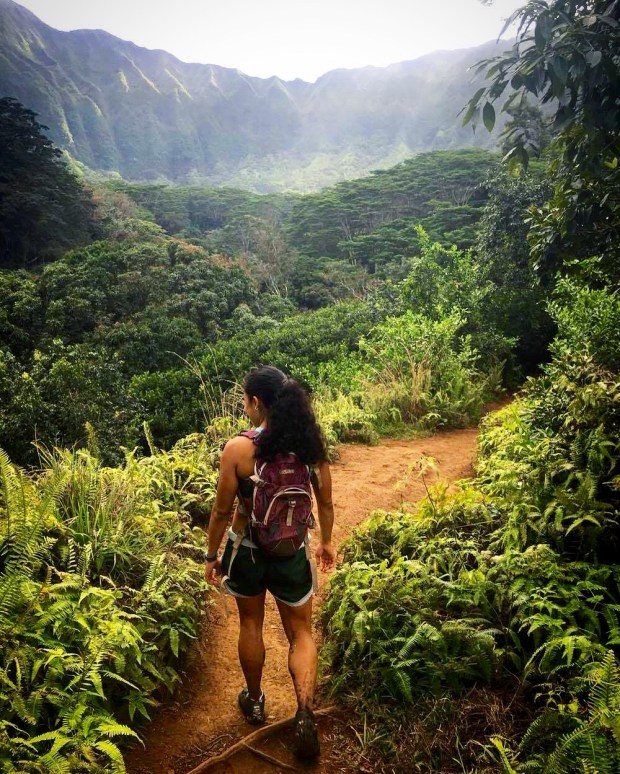
The discovery is a montage, flashes of light shot through my heart: bursting into laughter on a hike, catching my breath in open ocean,  a heavy sigh of satisfied relief at the end of a long day; all the images reveal the mini-epiphany of, “Oh! That’s who I am!” and are full of a sense of wonder I thought I had lost long ago.

Is there a word for the moment between falling and flying?

I haven’t found one yet, something that properly captures the silver second where the sheer ridiculousness of what you are doing becomes perfectly clear. It’s elation and fear. It’s passionate and sensual and make-your-stomach-drop terrifying. It’s the silence in your ears before going down the big hill on a roller coaster; it’s sharp intake of breath before you hit the water from the cliff you just jumped off of.

It’s the knowledge that you cannot go back, that what lies forward is completely unknown, but that the horizon out there is full so much potential you can’t help but just start giggling like a kid seeing the ocean for the first time.

It is wild and unfettered and chaotic and perfect.


The Miracle Is That We Are Beloved

The worst part of death is the terrible silence. It is absolute– a void so empty it is rich in its darkness.

Be it of a loved one, a relationship, or a period of our life, there is always still the silence. The pause after the final breath. The moment when any denial we had about what was happening is stripped away. We can only look down at our hands and know, ‘This is my reality now.’ I heard that silence when I hung up the phone with my grandfather after telling him goodbye, knowing I wouldn’t be able to see him before he passed. I felt it when I returned home from an ex’s, with three years of my life reduced to a few garbage bags in a now empty-feeling apartment. There is nothing we can do but look down at our hands and realize that our previous reality has shattered, and that there is a looming darkness we can only face.

It is easy to feel unworthy in those moments. Everything we held dear has been stripped from us, it seems, and we realize just how fragile we are, how human and imperfect we are as we stumble through life. It is easy to look in the mirror, see nothing but the pain and darkness of that death and feel like we will never find the love or joy or happiness we are certain has left forever with death.

And yet.

Growing up, I had a priest who once reminded us that the renewal of God’s love at Easter didn’t, you know, have to take place on Easter. “If not today,” Fr. Fred told us, “Easter will come.” Even if it was not that Sunday morning, we were reminded that at the end of it all God’s love renews, heals, saves. Even after we have beaten, spit on, and ridiculed Christ, God still decides we are worthy of His love and forgiveness. 

I am reminded of this now, on an Easter Sunday where I am in the process of rebuilding. The darkness we face after a death isn’t a completely false one. Often times, it is an important reminder of our own humanity and imperfections, of the places we faltered and failed.

The darkness isn’t the lie; the lie is that we will never find that joy again.

I know that the miracle of God’s love is not that the world is perfect or that everything is good. The miracle is that, with those imperfections, we are still beloved. The miracle is that even when we are sure we are horrible and hopeless creatures, God reminds us that we are still worthy of love and grace. If we allow them, we still have people and moments that move us to uproarious laughter and countless joy.

This morning, I send a friend of mine a quick Easter message saying, “Rejoice! His is Risen!” He replied in kind and mentioned how blessed we were that we looked inside the tomb and see that is empty.

There, too, is the miracle. The story of Easter does not run away from the notion of death itself. Christ is still crucified on Good Friday and mourned for those three days. We all have parts of ourselves that die as we seek renewal. God’s love doesn’t make death disappear. The resurrection is not a wiping-the-slate-clean reaction of naivety. When Christ looked down and showed us His hands after the resurrection, they weren’t magically devoid of scars. Christ still bore the wounds of His past and crucifixion, even after He rose.

Easter is not about easy fixes or magic healings. It is when we acknowledge both death and the imperfections that came before it but do not stay in the darkness with the decaying forms of our past. The tomb is empty. We don’t have to cling onto those parts of ourselves anymore. Instead, we decide to walk out of the darkness with Christ and rise up better than before.

So, as this Easter comes, I am eager to walk forward in the miracle of God’s love. I look down at my hands and see the reality that they are still weathered and broken from the last part of my life.

This is my reality now, and that is okay. It is good. It is blessed. I have no need to dwell in these past pieces of my life. Instead, I stand up and walk forward out of the tomb and towards light.

FullSizeRender.jpg

A Letter to My Wayward Self.

Over the past few months, I’ve been having my students write papers about love. In doing so, it made me both read and reflect on my own experiences with love and growing up– especially in my early twenties. This is where that led me.


A letter to my wayward self.

My dear girl,

I have no idea where you are running to, but I promise you none of the directions you are heading towards are “home.”

I know: you are horrible at the long game. There is no patience in your bloodstream, no chill hidden anywhere in your bones. You are all chicken skin and red hot veins. Your muscles are overrun with fast-twitch fibers. You go far beyond “starry-eyed”— your pupils dilate again and again as your mind wanders in explosive bursts with fury, unprepared for what happens in the moments after when the star has burned out and things are dark again.

You are spontaneous decisions and seeking the next high. Yours is a rabbit-heart that beats furiously, always asking questions: when? who? why how what where where where where? always searching. You race—no, bounce and sometimes tumble— down trails, so assured that the next turn will lead you to find home. You are certain that this rock or that tree is a sign, that the next moment will finally find the thing you want most: an anchor, a resting place, a haven that just might soothe the pitter-patter that runs from your heart, through your veins and into every other part of you.

The problem is, “home” is a vague X on a map without a key. There is no description or clue as to what it is. So you keep thinking you’ve found it: in the hands of one boy, in the furtive glances of a different man, the fervor of a blurred dance floor, the bottom of an empty wine glass. You hop from all these things, assured that each sip or kiss or beat is a sign that you are almost where you need to be.

It’s a confusing concept, but I promise you none of these things are where “home” is. Don’t confuse the feeling you get when you catch his eyes meeting yours with the experience of being appreciated fully in the gaze of someone who loves you. Don’t mistake a flurry of kisses for a downpour of actual caring. Don’t assume the pain-numbing warmth at the end of a long sip is the same as the soothing release of healing when you actually take care of yourself.

“Home” is not found in the temporary bliss of mind-numbingly good kisses. Don’t get me wrong— you can still have mind-numbingly good kisses, but they are merely decoration on the outside. “Home” is built by weathered boards that have been worked on and sanded. They are stained with difficult decisions and tears. Their nails are the choices you make, hammered in with mutual respect. They are painted with the laughter of jokes built over years of shared comfort. Home will wrap you in its arms when you walk into it looking like something the cat dragged in. Home will stay standing when you tear the furniture apart in rage. Home will still protect you when you can do nothing but sit there in silence.

I wish I could tell you things turn out okay.

The problem is, it’s hard to know when you have found a forever-home. Sometimes we outgrow a place, decide we need to do what’s best, move on. Or we realize the foundation isn’t solid. Or we take a job in Hawai‘i and move thousands of miles away.

Here’s the thing you will need to learn: home can never be some summit that you have to venture to. Home should never be a place that can only be entered when terms and conditions apply. Home can never truly be yours if it only exists within the happiness of another’s.

The only place you will truly find it is when you stop, close your eyes, and breathe. You will feel the ground beneath your feet, the beat of your heart in your own ears, the muscles behind your eyes relax. Then, you will realize that home was never some external site to begin with. You will realize the only real home is the quiet, still place where you both know and love yourself, exactly as you are.

And in that moment, you will finally be found.IMG_8512.JPG