Rolling Thunder: Falling In Love With My Thighs

NOTE: This piece originally ran 3 years ago for The SF Marathon, and was edited for clarification and grammar.

But, after trying to love myself today, post-half-marathon, it felt worth revisiting.


When I woke up last Tuesday, I knew I shouldn’t run. I had injured my leg at Surf City the week before, and it wasn’t feeling any better. It was tight and kind of painful and none of it felt right.

After a few years of running, I frankly should’ve known better. I should’ve known that, even with a marathon 5 weeks away, I should rest. No, the marathon wasn’t what got me out of bed and got me to put on my running shoes that morning, despite my better judgment. Confession time:

I woke up that morning feeling a little fat.

Now, that’s a big thing for me to admit. Firstly, admitting that you feel fat or even just not-great is not sexy or becoming in any way. I try to be a big believer in loving your body (and, generally, I do). As an advocate for positive mentality in running, I also am a big believer in being happy with who you are, as long as you’re healthy and you feel good.

Still, with all my positive attitude and happiness about running and the self and blah blah blah, I have to admit that, as a 24-year-old woman who lives in Los Angeles, sometimes I wake up feeling a little gross.

My struggle with weight isn’t really a traditional one. Sure, I grew up in Laguna Beach, California, home of the perennial beach bunny. As a chubby kid, I definitely didn’t fit that mold, but I was never really picked on for my weight.  My parents were very attune to what kids deal with, and always made it a point to tell me I was pretty and loved. I’ve even been lucky enough that I’ve dated generally good guys, and have yet to be with a guy who has ever said anything negative about my weight– a huge bonus for a curvy girl.

Still, even though I had a lot of support systems and luck, I’ve struggled with my weight since I was a kid. I always felt kind of chubby and like I was never going to be skinny enough to be like “other girls” (I don’t know who these other girls were).

I remember, in middle school, a girl in my class put her feet together and her thighs didn’t touch. This blew my mind.Are you kidding me!? I thought. How can her thighs not touch in the center?! My legs touch all the way from my calves up!

Cut to my senior year of college. I was chubby and unhealthy throughout most of college (I recall lots of cookies-for-dinner nights). That year, though, I began working out– nothing crazy, just a few hours every week. I noticed my body changing. I was way hyped. I started eating healthier too. I dropped a few more pounds.

Then, I got engrossed in the stress of my senior thesis. I was so stressed, and felt so out of control that I pretty much stopped eating. Looking back, I estimate that I ate under 800 calories a day. I pretty much subsided on 4 or 5 cups of green tea, and a handful of grapes or a few pieces of fruit every day. After a few months, I noticed that my clothes were a little loose. Without having really looked at myself in a while (since I was so caught up in my work), I jumped on a scale. I was far below my goal weight, the lowest I had ever been in my post-adolescent life. I finally looked at myself in the mirror, expecting to look glowing and thin.

The girl looking back at me was a little surprising.

I had dark circles under my eyes.  When I lifted my shirt up and raised my arms, I could see all my ribs– I could count them. My collar bone stuck out in a really weird way that I didn’t like.

Ironically, my thighs still touched.

When I started training for marathons, I began looking at my body in an entirely different way. My body had always been this thing I fought against. It was this thing that I hated and that didn’t do what I wanted it to do and didn’t look how I wished it would look.

As a runner though, it was hard to hate my body and be able to succeed. My mind and my body had to work in tandem.

My body was the vehicle, and when I mentally pushed myself to run 15 miles and my legs responded by actually doing it, I finally started feeling gratitude for what my body was giving me. When I had the mental elation of burning past another runner in the last half mile of a race, it was those muscular-always-touching calves that I had to be thankful for it.

I actually started to like some things about my body. I felt good about myself. No, I was never going to be a size 0, but, after training, I could run 26.2 miles. There are definitely some trends that these hips will never pull off, but they are able to get me through 5 hours of running straight.

I knew my body image had changed one morning, when I was running before going to work. I looked down my legs. Each time they hit the pavement, I saw my quads flex on impact, pushing me forward every step, every mile.
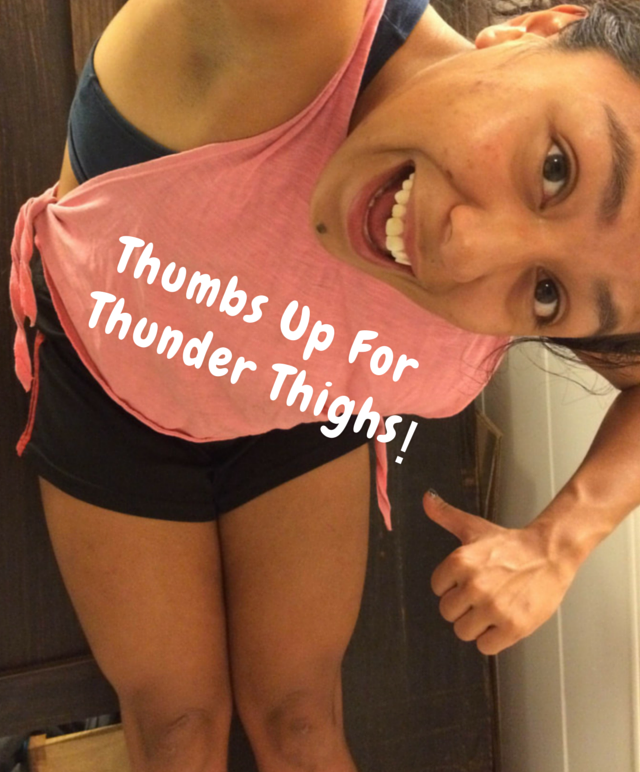
ThighsThen, I surprised myself. My thighs are definitively not lean, tiny, not-touching thighs. I looked down at my now muscular thighs, and the first thought that came to mind was:

Damn. That’s pretty hot.

I can’t stress enough how much running has changed the way I view myself, and I hope it’s a message that I (or you!) can pass along. I wasn’t the only middle-schooler that struggled with my weight. Recently, the National Heart and Lung association polled a group of girls. 40% of them said they had tried to diet.

They were between 9 and 10 years old.

It’s not easy on men either. The same organization polled a group of fifth grade boys, and 45% of them said that they had felt dissatisfied about the way their bodies looked.

These issues, this battle with what our bodies are and what they can mean to us starts young.

When you work out and take care of your body, it’s important to not only know your weaknesses and set goals, but to show a little love towards yourself too. After finishing my first marathon, I felt limitless. I was the kid who had cried to get out of the weekly mile, and now I had run father than I ever thought I could. I had my body to thank for that feeling.

So, as I take a little break from running (oh, yeah, that run I did last Tuesday? I pulled my calf. Learned my lesson, huh?), I’m using it as an excuse to fall back in love with my body. I sit in the jacuzzi and actually relax for the first time as I love my body by letting it heal. I look at myself in a new dress, and try not to feel guilty or boastful by thinking Huh. I look good. I do cheesy, clichéd things like yoga in the park while I enjoy a beautiful day.

Oh, and I maybe reward it with some frozen Cherry Garcia yogurt too.

Enough. 

I will never do
Enough.
I will never give
Enough.
I will never have
Enough.
I can never be
Enough.

There is so much more
that I could do, that I could give,
that I could know.
There are always flaws, always
cracks, always empty, gaping holes.

I dip my thumb into the
vastness of all these perceived
Slights and fails. In them, there is
that human stillness–perfect, frail.

In my flaws, I find
Enough.
The holes, they let in breath–
Enough.
The cracks that let in light–
Enough.
In these broken, empty hands–
Myself.
Enough.
Enough.

Gone Quiet

But yeah… running was romantic; and no, of course her friends didn’t get it because they’d never broken through. For them, running was a miserable two miles motivated solely by size 6 jeans: get on the scale, get depressed, get your headphones on, and get it over with.

But you can’t muscle through a five-hour run that way; you have to relax into it, like easing your body into a hot bath, until it no longer resists the shock and begins to enjoy it. Relax enough, and your body becomes so familiar with the cradle-rocking rhythm that you almost forget you’re moving. And once you break through to that soft, half-levitating flow, that’s when the moonlight and champagne show up : “You have to be in tune with your body, and know when you can push it and when to back off,” Ann would explain.

You have to listen closely to the sound of your own breathing; be aware of how much sweat is beading on your back; make sure to treat yourself to cool water and a salty snack and ask yourself, honestly and often, exactly how you feel. What could be more sensual than paying exquisite attention to your own body? Sensual counted as romantic, right?    –McDougall, Christopher, Born to Run.


Lately, I have been running silently.

I fully blame this quote. Before, music was an escape. Now, I push through and try and find the sweet, subtle place where my body finds peace, grace, the quiet calm at the center.

I never really thought I’d ever be able to run silently. Like most, running was an escape, and music only aided in that. I’d jam to songs that I would eventually come to know as well as the pattern of my footsteps. I would look forward to the stop lights that forced me to wait and eventually have a little solo-sidewalk-dance party. Running without headphones felt more like torture then the dance party music made it.

This past year, however, I’ve been running more and more for the love of it. Once I stopped timing myself last year, re-centered myself around my running goals, and became stronger for it, I also rediscovered how much I actually liked running. For so long, it had been a way to lose weight, then a way to bond with kids.

Now, though, after trying lots of other types of exercise, I’ve come to realize that I just love the act of it– the rhythmic, soothing, visceral connection. Running is so unique because it requires almost nothing: just the road and your own will. There’s no bike to set up and little gear to put on. It’s just the consistent conversation between the yammering of your brain, the thump of your heart, the swirl of your breath and aligning it all with the patter of your footfall.

Once I found that, I actually stopped wanting to use music. I would pause it while I followed my breath, or zoned out and worked on a problem while I ran. I realized that music was actually separating me from the run, and I didn’t like it.

So, now I guess I’ve gone quiet for a bit. I don’t plan on giving up sidewalk dance parties anytime soon, but I’m certainly loving this reconnection with my body.

The Paradox of High Expectations

Recently, I received an invitation to a group on Facebook that filled me with a strange joy and abject terror.

Screen Shot 2015-03-28 at 7.42.17 AM

Yes. It is, in fact, time for my 10-year reunion. Time seriously flies.

I do want to make something clear: I loved high school. I had a great group of friends, and thankfully still have many of them in my life. I had great teachers who pushed me, challenged me, and also humor me with a visit when I come back. All-in-all, I was very, very lucky, and look back on high school with great fondness– a privilege I know that not a lot of people have, even at my own school.

Still, I dealt with taunting– some of it the normal high school stuff, but some, as  I’ve written about, around race. In middle and early high school, I remember quite a bit of racially charged taunting, and I know my older brother faced similar things. Anecdotally, I always felt like I stuck out like a sore thumb– one of a small handful of dark-skinned kids in my classes.

Continue reading

It can only whisper back at us. It can no longer roar.

It’s astounding, really, how quickly the human mind is able to go into damage control. The body is often the star of regeneration, regrowth, and healing; we celebrate the body’s ability to accept and become attached to new parts, grow back bits of ourselves that have been stolen and hacked off, or mimic the actions and feelings of a limb when we are left wanting.

The body can even take over when the worst happens. The main functions for the body itself to survive– blood-pumping heartbeats, air-filling breaths– are programmed to continue no matter what is happening in the outside world. Without choosing too, the body works within itself to make sure it keeps on living.

The human mind, however, works differently. A sponge of information, the mind rarely needs to work to attach itself to new ideas or memories. Instead, we constantly take in everything surrounding us. We are bombarded by a seemingly unending stream of images, soundbytes, voices, words, numbers opinions beliefs emotions faces tacticsideashopesstragegiesfantasiesdesires. The mind is consistently full and racing to process, file, and respond to all of these things.

When disaster–or at least an intense shake-up of the normal day’s happenings– occurs however, the mind must make a switch. There is too much going on, and it becomes like the body and begins to triage. It prioritizes the necessities that must remain with you on the other side of this moment, this temporary crisis.

The basic facts of the memory remain: the date, time and place, the clinically bare images that swoop through when you try and piece together something; the heart of the memory still beats and the lungs still take in shallows breaths of air. Maybe the eyes flutter and a slash of color or hint of scent peek through.

There are other things, though, that the mind decides is no longer safe to keep as a memory. Things that were too intense or too emotional or just too damn vivid to live on in our mind’s eye, and the mind proceeds to slowly rob us of them. Even if it’s something we may desire to keep, there are some things that are perhaps no longer worth knowing. To know them, to feel them, to wrap oneself in the blanket of that memory would be too raw, too confusing, or too painful to keep.

So it fades.

Morning comes, and the first gray-yellow rays sunshine creep in through your windows. Just as the sun comes up, it sheds light on the memories of the previous day. The colors are less vivid when stripped of their once-black background. The memory that had so powerfully ran through your mind in crazy loops, begins to slow, then walk, then fade quietly into the background. We open our eyes to reality again, and we re-align and re-adjust to what was once normal, or what now is normal. The mind accepts the occurrences of the previous day and, if possible, moves past them. When we try to recall the memory, it can only whisper back at us. It can no longer roar.

Are we angry at the mind for taking these memories away? Or, deep down, do we appreciate the mind for taking some of the responsibility off of ourselves?

Remembering is often considered such a sacred thing, something that we should be holding ourselves accountable to as often as we can. Perhaps, the mind robs us of these thoughts because it knows that, deep down, we may not really want to remember.


4 years old, but I still love this piece a lot.

#RaceTogether and Speaking with Your Ears

So, I just found out about #RaceTogether, a partnership between USA Today and Starbucks to begin conversations about race because, apparently, “we are all one human race.”

And… I appreciate that sentiment. Like lots of things, I think it is well-intentioned, for sure. Still, I am a strong believer that intent < actual impact for those you may want to help. And while this is well-intentioned, I worry about the actual impact of this for two big reasons:

1) The concept itself assumes that people of color are not already talking about these issues, or that these concepts are new. It assumes we need help talking about race from a large corporation that’s likely not where we come from.

If you’re not from an oppressed background, it’s easy to forget that many PoC are thinking about these issues all the time. We are often navigating these issues, whether with others or silently and subconsciously. This means you’re sort of deciding to come in and tell us how to do something that we’re doing.

2) You’re asking a bunch of folks to jump into conversations about race, which can bring up a LOT of emotions and be difficult for both parties. I worry that micro aggressions, misunderstandings, and defensiveness will abound. In fact, I know they will, because that’s what conversations about race do: they unsettle the status quo we’ve come to accept about our implicit and explicit biases. Stuff is gonna come up.

So, normally, you prep for that. You read some stuff. You prep emotionally. You come to terms with things. I don’t foresee that happening in a 5 minute interaction after waiting in a too-long line for coffee.

You really want to know how I developed identity and race from my parents? How they had to teach me how to deal with oppression? You want to ask Black men how they try and explain what it is to grow up Black? Is that something we’re willing to share with strangers? Are we ready to also talk about my own internalized racism?

More importantly: is that something the baristas are willing to listen to? That Starbucks is ready to hear? Because it’s going to be really hard. I hope so. The way this has started out doesn’t lead me to think so.

So, Starbucks, if you want to talk about race, that’s ok. That’s great. I encourage you to remember something a mentor and colleague told me when I started teaching: speak with your ears, not your mouth.

Instead of forcing us to talk race with a hashtag and forced conversations starters, you might want to listen, learn, and ask how we start these conversations first. You may learn that the loudest thing you say to us is providing your intentioned, focused, listening silence.


A quick addendum (3/20/15):

Thanks Teaching Tolerance for sharing my piece! I’ve had some good discussions since.

Here’s the thing: I think hope is good, and like I said, I appreciate the intention. My concern is that a “small stumble” or “fine tuning” that needs to happen in the execution of this could lead to big, negative ramifications on a community or individual consumer.

So I ask: wouldn’t it have been better for Starbucks to partner with or donate to a community organization that serves this purpose, instead of assuming they know best and forcing the conversation in the way they see fit?

Part of being an “ally” to communities of color means asking what they need and really listening first, instead of just jumping in and assuming you know how to fix the problem. While I love them, this is an issue that my former employer, Teach For America, ended up having to face. You’re not really allying with our communities if you’re not willing to listen to us first.

So. Here’s to hope, and here’s to the hope that the future includes much listening, THEN doing.

Conversations With Literature – Using Instagram With “The Count of Monte Cristo”

So, after hearing Pop Culture Happy Hour’s show on “Required Reading,” I was struck by something that Margaret Willison and Glen Weldon mentioned. To paraphrase, they said: “Literature shouldn’t be in under glass as at a museum. It should be something students have a conversation with.”

What a reminder and revelation! I’m currently teaching The Count of Monte Cristo. I’m planning on eventually turning it into a mock trial, per this amazing lesson plan, but if you’ve read the book, you know: it starts out slow. There’s a lot to get through. It’s going alright, but that podcast specifically made me take pause and really consider what I could do as a quick, fun lesson to reinvest them a little.

I did a lesson with Tom Sawyer where I had my students make fake instagram accounts on Google Drawing as part of understanding characterization. I decided to do the same for TCoMC after Dantes’s 14 year prison stint. It also happened to be a Tuesday. This led to…

TCOMC #TransformationTuesday Assignment

Their assignment: Fill out a fake Instagram post for any of the characters we’ve met so far in the book. How have they changed since Dantes went to prison?

I give my students the templates via Google Classroom, since each student can get a copy of the template I created (templates below).

The results

Overall, I thought this assignment went well, especially as a good informal and formative assessment. This project help me realize that, with the amount of twists and turns in the book, I definitely needed to give some of my students more scaffolding (eg a character map) to remember what’s happened so far to characters.

It also helped me get a better understanding of how my students are perceiving characters, as well as gave me the opportunity to talk through some important character points they may have missed (eg Mercedes overcomes of low expectations about her ability to become educated from Dantes himself).

That said, this was another great chance for my students to show their creativity. ALL the ones they did are available here, some favorites below:

  
What I’d Change or Add: Due to time, I didn’t follow up beyond this assignment. I wish I had given stricter guidelines as well. Also, next time I’ll give a writing portion to ensure that they were actually focusing on characters and not just doing a fun insta post that was tangential to the book (I did this with The Adventures of Tom Sawyer and found it to be useful).

Also, to increase the conversation aspect, I think that you could make this an AWESOME long term project and assign characters to members of a small groups. Then, have them talk to each other via the fake instagram accounts! A lot of students used comments to show connections with other characters, which I didn’t even ask them to do. I think there’s something interesting there.

Alright, more to come soon, I’m sure. Hope this was helpful!

Resources

Stories and Rain

A light Mānoa rain flicks
down so lightly you can’t even
really see the drops. Just cold,
tingling moments— like stars
in the milliseconds after they explode.

Painless, perfect, they
are the seconds after the splash
of your most perfect canonball.
They are the nerves on your lips
after your first kiss comes up for air.

Here, I walk at the foot of a valley,
a long trench flowing into the urban
mouth of movement. I go, I run
I hustle I work I live and then
a light Mānoa rain falls. I pause.

I used to be terrified of things I could
not see. Ghosts, demons, beasties
were waiting, their cold, wet fingers
creeping around corners, under beds,
just outside my window.

Now, tucked into the corner of
two colliding worlds, the future
creeps its fingers up the soft cheek of
an evergreen face. A white blanket rolls
down to cover them both. They rest now.

I look up and see them. Pinpricks cover
my face. The stars, the nerves, the splash
the kiss— their magic unquantifiable and
too quick, too grazing to even be registered.
They are only even real if you take notice.

And I hold out my hand and tiny pools of
rain collect, in the creases like magic.
The terror and the wonder of the unseen
are equally real and not mutually exclusive. They
are merely waiting to be seen in the stories we tell ourselves.

Yo No Sé Que Hablar — I Don’t Know What To Say

The man sitting behind me at the restaurant last month was speaking Spanish.

So was the park worker the other day, which was a surprise.

There was the couple wearing “Great Aloha Run” shirts, asking each other about rain, parece que va a llover. Their accents were wonderfully soft, elongated, melodic and tripping. Dominican, I think, like my friend Carolina’s.

When I lived in LA, hearing Spanish was a given. It was everywhere– on buses, at the bank, on signs and on my radio in the car. Even though I lacked fluency when I moved there, it was omnipresent.

Now, living in a state with under 10% of a Latino population (a huge increase from before), hearing Spanish is a rare treat, something that immediately makes my ears perk up. I remember each time like a small gem, holding it close as a reminder of home.


I love living in Hawai‘i– I really do. People see me and know I’m part Filipina, which almost never happened before. It’s an exciting rush– “yes! You see this part of me! You get me!”

Like I’m sure lots of mixed kids deal with, though, I always have a hard time trying to navigate both cultures. I love living here and being seen as Filipina, but now I miss part of my Latina culture. I miss speaking Spanish with people. I miss hearing mariachi on the radio when I would scroll through channels. I spent all of McFarland U.S.A crying. Not just crying, really, but sobbing. From the quince scene on, I was a mess. The hand-painted signs selling aguas de fruta and the casual mix of Spanglish made my heart ache for something that I still don’t know how to fill. Continue reading