The Gatekeepers: On Being a Woman in Mathematics

This post originally appeared in Education Week.


This month, I’ll be featuring the voices of female educators in honor of Women’s History Month. More written about this is here.

Guest post by Stephanie Capen.


I struggled with mathematics throughout most of my formal education, but I don’t entirely know why. It’s hard for me to look back and decipher exact reasons.

I always had a very black-and-white perception of mathematics: an answer is either right or it is wrong. I don’t know if I invented this perception in my own mind, or if it was influenced by the way that mathematics was presented to and portrayed around me. Still, this belief was often coupled with the idea that you are either “good” at math, or you are not. I was frequently wrong, and therefore, not “good” at math.

Every math teacher I had from 6th grade through college was male. Every school year I would sit down in my math class and see the face of a man as a gatekeeper to my success in the class. I would often wonder why only men taught math, and I learned that some of my friends often wondered the same. My male friends loved saying that it was because men are better at math.

Of course, this was said in jest. I would laugh, but part of me believed them. I mean, you can’t argue with the numbers, right?. ALL our math teachers were men. Women, I guessed, were better at other things like language or history. In high school, I accepted that I would never be “good” at math and just needed to get through until college. Then, I would never have to take a math class again.

I started college as a history major. I had always done well in history and so it made sense. My first semester, I took an introductory astronomy course for a required lab credit and loved it. I was at a small, liberal arts college and, unfortunately, there was no astronomy program, my astronomy professor recommended physics.

Physics, really?

He assured me there would be lots of opportunities to study astronomy if I pursued physics and he told me I would be fine as long as I was “good” at math. There it was. Math had crept back into my life and if I wanted to pursue physics I would have to confront my lack of confidence in mathematics. I had to break my resolve that I wasn’t good at math.

And so, I did.

It wasn’t easy. In fact, it was incredibly hard. I spent hours of my time in college in the library, study groups, and buried under books in my dorm room. Other hours were spent wondering if I had made a mistake, if I would ever feel good enough. Four years later I graduated.

I learned a lot about both math and myself in those four years. I realized that I am good at math. I learned that men and women alike can succeed in mathematics related courses and fields.

And I learned that math is not so black-and-white. There are many ways of learning and doing math. We come to math with rich, diverse experiences from the real world, and mathematics is the thread of all those experiences. We can use our everyday language to describe mathematics, and to construct and make sense of mathematical ideas.

Reta-Math-080.jpg

Today, I am a high school mathematics teacher and I am still a woman. My hope is that my classroom is a space where young women are inspired, and the young men learn to see their female classmates sitting next to them at the table as equals, now and in years to come. My hope is that my classroom is a space where all students feel they can be successful and that their ideas are valid and important.

I hope my students see that there are multiple ways of knowing and approaching a problem. I hope they don’t see my face as the gatekeeper to their success, but find their success within themselves. I hope they see how incredible they are and I hope they find themselves on the endless road of possibilities awaiting them. 

Image via Reta Youkhana and University Laboratory School


steph.jpgStephanie Capen is a high school mathematics teacher at the University Laboratory School in Honolulu, Hawaii. She is currently pursuing her doctorate in Educational Foundations from the University of Hawaii at Manoa. She is most recently engaged in research projects focused on student development of geometric reasoning and the development of algebraic concepts through geometry. Her dissertation work focuses on teachers’ perceptions of professionalism.


Find Christina online:twitter.jpg : @biblio_philefb.jpg : /christinawrites
globe.png : http://christinatorres.org
   

When Higher Ed Means Going Through Hell

This post originally ran in Education Week.


 This month, I’ll be featuring the voices of female educators in honor of Women’s History Month. More written about this is here.

Guest post by Sydney Brady.


“Take martial arts,” my mom says, “or you’re probably going to die in college.” While this is obviously hyperbole on a very inappropriate level, it is true on so many others.

What are the statistics we, as high school seniors, look at when we apply to colleges? Acceptance rate, rejection rate, graduation rate… and date rape? While there’s a 14% chance I’ll get accepted into the school of my dreams, there’s a 25% chance I’ll be raped or sexually assaulted while I am there.

And isn’t that horrifying?

On Pinterest, the college survival kits for girls recommend not only cute pens and notebooks but also Mace to, at most, frighten off my inevitable attacker.

When you enter “how to prevent college rape” into the Google search bar, the third article that pops up is from The New York Times. It says that the risk of rape was lowered in colleges when females took a class on how to protect themselves from potential attackers. But measures like these only allow women to be reactive once a sketchy situation occurs. These techniques fail at one key aspect: they don’t teach men to be proactive and not rape in the first place.

And isn’t that horrifying?

I read a draft of this speech to my mom and asked her if it sounded good. She replied with a grimace, saying, “It’s horrifying… but true.”

And isn’t that horrifying?

The woman who has raised me for 16 years has come to accept the fact that for me to advance my education, I will have to go through hell. My mother has accepted that the pearls on the gates to my dream school only bedazzle an iron frame that locks me into a one-in-four statistic.

Shouldn’t I have the right to walk through campus, free from gripping my bag a little tighter when I leave the library at night, free from being scared of footsteps behind me, free from having worry about screaming, and Mace-ing, and rape-whistling? But the reality is that I won’t be free.

And isn’t that horrifying?

So while I will protest martial arts, as I hate them and am uncoordinated, I will reluctantly go. After all, statistics show that I may be gearing up to enter the most traumatic experience of my life.

And isn’t that horrifying?

college.jpg


Sydney B. is a junior at Kauai High School. She is a diehard fan of J.K. Rowling, and a self-proclaimed master of Harry Potter trivia. When she’s not in school, she can be found running at the track or feeding her fish slices of cucumber.


Joy on a Page

To the girl hunched over the keyboard:
I sit here weary
barely able to keep eyes open
a mind troubled with adult worries.

You,
14 and all unwoven tales all unspent dreams.
You of crazy dance moves and unaware and unassuming
bliss in the exquisite creature that is yourself.
You type, crazy fast fast fast over the keyboard
smiling, laughing at the inside joke you are telling
yourself. Your fingers fly faster than the keys and
you are unable to keep up with your own
beating rabbit-heart. You make yourself
giggle, almost embarrassed at the joy and
the vulnerability you are throwing on the paper.
I hope you are marveling the way that I am.
Look with wonder at the way you are
finding yourself as you put words on paper.
Bask in the glory and cherish the light
that you unleash, splashing joy onto a white screen.
Let your heart and your own too-big
feelings melt out of your
fingers and onto the page.

I, Woman, Teacher.

This post originally appeared in Education Week.


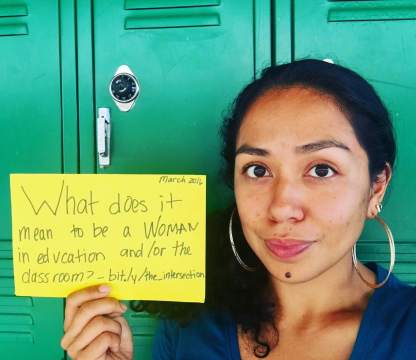
This week marks the beginning of Women’s History Month. I am interested in hearing from other female teachers about how their gender identity affects their practice in the classroom. Please contact me if you’d like to share some of your thoughts.


IMG_8494.JPGWhat does it mean to be a woman in education?
I asked myself on a run this morning. For all my discussion about “identity,” I realize that I have actually done very little reflection about my gender identity as a teacher. I deconstruct it occasionally in my personal life, but I haven’t really thought about what it means as an educator.

I think it’s important to remember with this month, as with all months devoted to a group of people, that simply because it’s “[_____] History Month” doesn’t mean that the conversation is only about the past. It is important to know not only where we come from, but also consider how this aspect of our identity influences the present spaces we are in with our students.

Here’s the thing I realized: I know that being a woman in education (where I am in the majority, which also has interesting implications), is important and affects the way I interact with my students and my work. I just have no. idea. how.

I am eager to keep reflecting and hopefully hearing other’s thoughts on the subject. All I have right now are a few moments from over the school year.


“WOO-woo!” A sharp, high whistle pierces the air. My students and I all instinctively turned towards the street and watch the truck slowly stop twenty feet ahead of us at a stoplight.

Back on the field, a few girls and I roll our eyes instinctively. I am surrounded by my fifteen upper-classmen drama students, and we are stretching on a field bordered by a busy street. While the whistle doesn’t surprise me, it does fill my stomach with a white-hot rage. It’s frustrating enough when I am whistled at on a street while running or merely trying to get from point A to point B. It is infuriating that someone felt it was their right to harass my underage female students.

I look back at them, then back at the truck. “Was that the car that did it?” I ask, knowing the answer– the window is still open, a man’s arm hanging out with a sly face occasionally peeking back and laughing, as though he is daring me to say something. My girls nod.

I look back at them, think for a moment, then begin moving towards the car. I briefly turn to my students and lob my room keys at one of them. “Go back to the classroom. I’m going to go have a talk with them.” The kids cheer briefly as I run over, before heading upstairs.


“I just…” she trails off. One of my ninth-graders sits above my desk on a stool, reading her paper rough draft to herself. In a paper about love, she has revealed an emotionally abusive relationship she was in. She wants to finish the paper by writing about how she learned to love herself.

“I just… I don’t know how to write about myself. I feel weird talking about what being strong feels like,” she finally finishes.

I take a second, understanding her sentiment completely. “Why do you think it’s hard?” I ask.

“It… feels weird,” she shakes her head.

“I think a lot of times we as women are told not to write about ourselves or what we like about ourselves,” I offer. “Because, you know… the patriarchy.”

She smiles. We have often talked about “the patriarchy.”

“I think writing about yourself can fight against that,” I continue. I look at my own computer, full of open drafts that I, too have abandoned because they felt “weird.” I look back at her, “Maybe writing about ourselves can be a radical act.”

She thinks about it, then nods her head.


“Ms. Torres, do you ever wear make-up?” A student asks me towards the beginning of the year. With the exception of the first day (where I wore slacks, a button-up, and a bow-tie), I rarely go beyond combing my hair and throwing on a pair of baggy jeans before school.

My regular day-to-day wear consists of ripped jeans and UFC gym attire. I often mention to my students that I am headed to an MMA class or off for a run or to lift weights.

All of this is with purpose. At some point, I began to see traditional, stereotyped forms of femininity as weak– or, at least, as vulnerable. To be feminine and pretty meant to conform to societal norms that seemingly put me in a place of oppression.

So, I gave up those things. I rarely wore makeup. I no longer danced Salsa. Instead, I ran and punched. I decided to see how much I could lift or how fast I could run. I tried to subvert the patriarchy by showing I could mimic its forms.

I look at my student and laugh. “No, not unless I have to,” I said. Then, in a mock-conspirator’s whisper, I say “I’m a bit too busy to worry about stuff like that.”

The student laughs, and I do too. Then I catch the gaze of another female student. She is often well-dressed and wearing make-up. I don’t know if she has heard me, but I can’t help but wonder how she would feel about my comment. Would I have embarrassed her? Shamed her? Angered her?


Now, I am forced to hold up a mirror to my own ideas of femininity, power, and vulnerability. It took years to let go of the idea that my identity as a woman was tied to dressing and looking a particular way. If I am trying to subvert the patriarchy then I would hate to be complicit in the myth that femininity is somehow weak.

I am challenging myself to stand in that mirror and love the feminine, “girly” side of me as much as the one that runs marathons and talks sports with my students. I worry that to do anything less would send a detrimental and subtly misogynistic message to my students. Instead, I want to reclaim that aspect of identity as anything but weak, and see it for its full worth as wonderfully and beautifully powerful.

A Letter to My Wayward Self.

Over the past few months, I’ve been having my students write papers about love. In doing so, it made me both read and reflect on my own experiences with love and growing up– especially in my early twenties. This is where that led me.


A letter to my wayward self.

My dear girl,

I have no idea where you are running to, but I promise you none of the directions you are heading towards are “home.”

I know: you are horrible at the long game. There is no patience in your bloodstream, no chill hidden anywhere in your bones. You are all chicken skin and red hot veins. Your muscles are overrun with fast-twitch fibers. You go far beyond “starry-eyed”— your pupils dilate again and again as your mind wanders in explosive bursts with fury, unprepared for what happens in the moments after when the star has burned out and things are dark again.

You are spontaneous decisions and seeking the next high. Yours is a rabbit-heart that beats furiously, always asking questions: when? who? why how what where where where where? always searching. You race—no, bounce and sometimes tumble— down trails, so assured that the next turn will lead you to find home. You are certain that this rock or that tree is a sign, that the next moment will finally find the thing you want most: an anchor, a resting place, a haven that just might soothe the pitter-patter that runs from your heart, through your veins and into every other part of you.

The problem is, “home” is a vague X on a map without a key. There is no description or clue as to what it is. So you keep thinking you’ve found it: in the hands of one boy, in the furtive glances of a different man, the fervor of a blurred dance floor, the bottom of an empty wine glass. You hop from all these things, assured that each sip or kiss or beat is a sign that you are almost where you need to be.

It’s a confusing concept, but I promise you none of these things are where “home” is. Don’t confuse the feeling you get when you catch his eyes meeting yours with the experience of being appreciated fully in the gaze of someone who loves you. Don’t mistake a flurry of kisses for a downpour of actual caring. Don’t assume the pain-numbing warmth at the end of a long sip is the same as the soothing release of healing when you actually take care of yourself.

“Home” is not found in the temporary bliss of mind-numbingly good kisses. Don’t get me wrong— you can still have mind-numbingly good kisses, but they are merely decoration on the outside. “Home” is built by weathered boards that have been worked on and sanded. They are stained with difficult decisions and tears. Their nails are the choices you make, hammered in with mutual respect. They are painted with the laughter of jokes built over years of shared comfort. Home will wrap you in its arms when you walk into it looking like something the cat dragged in. Home will stay standing when you tear the furniture apart in rage. Home will still protect you when you can do nothing but sit there in silence.

I wish I could tell you things turn out okay.

The problem is, it’s hard to know when you have found a forever-home. Sometimes we outgrow a place, decide we need to do what’s best, move on. Or we realize the foundation isn’t solid. Or we take a job in Hawai‘i and move thousands of miles away.

Here’s the thing you will need to learn: home can never be some summit that you have to venture to. Home should never be a place that can only be entered when terms and conditions apply. Home can never truly be yours if it only exists within the happiness of another’s.

The only place you will truly find it is when you stop, close your eyes, and breathe. You will feel the ground beneath your feet, the beat of your heart in your own ears, the muscles behind your eyes relax. Then, you will realize that home was never some external site to begin with. You will realize the only real home is the quiet, still place where you both know and love yourself, exactly as you are.

And in that moment, you will finally be found.IMG_8512.JPG


“Shoots”

“Shoots.”

As soon as the word slips off my tongue, I feel stupid.

It’s oddly a surreal moment for something so small: I am huffing and puffing up a hill off the Pali highway. The guys ahead of me say they’re veering off. A puff of air fills my cheeks, and without thinking expels through my lips. “Shoots guys, bye!”

To anyone not from Hawai‘i, it’s probably innocuous enough– maybe a weird use of the word “shoot,” which usually either conveys a gun blast or a substitution for an angered exclamation– but nothing offensive.

Still, I’ve lived here long enough to know that, here, it’s a word usually used by locals, something like a mix of “okay” and “sounds good” (I think). I’ve also lived here long enough to know that I am by no means “local.” I could double my four years of residency and I still don’t know that I’d be able to claim that I’m “local.” I didn’t grow up here, I moved here for a job, I spend most of my time near the University. I don’t really get to make a claim on anything.

Which is fine. I’m not upset– I know I’m lucky to get to live here at all. I’m just consistently in a state of uncertainty: is my living here an exploitation in and of itself? Will I ever be able to feel at home here?

Of course, those aren’t questions running through my mind as I walk up the road. I’m just hiking, and trying to talk story with a few guys who are helping my friends and I get back on the right trail.

I say the word and immediately feel like an idiot. Why did I do that? I think to myself. Who do I think I am? I have, frankly, silently mocked transplanted folks who try desperately try to “sound local,” failing miserably at hiding their own discomfort with being a stranger in a place they want to try and claim as theirs. I have tried to keep myself in check time and again. It’s not a big deal, I suppose, but I know better. I know that I sounded stupid, too. So what the hell happened?

Later, the memory slips back into my mind and I sit in my discomfort. “Shoots.” A word bandied over my head at guys passing each other in my gym. It is thrown down hallways and over balconies by students at the schools where I teach as they share plans and gossip for the day. Sometimes I have it bounced at me, a pass I’m not ready for, by kids after I clarify an assignment, folks who assume I’m local, or people who decide to share it with me anyway.

I hold it for a moment and admire it, like every other local word, phrase, or marker I’ve learned. I haven’t been here long, but it’s long enough to appreciate living somewhere I can finally be mistaken as belonging. It’s is always tempting to slide on the cultural uniform of this place that has, in many ways, finally provided a haven for external acceptance. When I let myself slip, I act like I know how to play this game, exhale and throw a word or phrase in, hoping for a moment to let the masquerade continue.

Still, I know to do any of this– shimmying into someone else’s life as a disguise to make myself more comfortable– isn’t any better than any of the other times I’ve felt pressured to play with words or rules that weren’t mine either, in the name of “fitting in” or “being professional” or “getting ahead.” I know that, if I try and throw these words and phrases back, try to bandy and toss them with the same levity as actual locals, I’ll only fumble miserably.

Which, of course, is what I did that muggy afternoon walking up the Pali. For a moment, I thought I could get away with the ruse, with the idea that this was a world I could claim for myself when I know that’s the farthest thing from the truth.

“Shoots.” My mouth closes at the end of the word and my lips purse immediately, a quick burst of shame and embarrassment wash from my tongue to the tips of my toes.

I sit, later, and shake my head.

…Shit.


Knowledge, Self-Control, Endurance: On Lent

It’s the Lenten season again, which means a time for reflection and renewal. A time to let parts of us die so we can draw closer to Christ.

I’ve struggled a lot with what to do this Lenten season. I’m much busier than I had planned to be this spring, and I honestly worry that keeping to something particularly strict would be too hard and not in line with what I actually need.

Last year, I gave up ice cream and alcohol. A noble task and one that I’m proud my partner and I accomplished (having an accountability buddy certainly helped). While it was probably a healthy thing to do, I don’t know if it brought me closer to God. It pushed me as a person, but I don’t know that it pushed me in my relationship with Christ (though the two aren’t mutually exclusive).

This year, Pope Francis has declared it a year of an Extraordinary Jubilee of Mercy. We are called to revel in Christ’s extraordinary mercy on us, and seek to live that holy mercy in our everyday lives. It is only fitting that the reading for Ash Wednesday this year are the Beatitudes. The juxtaposition of those who are struck low now being brought high by Christ reminds us that there is always room within God’s mercy to be made whole again; life tends to trend towards an equilibrium.

For me, this means attempting to live compassionately towards others and towards myself. It is a reminder that in Christ is not just the compassion we hope to be brought, but what we should bring and seek within ourselves for others as well.

Since last year was a year of extreme physical sacrifice, I am going to try and live a compassionate life– towards others and myself. This Lent, I am going to seek moderation. I hope that, in learning to live a more balanced, tempered life, I can attempt to find a sustainable way to live with God at my center. As 2 Peter says:

For this very reason, you must make every effort to support your faith with goodness, and goodness with knowledge, and knowledge with self-control, and self-control with endurance, and endurance with godliness, and godliness with mutual affection, and mutual affection with love. For if these things are yours and are increasing among you, they keep you from being ineffective and unfruitful in the knowledge of our Lord Jesus Christ.

God reminds us that love isn’t just butterflies-in-the-belly, but flourishes in knowledgeable, self-control that helps us endure trials when the path is less than rosy. Love of all forms– towards each other, ourselves– isn’t always about the extremes. It’s also about the patience and ability to endure.

So, for Lent, I am going to do a  few things to try and live a more moderate life– around drinking, rest, and social media use.

I’m also making a conscious choice to keep these personal. I worry that some aspects of my faith have become for show, and want to try and keep somethings for myself (despite doing work and generally enjoying sharing about my life).

I hope the Lenten season pushes us all to be more compassionate and seek more of Christ’s understanding love in ourselves and each other.

One final thing: check out the Ignatian Solidarity Network’s Lenten journey for Racial Justice. I’m really excited to take part.

280 Words on the Radical Non-Conformity of Cam Newton

I’m not a huge NFL fan. I follow the league in a roundabout way, since I follow college sports. All this to say: I was neither a Panters fan nor a Broncos fan when I watched the Superbowl. I’m still not particularly tied to a winner.

That’s not what’s been sticking with me. What stands out is the fascinating debate between Cam Newton and American consciousness.

Props to Jose Vilson for sharing this article from SB Nation, which had this quote:

“I don’t have to conform to anyone else’s wants. I’m not that guy. If you want me to be this type of person I’m not that and I’m happy to say that. I am my own person and I take pride in that.”

In an earlier interview with NBC, Newton said:

“I’m doing what I want to do, how I want to do it, and when I look in the mirror I see me.”

I understand why some folks are irked by Newton. I do, and don’t particularly fault anyone for that. I think, like many twenty-six-year-olds, he will probably grow and change as he gets older.

Stillthere is something radical, powerful, and exhilirating about something who so unequivocally is themselves, unwilling to twist themselves to the dominant culture’s demands. Like Beyoncé’s Superbowl performance and Formation video (and Jessica William’s marvelous response afterward), the notion that Black and other PoC people have to function along the same cultural systems as white entertainers is a false.

In a world where “professionalism” is often tied to whiteness (reading 1, reading 2, reading 3), it is thrilling to see culture figures actively and purposefully move away from that.


None of this is to say that I think this means we’ll get rid of existing cultures of “professionalism,” or that I don’t understand how it ties into existing American culture.

All I’m saying is that the more we make radical choices towards non-conformity, the closer we get to busting down the oppressive systems that often make non-conformity a threat against “American” culture instead of celebration of one’s individuality.

Image via The Root.

God Meets Us Where We Are: On Running and Meditating

It’s been a crazy few weeks, and I know I need sit down to make some space to actually write for myself. EdWeek often takes up much of my writing time and brainspace.

Fortunately, over the break, I was able to carve out a piece to submit to OnBeing, one of my favorite programs ever. This weekend, they published my piece! You can read about running as moving meditation on their site. An excerpt:

A few months later, an acquaintance learned I was a marathoner and asked, “What do you think about while you run?” Without hesitation, I responded, “I meditate.”

I surprised myself. While I’d always considered myself a mindful person, I often had trouble meditating. I would get distracted by my phone, or bugs, or the wind, or how thirsty I was or how hot I was or a million other things. Running was not the zen, silent space I imagined I could meditate in. With my feet pounding and arms pumping, how was I finding inner calm?

I’m excited to push forward in my running, spiritual, and writing goals in 2016.