The Year I Burned It All Down: 2016 In Review

I had plans for this post, I did. I have been slowly crafting it in my head. It was going to be about goals, about big things, about my body and trying to do new things. I knew I was late with a New Year’s Wrap-Up/Resolution post (which I normally love doing: see 2015), and I felt like I had to bring in something good to make up for that.

See, I had set out a semi-private goal for myself in mid-October. After hitting my PR of 280 for a deadlift, I wanted to hit 300 lbs by the end of the year. It would be a few weeks after the Honolulu marathon, and I’d have some time to get back to lifting before making my attempt. I thought that’s what I’d end up writing about.

Yesterday morning, I went for it. A little delayed, sure– I’d jumped back into CrossFit with a vengeance at my fave non-CFO box, CrossFit Kona while I was home for the holidays. This resulted in lots of gains, but also a back pull in the middle of the week. Then, a friend of ours has been helping my boyfriend and I try some new gymnastics stuff, so I wanted to let my core rest before lifting something heavy.

Monday morning, on a whim, I decided to go for my attempt. Was I tired and still monumentally hungover from celebrating 2017? Yes, yes I was. Did I eat before like a smart person? Nope.

But I went for it. I had my whole plan set out. I got up to 235lbs easy. I tacked on 20 more, rested for a moment, then pulled.

I swear, I see a strained muscle before I fully feel it. Suddenly, I see white for a second, then I feel the electricity shoot through my body. It burst right along my lower back, down my right hip and quad. I immediately dropped the weight and sat back, my entire lower body screaming.

And just like that, I knew I was done for the day. I was tempted to try and rest and go again, but I knew that would only make it worse. So, despite my romantic notions about how I was going to start 2017, I slowly started to put my weights back and knew I’d have to give it a go another day.


And, somewhere in there, is the allegory. Or, at least, the metaphor.

Let me explain: I’ve been struggling with what to say about this year because I feel like I’ve grieved it and rebuilt it multiple times already. I did it in March, in May, in August. As a writer, Lord knows I love romantic notions. I have been working towards them since childhood; I have been trying to write the narrative of my life from the beginning.

Then, something happened. I looked at the story I had been writing, this epic ship I had been building to sail off into the sunset. I had put blood, sweat, and tears into it. I had babied it from the beginning.

And then I looked at the life I had built and I burned it all down. 

Let’s be honest, that’s what I did. I did some pretty crazy shit this year, which included the systematic destruction of a life and routine I had been planning for years. I set it aflame and walked away. And I don’t regret any of it. Not for a moment.

The thing is, the whole, clichéd, rebuilding-from-ashes theme is probably a cliché because we all have to go through it sometimes. We can move down the path of our lives and try and course correct along the way, but sometimes it takes a complete destruction to actually forge something much stronger.

I know– you’ve read that somewhere before. I have too, and to be fair, I believed it (hell, it’s kind of what I did when I moved to Hawai‘i).

Here’s the thing I realized this year, though: the process of rebuilding isn’t always romantic. It won’t always fit your timeline. It won’t always happen with fanfare and confetti. Sometimes it’s the quiet acknowledgment that you have to set down your barbell and try again another day.

There’s something strangely beautiful about that, though. What would it mean if I stopped assuming that success was this shiny, noisy thing and accepted the joy already in my life? What would it look like to stop seeing success as some, forever-moving finish line and see the moments of hard work, of coming back to the mat, of thankless and private hours of sweat and tears– what if that was success instead?


With that, here are 5 things I’m happy about, despite the burning-it-all-down:

  1. I diversified my writing to include things about running and religion. I still love writing about education and race, though!
  2. I kept running (and got my first first-place!), started CrossFit, started Muay Thai, and started teaching Yoga again (and scored my first consistent gig!)
  3. I was in three back-to-back shows.
  4. I like to think I got offline more, got outside, and spent more time with the people I love face-to-face.
  5. I wrote. A lot. Never as much as I want to– but I put more words to paper this year than I have in a long time.

And, of course, some things for 2017:

  1. Keep writing. Stop procrastinating on the writing I have.
  2. Turn-Off Autopilot. (more on what that means here)
  3. Get a strict pull-up and start Brazillian Jiu-Jitsu.
  4. Rest/Active Recovery 2 days a week. Working out multiple times a day 6 days a week is not a thing I should keep doing.
  5. Get rid of all the clutter/books I don’t read/clothes I don’t wear. Adulting. Let’s do this.


Alright, 2017. Let’s do this.


This Is What You’ve Worked For: Honolulu Marathon 2016

It has been, in truth, far too long since I last wrote. 

I have a whole list of posts on the docket– things I have started writing, things that explain my absence, things that have been on my mind.

I hope to get to them, I do. For now, here are a few thoughts on this year’s Honolulu Marathon.


Pre-Race Thoughts

The Honolulu Marathon always feels like a homecoming of sorts.

This is my third year running the marathon, and since most of my races involve a plane ride to new and sometimes different climes (last year’s CIM was a brisk 39 degrees for much of the race! Quite different from Honolulu’s consistent 70-85 degree weather), it’s nice to have a course that I’ve trained on all year and a race that I can run from my apartment as my warm-up.

This year, I admittedly felt a strange bit of pressure about the race. After 6 years of marathon racing, I’m pretty quiet about my races now. I might share a post or two the day before a race, but I’ll generally keep runs to myself, lest I set myself up for epic failure.

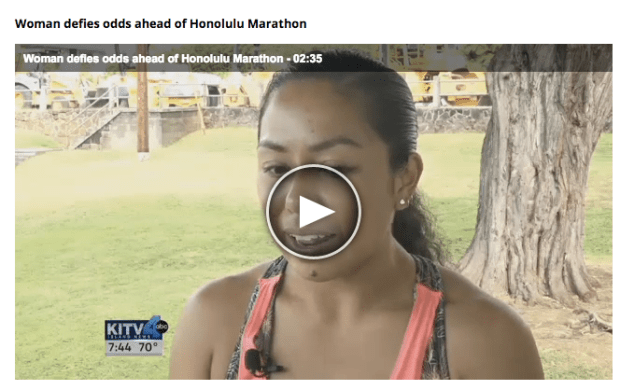
That wasn’t so much an option this year. After sharing my running journey with KITV, plenty of folks knew I was running. I’m not fancy or anything, and I made it a point to say that I didn’t have a time goal this year, but I wanted to have a good showing at the very least.

I’ve been running pretty consistently at a 8:15-9:00 pace this year, and I secretly had hopes of hitting another sub-4 time at Honolulu (my previous being CIM last year). I had come so close at the Kauai marathon, and Honolulu’s course is far less hilly. Still, I didn’t want to throw my hat into a ring I hadn’t trained for, so with the exception of my boyfriend Chase, I kept those hopes to myself.

I had a hard time fitting in my twenty-miler over the weekend. Cheesy, but I rarely get to sleep in with my guy since we both work early morning jobs, so my willingness to, say, wake up at 4:45 AM to run twenty miles when I could just snuggle with him, has waned. So, I did another mid-week long run, fitting in my twenty-miler after work on a Tuesday, 10 days before the race.

I felt good going into the race, but I’m always one for cautious optimism, so I got my bib and just hoped for the best.

Screen Shot 2016-12-26 at 8.42.36 PM.png

The photographer made me giggle hard. It worked.


Race Report

Admittedly, I haven’t had a race go this smoothly mentally in quite a while. After a nice two-mile warm up from my apartment to the course, I shook out my pre-race jitters and felt ready to go.

The highlight of my morning was having one of my former students find me before the race! She was running her first marathon on her own, so we talked story before the race started. That was exactly the kind of mental boost I needed pre-race: a reminder of the excitement and joy encapsulated in this sport, and the kids who help me feel this way off the course.

Some Key Takeaways From This Year’s Race

  • The Honolulu Marathon is just a really fun race. You see families running together, folks who have flown in in ridiculous outfits, locals just going out there to try something new. It really felt like there were more spectators on the course this year, and Honolulu does an excellent job of having great volunteers the entire way. For me, this is incredibly helpful as a runner. It makes a race fun and spirited, which helps me keep a positive mindset throughout the race. The Honolulu
  • I wish Honolulu had pace corrals and that folks self-monitored where they start. It’s probably my only small issue with the race. I always have to fight through folks who are walking and taking photos in the first few miles. Don’t get me wrong– if that’s why you race, that’s great! But please, don’t start towards the front of the pack! Move towards the back/sides so those folks who are trying to make good time have a clear path.
  • Still, the course is gorgeous and well-managed. Really, I don’t know if Honolulu gets credit for being such a well-timed and mapped race. Not too hilly, great weather (Hawai‘i is always unpredictable, but December is probably the best bet), fuel and medical stations well-manned and consistent throughout. I always feel like I’m in good hands with this race.
  •  This is me being an old race curmudgeon at this point, but knowing the really course pays off. For me, this being a hometown race really gave me an advantage as far as mentally preparing for what was to come. It was also a reminder that I have to study the course before I race! I used to be all fly-by-the-seat-of-my-pants, but I’m seeing now how useful it is to know what’s to come. Study!
  •  Train and plan for the toughest circumstances as far as fuel and hydration go. I had 5 or 6 friends talk about hitting the wall this year, and some folks blame watery Gatorade and humid temperatures. I was fortunate to miss this, and I think it’s for three reasons:
    •  I pretty much always train and plan for the apocalypse for Hawai‘i races– I don’t train with water or fuel so that on race day I run better than I train.
    •  The day of the race I follow a tip from my old SRLA race director: drink water and electrolytes at every aid station until at least the halfway point. This allows me to get ahead of any cramping issues before they happen. At the half point, I start assessing at every aid station what I think I need.
    • I’m very careful about eating and drinking in the week before the race. I start upping my water and sodium levels early on. The night before the race, I chugged some of boyfriend’s leftover Pho broth after my customary vermicelli bowl (thanks PHO’hana!), and I think the extra salt came in handy!
  • Racing without music is still the best option when I can. It sounds impossible to so many runners, and definitely was (and at times still is– I used it at Kauai when I struggled mentally) to me when I started, but I really think being super mindful as I ran helped me avoid cramping too.

I kept a solid 8:30-9:00 pace throughout. I was clocking right around 8:45 for the first 6 miles and decided if I could stay in that area throughout the race, I’d finish feeling good. Admittedly, the course generally flew by. My mental game felt strong, I smiled looking for folks I knew on the course, and just enjoyed the race. I was able to wave to and talk to some friends who were spectating, and see a few friends as I came back around from the halfway point. That’s the kind of stuff that makes racing really fun.

I finished at 3:53, 19th in my category, just shy of my PR and an 11-minute course PR! I think I could’ve hit a new PR, but since it wasn’t my plan, I didn’t push some of those early miles outside my general comfort zone. Plus, Honolulu is a hillier and much warmer course than CIM. So, I’m happy I finished with a smile on my face instead.

At the end, some former students were handing out medals. They clapped when they saw me. Needless to say, I lost it.

https://www.facebook.com/plugins/post.php?href=https%3A%2F%2Fwww.facebook.com%2Fhonolulumarathon%2Fphotos%2Fa.10151869536785928.1073741827.229185790927%2F10154681035270928%2F%3Ftype%3D3&width=500

Thanks Honolulu Marathon for the great photo!!


Reflections

At the end of the day, a marathon isn’t just a race, it’s the culmination of the months, weeks, hours of training you’ve put in to get to this point. Every mile you’ve run is a step toward the eventual finish line of the marathon.

For me, this third Honolulu marathon truly felt like a reward for all the hours of training. Every step of that race was built on other training runs I had put into that course. Every mile that I felt good at was a reminder: this is what you’ve built your body to do. This is what you’ve worked forEnjoy it.

As much as I’ve been trying new sports, I think one of the reasons I come back to distance running isn’t just about the space I make for myself or the meditative calm I find, but it’s also because there a few sports that so completely test whether you’ve trained and prepped for this moment. Running for that long is incredibly humbling. There is very little room for plain luck in a marathon. You need to put the hours in to be successful. No matter how gifted you are as a runner to begin with, trying to take down 26.2 is a test even when you do put in the work, much less without.

Is that, at times, difficult? Of course. But it also makes crossing that finish line only that much sweeter. screen-shot-2016-12-26-at-8-44-37-pm

The Prayer – Conversations While Running Twenty Miles

One of my favorite assignments that my mentor teacher, Bill, gives his seniors is to write about a piece of music and weave it into a story or memory. Here’s a little reflection on prayer, running, and trying to hold onto faith.


Casting Crowns – Just Be Held

Hold it all together / Everybody needs you strong / But life hits you out of nowhere/ And barely leaves you holding on.

I was so prepared to write about this run. When I went out a week ago, I was already crafting titles in my  head. “The Gauntlet,” I’d thought at first because I was so sure it was my last pre-marathon test.  I did it out of the blue– went to bed on a Monday thinking, “Screw it, I’m gonna run tomorrow.”

So, when I went out that Tuesday afternoon, I was ready. I sprinted off-campus as soon as my students left the classroom, knowing I had 3+ hours of work ahead of me. I had my earbuds in, some good music, and I was ready to zone out.

But that didn’t happen. 

And when you’re tired of fighting/ Chained by your control/ There’s freedom in surrender/ Lay it down and let it go.

As my feet began to hit the pavement, my mind immediately starts racing.

I have about a million things running through my head at the moment, and if I’m being honest, I’ve been in a mood lately. Between the election, feeling burnt out about my work, facing a never-ending pile of student loans, and general uncertainty about my future, being an adult has been a bit tumultuous lately. Like I’ve said, I’m very happy, but I’ve perhaps been repressing some stuff with my usual strategy:

post-64231-this-is-fine-dog-fire-comic-im-n7mp

Ok, I kid. The world is clearly not on fire, but I don’t think I’ve been honest with myself about how I’m doing.

The thing about running for 3-4 hours is that it doesn’t leave you with a lot of space to hide. You end up spending so much time with yourself, that you have no choice to but explore all the nooks and crannies of your psyche that you’ve been casually ignoring until now.

After a few minutes of trying to focus on the music, I gave up the ruse. I turned my music off, tucked them away, and decided it was time to let it go and finally start facing my self.

So when you’re on your knees and answers seem so far away….

For those first few miles, I flew. I was so preoccupied with myself that I was pounding the pavement with questions. ‘But what about…?’ ‘Or what if…?’ ‘How will I…?’ They’re the kinds of questions that don’t have any real answers– they burn in the belly, churning and steaming inside precisely because they are unanswerable and out of your control.

And that’s terrifying. It’s infuriating. In a world that is so desperate to ensure that I am well-planned– for my students, for my finances, for my career, for my love life, for my retirement– being unable to answer, ‘So, what’s next?’ makes my stomach hurt.

I know, I should be finding some kind of joy in it. I’m 29, have a good job and a nice boyfriend and live in Hawai‘i. The rest of my life will be plans and bills, why rush that? Why am I sitting here wallowing in a little puddle of misery and anxiety?

Still, the questions beat through my blood stream and I methodically place one foot in front of the other.

…You’re not alone, stop holding on and just be held.

It’s not until I reach the top of Diamond Head that it hits me.

“What are you holding on to all this for?”

I scrunch up my face. I haven’t been to mass in a few weeks, with no one to blame but myself. I tell myself I will find space in my life to pray on my own, and I try, but I know that I haven’t been putting the work into my faith as much as I wish I were.

So, I shrug. It’s not God, it’s me. I’ve been busy and stressed. I know that going to church will likely make me feel better, but I just haven’t been able to and I don’t really feel like the lecture. So, I shrug.

“All I’m asking if why you’re holding onto all this. You know you don’t have to.”

I raise my eyebrows. I had expected the quiet, loving lecture. The reminder to take care of myself, the call that asks me to put the work into myself the way I know I need to, the way that I deserve to. I had expected the mirror to be held up and show me all the ways I can do the work that I know makes me happy.

Instead, God smiles slightly, mostly with the eyes. “You seem pretty tired. Why don’t you let me hold onto all this stuff for a while?”

Before I know it, I’ve hit the five-mile mark, much faster than I had planned. I close my eyes and take a deep breath as I round the corner.

Your world’s not falling apart, it’s falling into place/ I’m on the throne, stop holding on and just be held.

I would be lying to you if I said the the run was perfect, or that at the end of it I had some beatific smile that meant that everything had blissfully fallen into place. The thing is my faith, my relationship with God is far from a perfect story. I prayed and debated and was frustrated the entire twenty miles. I was, and am, admittedly, still preoccupied with questions I know I cannot always answer.

Still, I am learning that the mistake is not in asking questions; there is no problem being frustrated or upset. The problem is when we believe the lie that we are abandoned through any of that.

If your eyes are on the storm/ You’ll wonder if I love you still/ But if your eyes are on the cross/ You’ll know I always have and I always will.

Concerns about our own abandonment and unworthiness, fears that haunt many of us in our darkest nights, are not only a lie but  one that uses its power to further isolate us from the truth: God never abandons. We are never abandoned. That love, at its most unconditional, exists with complete purity. It is in every moment we breathe and every time we experience love. I once had a priest remind us that the Savior who chose to be with us even after we beat Him, spat on Him, and ultimately murdered Him isn’t likely to be sent away by our questions and doubts.

So, let’s be honest again: it is not simply my own life questions I’ve been grappling with, but my own faith as well. Not of His existence– my certainty of that has stayed true for the past few years in a way that is, honestly, really satisfying– but at His general plan for the world. “Um, hello?!” I called out, wildly waving my hands, “What’s going on here? Why am I feeling like this? What do I do next? Where do I go?!”

And not a tear is wasted/ In time, you’ll understand/ I’m painting beauty with the ashes/ Your life is in My hands.

And as I’ve sat with a knot in my throat and a pit in my stomach, moments of grace and signs of my blessed existence have been waiting there the entire time I’ve battled the darkness. Long, unexpected conversations; people reaching out, just because; important lessons clicking in the most unexpected of places; and the constant care of my loved ones.

All of these moments have reminded me that I do not need to carry the weight of my own heart alone. We are surrounded by God’s love, manifested in those who are willing to love and hold us when we do not know if we can keep going.

When we are so sure our legs will not carry us up the mountain, we are reminded of the moments others have been there to help us move forward. These moments have been there, like buoys as I try and keep my head above water. Even when I am not listening, these little bits of joy whisper, ‘Remember, above all, you are loved.’

So, when you’re on your knees and answers seem so far away
You’re not alone, stop holding on and just be held
Your world is not falling apart, it’s falling into place
I’m on the throne, stop holding on and just be held.


We All Have a Problem With Race. Let’s Talk About It.

After a very divisive election, it seems that the maelstrom of online debates has only grown more violent on our social media feeds. From subtweets to twenty-plus long comment threads on Facebook, we are a clearly a nation devoted to righteously tapping our thumbs and clacking our keys.

Obviously, I’m not necessarily against that– I’m doing it now as I write this post. I only mean to say that many of us are becoming more engaged in discussion around recent topics in America, and are navigating situations that are often sticky and emotional. In a lot of ways, I think that’s a good thing. We can’t move forward until we discuss those topics.

As I’ve skimmed these conversations, though, I’ve noticed the resurgence (or perhaps it’s always been there and I’ve been blocking it out) of a popular phrase, “I’m not racist, but…”. It’s cousin, the defensive retort of “I’m not racist, how dare you?!”, pops up as well.

Here’s an important fact that, if you already read the blog (or perused the header), you may not need to hear, but bears repeating: we are all struggling with race. We are all operating in a racist society. Perhaps, one could quote a famous Broadway song and hum that “everyone’s a little bit racist.”

There are always a few interesting reactions to hearing that statement. Some folks read it, take a breath, nod and say, “Yup. So, now what do we do?” That’s good. That conversation starts leading us towards work and, I hope, equity.

Some, however, clutch their pearls as they gasp in horror. They insist that they can’t be racist, and how dare anyone make such an accusation? Others, such as the aforementioned song above, assert that this is true and so we need to accept it and move on. Neither of these moves conversation forward. The former stops the discussion in its tracks; the latter complacently shrugs it shoulders and lets the status quo roll merrily along.

The issue, I think, may folks have with the belief that we are all struggling with race is that we have attached moral absolutes to the term. Jay Smooth discusses this in his excellent TEDxTalk, “How I Learned to Stop Worrying and Love Discussing Race” (transcript).

As he points out:

We deal with race and prejudice with this all or nothing, good person/bad person binary in which either you are racist or you are not racist. As if everyone is either batting a thousand or striking out every at bat. And this puts us in a situation where we’re striving to meet an impossible standard. It means any suggestion that you’ve made a mistake, any suggestion that you’ve been less than perfect, is a suggestion that you’re a bad person.

So we become averse to any suggestion that we should consider our thoughts and actions, and this makes it harder for us to work on our imperfections. When you believe that you must be perfect in order to be good, it makes you averse to recognizing your own inevitable imperfections and that lets them stagnate and grow.

When we see the term “racism” as a moral absolute, we add emotional baggage that gets in the way of having conversations that are really important. Instead, it’s essential to understand that we all operate in a racist society, and doing so has made us all have problems with race. From Jay Smooth’s talk:

…we all have unconscious thought processes and psycho-social mechanisms that pop up. There are many things in our day-to-day lives that lead us toward developing little pockets of prejudice, that lead us toward acting unkind to others, without having any intent to do so.

These are things that will just naturally develop in our day-to-day lives, so the problem with that all or nothing binary is it causes us to look at racism and prejudice as if they are akin to having tonsils. Like you either have tonsils, or you don’t, and if you’ve had your prejudice removed, you never need to consider it again… But that’s not how these things work; when you go through your day to day lives there are all of these mass media and social stimuli as well as processes that we all have inside our brains that we’re not aware of, that cause us to build up little pockets of prejudice every day, just like plaque develops on our teeth.

Dr. Beverly Tatum points this out as well. In multiple writings and interviews (including Why Are All the Black Kids Sitting Together in the Cafeteria: And Other Conversations About

Books, computer games, the Web, television – there are so many places that we can be exposed to stereotypes, that we can be exposed to distorted information. And there is a whole universe of information that we’re not getting. Think about these stereotypes, these omissions, these distortions as a kind of environment that surrounds us, like smog in the air. We don’t breathe it because we like it. We don’t breathe it because we think it’s good for us. We breathe it because it’s the only air that’s available.

And in the same way, we’re taking in misinformation not because we want it… And it’s so pervasive that you don’t even notice it sometimes. In fact, a lot of the time you don’t notice it.

We’re all breathing in misinformation. We’re all being exposed to stereotypes, and we all have to think about how we have been impacted by that. You sometimes hear people say there is not a prejudiced bone in my body. But I think when somebody makes that statement, we might gently say to them check again. That if we have all been breathing in smog, we can’t help but have have our thinking shaped by it somehow. As a consequence, we all have work to do. Whether you identify as a person of color, whether you identify as a white person, it doesn’t matter. We all have been exposed to misinformation that we have to think critically about.

Dr. Tatum also points out that, our actions can be racist without intending to (as an educator, this example spoke particularly to things I have done in my own classroom):

…there is a lot of behavior that also supports a system of advantage that we might describe as passively racist. For example, in education – if I am teaching a course in which I exclude the contributions of people of color, only talk about white people’s contributions and only talk about white literature. And I never introduce my students to the work of African Americans, Latinos or Native Americans. I may not be doing that with the intention of promoting a sense of cultural superiority, but in fact the outcome of leaving those contributions out is to reinforce the idea that only white people have made positive cultural contributions.

I know a young woman who went to her English professor and asked, “Why is it that there are only white writers on our list? This is a 20th Century American Literature course. How come there aren’t any writers of color?” Her professor, to his credit, was quite honest and said I’m teaching the authors I studied in graduate school. It wasn’t malice on his part. He didn’t wake up one day and say, “Over my dead body will there be writers of color on my syllabus.” He was simply teaching the authors with whom he was most familiar.

The thing is, neither of these reactions is acceptable as educators. We are living in a time when race is an issue that is too important to ignore. Gene Demby writes in NPR’s Codeswitch:

We’ve developed a whole grab bag of tortured terminology for contentious racial subject matterter —racially insensitive, racially charged or just plain racial — to avoid committing to calling anything racist. The dangers here are obvious. Because active racial discrimination and inequality remain defining features of American life — in housing, in our schools, in our criminal justice system, in employment — avoiding the word racist misrepresents the truth. The result is that racial issues have no meaningful distinctions, and racist in our mainstream discourse is defined only as something as extreme as the lynching of Emmett Till, or as an idea up for debate (Is THIS racist?), or as a phenomenon with no contemporary human vectors.

We see this, too, in our education system. As school climate worsens, we can’t afford to stay silent on topics that are clearly affecting our students. As Jonathon Gold wrote for Teaching Tolerance, “Neutrality won’t work in the face of bigotry, xenophobia and fearmongering…” We are clearly in a place where issues around race and power are playing out in the lives of our students. If we don’t accept both this fact and our role in those issues, we cannot begin to move forward to fix the problem.

So, now what?

Besides the resources I’ve linked above, Stacey A. Gibson recently wrote a wonderful piece for ASCD about disrupting inequity and the silence about race. She provides a number of ideas and tangible sources (such as Teaching ToleranceEDUCOLOR, and Radical Teacher) to help us all self-educate and begin having the conversation.

The first step, though, is actually two-fold. First, we have to shrug off either our complacency or un-clutch our pearls and lower our defense mechanisms. If we’re so caught up in the idea of being “good people” that we can’t see the forest for the trees about systemic issues, we won’t be able to do the internal work to combat them. Then, we must be brave. Neither this realization nor this conversation is easy. But the consequences of ignoring it far outweigh the discomfort having it will bring.

Fleeting Peace

I am sitting laying curled up in bed, trying to overcome a massive food coma.

It has been nearly a month since I’ve written. I don’t know what to tell you, except that I’ve just been… tired. Don’t get me wrong, I still write over at EdWeek, which has much of my focus. Still, I know my entire fall has been colored by my own emotional and physical fatigue. I open the page and I don’t know what to tell you. I don’t even know who “you” is anymore. Myself in

I don’t even know who “you” is anymore. Myself in ten years? The ether? I shouldn’t write for an audience, but I haven’t had much of a desire to wax poetic on my inner sleepiness to myself.

So, what’s been going on?

I’m… happy. That’s really it. The ellipses isn’t a bad pause, it’s just an admittance that there’s nothing to analyze beyond the simple statement of fact. My life hasn’t been particularly tumultuous. A few weeks ago Chase and I traveled to San Francisco and it was gorgeous. We had an excellent time eating all the Mexican food, drinking, and seeing families and friends. We even caught The Lion King, which was a joy as always. We had an excellent time and are hoping to head to Chicago to catch Hamilton sometime in the Spring.

Besides that, things are generally steady. I run and teach. I want more sleep. I have a wonderful family who I miss, friends who cry and laugh with me (especially during the election season), a relationship that feels steady and happy. I am taking things day by day, which is all anyone can ask, I suppose. There’s not much drama or turmoil to spur any kind of writing. When I lamented this to Chase, he joked that he could act like a jerk for a few weeks, but even then I actually feel like even if he were a jerk, I’m finally at a place where I’d either make him talk through it or leave.

I think, right now, my biggest internal enemy is my own complacency. Things just feel so steady, it is easy to shut myself off from the things that used to make me angry and spurred me to lean into difficult work. I see now that some of the passion I funneled into other aspects of my work– teaching, returning to acting– were an attempt to escape aspects of my personal life that were less-than-pleasant. Of course, they were also from a deep, internal desire to do what I believe to be right, but working against oppressive structures is, obviously, tiring. When that sense of fatigue and stress was mirrored in my personal life, it felt easier to rage at it all since I was embedded with a deep sense of discontent.

Now, if I’m honest, my personal bubble feels warm and safe and happy. I finally feel supported in a way that I can actually relax into it– and I think it’s becoming a little dangerous. I am trying to find the thing that forces me to come out from behind the battlements of my stability, but I have been so tired the past few years, it’s been a little hard to get off the mat.

So, I’m hoping the find the spark again soon. I see glimpses of it here and there– clearly, the election was a big kick in the ass– but I’m also trying to remind myself that these things come in waves and that at some point I will sorely miss the sense of quiet joy I have each day now.

For the moment, I’m going to call it a day. I’m going to thank the universe that, despite the shenanigans of 2016, I still find a deep sense of gratitude for all the joy in my life. As my boyfriend plays video games and I curl up to The Gilmore Girls revival, I know that while this sense of peace is fleeting, it is still quiet enjoyable.

Redefining Measurements

Recently, I  asked my students to write about something that had recently begun or ended in their life.

Their ears perked up immediately, and I have to say the prompt got me thinking too.  What  had I given up in my life recently? What have I learned to let go of, in order to make space for new things?

Now, there are a whole lot of emotional things I could bring up, or relationships that I’ve moved past. But a few weeks ago on my birthday, I was reminded of one have it I had recently given up without even meaning to.

I looked in the mirror on the morning that  I turned 29, smiled, and realize that it had been weeks since I’ve measured myself.

Whenever I’ve written about fitness, I’ve tried to be honest and that I’m nowhere near perfect when it comes to self-love are having a positive body image. I struggle like anyone else. While I had learned to let go of the scale, I still measured my body every day. Bust, waist, hips, thighs. Every morning, sometimes even multiple times a day, I would take stock of how much “progress” my body had made. How much I ate or whether I worked out were anchored to that  daily act of measurement.

In the past few months, something has changed. I’ve implemented so many different things– CrossFit, Muay Thai, Yoga–  into my routine with running, but I frankly just lost the ability to focus on these a static measurements. I have regularly found myself working out 2 to 3 times a day, and having the occasional private yoga session with my boyfriend in the evening to try and recover from it all.

Here’s what I know I’ve learned before, and will probably keep learning for the rest of my life: the more I focus on my body’s ability to perform rather act rather than just be seen, the better I am able to redefine how I perceive success.  Instead of using a measuring tape to figure out exactly how much I would let myself eat that day, I’d see three different work outs in my calendar, listen to the growling in my stomach, and stop leaving the meal I had brought in my lunch bag untouched. It is impossible to perform at the level I want if my body doesn’t have fuel, so I’d set that as a higher priority than what the tape might say. Frankly, at a certain point, I just sort of forgot to measure my waist and just measured my ability to be moving at the end of three hard sessions.

A few days ago, I decided to check in with both my weight and my measurements, just to see if my actions have created any noticeable change.

My waist and hips had generally stayed the same. But I’ve gained about a solid inch of muscle in my arms. I can also with more, run faster, and throw a better punch that I could a few months ago. Those seem like successes to be happy with.

Here’s the thing: I don’t think you need to spend hours in the gym to attain some level of happiness, worth,  or pride in your body. I don’t think the change happened when I started spending more time working out, I think the change happened when I had new, exciting goals for my body.  The ability to run faster and focus on that was why I had dropped the scale in the first place. The ability to do new, crazy things with my body is, but I hope, has let me get rid of the measuring tape too.

So,  with my marathon season about a month away from the end, it’s time to start rethinking what’s next. Here’s what I’m sure of: it definitely won’t be boring, and I’m excited to measure how successful I am by how much fun I’m having along the way.

img_1063


Everything Ends: Bold Moves at 29

9/28, 11:30 P.M.

So, over the past few weeks the intensity of which I live my life has ramped up quite a bit. And that’s normal for September, I suppose. I’ve written before that I often enter my birthday season feeling spent, and this year seems to be no exception.

The main different, however, is that I’m a bit more of a writer-for-hire this year (I really want to say, “hired gun,” but I googled the actual history of the term and realize that, no, I am not doing anything illegal for anyone). Before, anything that floated across my mind ended up here or in previous tumblrs, completely for myself. Now, much of my time is spent writing for other people– which I love. I am immensely grateful that EdWeek or Sevenzo, among others, care about my words. 

Still, it means that the majority of my written-self ends up focused on other topics or other people. So, I’m trying to implement a little space to myself tonight. Yes, it means putting another piece on hold, but I think it’s important. 


Later

I’m turning 29 in about a week. Normally, I spend my birthday trying to think about what I want to accomplish in the next year, how I can grow and change as a human, I reflect on what I need to do better.

This year, I’m sitting looking at the blank screen, and I got nothing.

Not that I don’t think I have things I need to do better in, just that the fact that I made it here in one piece is still so baffling that moving beyond that hasn’t even crossed my mind. When I try to divine what’s in the future, it’s a misty haze of exhaustion, a to-do list, and the ever-present wondering if I’ve eaten today or not.

Last year around my birthday, I clicked a link on Faceboook to read my horoscope. I don’t particularly follow horoscopes– I find them amusing as the next girl and do feel like I embody the general qualities of a Libra. For 2016, it talked about “major life changes.”

Excellent! I thought. I was so sure I knew exactly what that meant. While I was trying to “read the waves” and “go with the flow” last year, I had a clear trajectory for what my life would look like for at least the next few years. I didn’t just have an idea, I knew it. I saw the life I would live over the next few years, and all the salient details– the who and where, the things we would build and create– were there.

And now, I got nothing.

No, I jest for the sake of narrative rhythm. What I mean is that, instead of the life plan, a few months later, I walked away. I looked at the map I had made for myself and realized it wasn’t going where I wanted it to. So, I set it down and started to make a new one.

And now I’m entering 29 and I no longer have that same life plan. While there are elements of stability in my life, I don’t have clear cut answers to questions like, “Are you staying in Hawaii forever?” or “So, what’s next for you?”

I. have. no idea.

And, frankly, I’m so caught up jumping from one project to the next that I haven’t even had time to be upset about that, which is probably okay.

Here’s the thing I realized while running the Kauai marathon earlier this month: everything ends. The hill you are struggling to climb over eventually ends. The pain you feel when we grieve for what was lost eventually ends.

That said, even most good things come to an end. My high school English teacher once reminded us (with a cynical but loving gleam in his eye– he loved antagonizing my ‘Pollyana-esque’ optimism) that even every relationship you are ever in but one (theoretically) will eventually end. We will have to leave jobs we love. We lose people.

In some ways, that used to freak me out. It wasn’t simply the fact that every ended, but the fact that I didn’t know when it would end. The end would hit me like a ton of bricks, and I wouldn’t be ready. I tried to course-correct by doing everything I could do figure out my end, to try and tell the story myself so that I could craft the exact correct ending at exactly the right time.

That’s not how the world works, though. We don’t get executive producer credits or final edits on our life’s script. All we can do is handle each page we’re given with grace and work through it the best we can.

The thing is, there’s something beautiful about that. Once you surrender to the  fact that you cannot control the outcome, you are free to relish what you have now. The end will come, you know it will come, you know it might hurt– but what is there to do about it? You can either worry about the end or enjoy the present moment for what it is.

There is also something to be said about making space for new things. I wrote last year:

…My exhaustion, my emptiness, isn’t a sign of lacking. This year, and hopefully from now on, it is a sign of preparation for the new. We cannot fill a cup that is already full.

I come to a new year of life completely spent: I have tried to give my words, my voice, my work to my classroom and loved ones. I have tried to ensure that I don’t refuse new lessons because I am so full of old ones that may no longer serve me. Instead of  feeling full and satisfied, I quite like the idea of coming into a new year on earth empty and open: there is a hunger in my belly that is still not satisfied. I am excited to spend another year filling it again.

Things are no different this year. It’s a terrifying thought sometimes, but I now see that this concept may begin to apply to my life plans too.

Recently, my father made an exciting new life decision. When he was on the fence about it, he mused, “You know, it was a bold move for your grandparents to move from the Philippines and Mexico to here. It was a bold move for them to come to LA, and a bold move when we brought you guys to Orange County.” He smiled, “It was a bold move when you came to Hawai‘i.” He was thoughtful for a moment, before saying, “We’re a family of bold moves. Maybe it’s time for another one.

I smiled, because I was so proud of my dad for having the bravery and strength to change his plans and adapt. I was inspired, too. Yes, it’s great to plan for life goals, and I never want to stop doing that. But I never want to be so married to the plan that I don’t make space for bold, exciting moves in my life. I don’t want to lose sight of the fact that it is never too late to scrap the map and do it better than you ever dreamed.

So, as 29 looms near (which I’m sure I’ll write more about), I’m excited to watch as my twenties come to an end. Is it a little scary? Sure. But it’s exhilarating that accept that the end will come no matter what, so my only job is to enjoy it while I can before making the next big, bold move.


The Stories We Tell Ourselves

I am still trying to write a thing. I don’t know how it’s going.


Here’s the thing: I like telling stories.

That doesn’t make me special. I’m a sometimes-writer and full-time English teacher. I have spent years fitting events into narrative structures: dynamic characters, dramatic tension, nuanced relationships wind through conflict and still end with a neat resolution. My world, most days, is spent somehow trying to craft something that fits into a narrative.

I thought this was just craft, something I did on paper. Then, someone noted a small, white lie in my work, saying, “You like making things fit your story.” It wasn’t mean, they were just making an observation. At that moment, it clicked.

It wasn’t mean, they were just making an observation. At that moment, it clicked.

I have been telling myself stories for years.

Nearly every relationship I’ve had is subjected to hours in the tumble-dry cycle of day-dreams. I take the smallest tidbits, find the narrative and fill it with so much hot air it floats away with the rest of my imagination.

My narrative habit has been curling its way through my brain, around my heart, and into my actions since childhood. A gossamer string, my desire to adapt my perception of reality– then manipulate that reality to my perception– has been woven into my life since long before I could understand it.

It’s in adolescent journal entries describing, in excruciating detail, the real meaning behind my crush putting his hand briefly on the back of my chair as he talked to someone else. It’s being sure that, when his “ocean blue eyes, like a stormy sea” (a line, no doubt, purloined from some bad fanfic I had read on the internet) locked with mine, it was because he was seeing something deeper in me. It’s embedded into the fabric of time I’d spend skulking around corners at school, hoping to “accidentally” run into some guy.

When, somehow, I would convince that crush to actually date me– with obvious flirtation, with praises and pretty words– I was still creating storylines for them that would, eventually, end.

Storyline: A young Mormon missionary falls in love with a Catholic girl. He proposes. She says yes. He goes on his mission and when he returns, they find a way to work through their religious issues and have a happy life.

In reality, six months after he left, the heady high of my first kiss and first love had worn off. I was sixteen when he gave me a ring. I was seventeen when I sent my missionary a Dear-John-email (we weren’t allowed to call or see them in person, or I swear I would have). He begged me to accept his God into my heart. I ignored his messages. I returned his ring. 

He’s married now, I think. He blocked me on Facebook.

I did this a few more times in high school:

Storyline: The midwestern track star who tutored me in math dates the unathletic drama kid after they meet in orchestra. Very High School Musical, before that was a thing.

He broke up with me when he realized our time was up. I threw a fit and sobbed some dramatics, though deep down I agreed.

Storyline: The fellow thespian, who I badgered to go out with me my senior year. We went to the same church, sang in choir together. It made sense.

In reality, we were both biding our time, play-acting what we thought love looked like. we fought, we made peace and we parted ways. 

This, of course, is natural for many high schoolers. As a teacher now, I see myself in so many sixteen-year-olds skulking around corners, hoping to bump into someone. 

What is more difficult to realize is that I didn’t leave the practice behind in my school like I thought I did. I see now that I have been weaving webs of stories and heartaches long past my graduation.


It is a weird, almost-archeological act to look back on old writing.  Yes, many of us find and keep memorabilia from past lovers (photo booth strips, ticket stubs, a napkin they wiped their mouth with after a first kiss and other moony tangibles of the like).

Words are different. Journals, emails, and even now text messages create archives that speak not just to the existence of a relationship, but our mindset while we were in the relationship. Much like past love letters my parents have, first-person stories of just how besotted (or frustrated) we have been with someone exist for years to come.

Unlike the previous generation, however, artifacts of my relationships are not hidden in a Tupperware box in my closet. They are strains of my old-self buried in my email account. They are left-over rice grains in the drafts folder of old blogs—just when I think I’ve cleaned them all up, one sticks to the bottom of my foot months later. Try as I might to delete someone (and trust me, I try), bits and pieces of past relationships are consistently available at my fingertips.

I look over old emails and the words still feel strangely foreign. The person in them doesn’t sound like me at all. Who was this “us” we created? It appears so strongly here—casual banter and mutual knowledge, names appearing as always-conjoined or pronouns notating the “we” and “us”. Don’t worry about us! We’ll meet you there.

It is strangely dissociative, and I’m filled with a sudden urge to figure out the mystery of the woman I have been these past few months who feels so distant now.

After a stable three-year relationship, I had a moving-too-fast fling. Maybe I was desperately seeking to fill the space left by my break up. Maybe I was overly romantic and allowed myself to get swept into someone else’s fantasy. Maybe I just went temporarily insane.

Some texts remain. Like the emails, I feel so removed from the woman in those words. She is more like a character in a story I have written than any semblance of my actual self.

I read the texts in her voice:

Meet you @ home in 20 min. Who was this girl who gave allowed a near-stranger to call her apartment “home”?

That’s ok, I just wanted to make sure you got home ok 🙂 Who let hours-long absences go because of a breezy “I love you.”

Who was this woman, and how was she ultimately betrayed?

He once joked that at least he would be an interesting story for me to write, but he ultimately failed there too. Our relationship ended with so much banality: he cheated on me. A tale as old as time that any good writer could have seen coming from a mile away, but I was so willing to accept his stories that I completely lost myself in them.

I read the messages, and then I realize that I was also telling myself stories the entire time: that I was okay with this “relationship,” that I had been okay with the break up before it, that the two weren’t connected. Even the past emails were, in some ways, stories: I was a girl planning a to meet somewhere with a man who didn’t particularly like travel; we were breezily headed somewhere that, in fact, we were not.

These past words feel foreign because they are merely images of the character I was in that part of my story. They are no mystery at all; they are merely chapters in my life now closed. 

The question is not, though, how to move onto the next chapter. The question is how long I will be able to keep weaving stories for myself, or if I will ever pause, look around at myself and my reality, and see and accept things as they are.

Here’s the problem: I’ve been weaving stories for so long, I can’t help but wonder what that even means. Even now, as I look at what I’ve written, it’s difficult to figure out what is “truth” and what is “story-truth.” I read the words and wonder how many of the choices I’ve made in my life happened because it was what I wanted, or because that’s what I thought, as the writer, should happen next. How many plot-line roller coasters have I strapped myself into, thinking I saw denouement at the end?

Storyline: A woman sits in her apartment trying to write. She is trying to figure out how the story should end. She sits, looks at the screen, sees the blinking cursor. She knows there is no one to ask for help writing the end. She also knows that, as much as she wants to, she does not know how to end the story.

She looks at the screen. She sees the blinking cursor. She waits.

Ocean Hearted: A Poem For My Mother on Her Birthday

Ma,
I’ve been thinking a lot about what “home” means
these days. When I’m stranded between oceans in
the middle of an always-changing land mass, it’s
hard to ever feel like I’m on steady ground.

Then, I remember that perhaps I have always felt
most at home when out at sea because swimming
in the ocean of your body was my first taste of
unconditional love. You are a constellation always
in movement. From rural-island rice paddies to
smog filled metropolises across countless countries
to find home at the top of a Los Angeles hill. I know
the old house isn’t there anymore but you made sure
that we learned the secrets of hidden honeysuckle taste,
the magic of turning tiny kalamansis to sweet nectar
and the joy of turning hard rock-filled dirt into magic gardens
that stayed in our skin and under our fingernails long after
any physical foundation. You showed us that places have
magic, and knowledge, and stories. We never forgot them.

And I know, you don’t really know how to swim, but
I don’t know if you see that you are still my ocean-hearted mother.
Your love is boundless and sweeping, the
tide of your mind forever following the moon of some new
adventure, the way you will spread your waves to hold
up whatever crazy dreams we have been floating on your current.

Now, you are beginning to run and you tell people that
you are trying to become a version of me and I don’t
have a word that tells you the mix of pride, honor, joy,
love that it makes me feel, but what I’ve never
been able to tell you that the miles I have pounded
under my feet were only because I was trying to teach
my body the persistence your mind and spirit always showed us.
I am trying to be a small manifestation of your strength.
Like the roses forever in bloom around our front door, the
flowers of my triumphs are measured in your tending and work.

You are never satisfied. Not in the stereotyped tiger-mom
way, but in your unquenchable search for
joy. You are the nectarines from a tree flowering in dirt
we were told could never bear fruit. Your smile is round
and full like moon when everything is bright, glowing, and touched
with magic. You are the giggling splashes against Diamond Head beach,
you are the roaring sea sprays as you accept new lava at the
heart of a volcano, you are the calm healing of Waimanalo bay
as the wind moves through pine trees. See, as I have used the water
of this island to heal myself, I see now all I was doing was taking this place
and learning to love myself the way you love me. You love the way the ocean loves
the creatures in it: it is so encompassing that it becomes as certain as the air I breathe each day.

While we are often separated by the Pacific, I see now that, like a turtle in the sea,
I could swim anywhere and home will always been the ocean of your love.

So now, as you begin another revolution around the sun all I can do is watch
are your horizons manifest and shine light like the sea at sunrise. All I
want to do is bask in the way your make everything brighter as you
reflect the sun’s first kiss of the sky. All I can do is try and reflect the kind of
love you showed me: one that is as certain as the sunrise and that is
as big as entire ocean itself.