The Miracle Is That We Are Beloved

The worst part of death is the terrible silence. It is absolute– a void so empty it is rich in its darkness.

Be it of a loved one, a relationship, or a period of our life, there is always still the silence. The pause after the final breath. The moment when any denial we had about what was happening is stripped away. We can only look down at our hands and know, ‘This is my reality now.’ I heard that silence when I hung up the phone with my grandfather after telling him goodbye, knowing I wouldn’t be able to see him before he passed. I felt it when I returned home from an ex’s, with three years of my life reduced to a few garbage bags in a now empty-feeling apartment. There is nothing we can do but look down at our hands and realize that our previous reality has shattered, and that there is a looming darkness we can only face.

It is easy to feel unworthy in those moments. Everything we held dear has been stripped from us, it seems, and we realize just how fragile we are, how human and imperfect we are as we stumble through life. It is easy to look in the mirror, see nothing but the pain and darkness of that death and feel like we will never find the love or joy or happiness we are certain has left forever with death.

And yet.

Growing up, I had a priest who once reminded us that the renewal of God’s love at Easter didn’t, you know, have to take place on Easter. “If not today,” Fr. Fred told us, “Easter will come.” Even if it was not that Sunday morning, we were reminded that at the end of it all God’s love renews, heals, saves. Even after we have beaten, spit on, and ridiculed Christ, God still decides we are worthy of His love and forgiveness. 

I am reminded of this now, on an Easter Sunday where I am in the process of rebuilding. The darkness we face after a death isn’t a completely false one. Often times, it is an important reminder of our own humanity and imperfections, of the places we faltered and failed.

The darkness isn’t the lie; the lie is that we will never find that joy again.

I know that the miracle of God’s love is not that the world is perfect or that everything is good. The miracle is that, with those imperfections, we are still beloved. The miracle is that even when we are sure we are horrible and hopeless creatures, God reminds us that we are still worthy of love and grace. If we allow them, we still have people and moments that move us to uproarious laughter and countless joy.

This morning, I send a friend of mine a quick Easter message saying, “Rejoice! His is Risen!” He replied in kind and mentioned how blessed we were that we looked inside the tomb and see that is empty.

There, too, is the miracle. The story of Easter does not run away from the notion of death itself. Christ is still crucified on Good Friday and mourned for those three days. We all have parts of ourselves that die as we seek renewal. God’s love doesn’t make death disappear. The resurrection is not a wiping-the-slate-clean reaction of naivety. When Christ looked down and showed us His hands after the resurrection, they weren’t magically devoid of scars. Christ still bore the wounds of His past and crucifixion, even after He rose.

Easter is not about easy fixes or magic healings. It is when we acknowledge both death and the imperfections that came before it but do not stay in the darkness with the decaying forms of our past. The tomb is empty. We don’t have to cling onto those parts of ourselves anymore. Instead, we decide to walk out of the darkness with Christ and rise up better than before.

So, as this Easter comes, I am eager to walk forward in the miracle of God’s love. I look down at my hands and see the reality that they are still weathered and broken from the last part of my life.

This is my reality now, and that is okay. It is good. It is blessed. I have no need to dwell in these past pieces of my life. Instead, I stand up and walk forward out of the tomb and towards light.
FullSizeRender.jpg

The Gatekeepers: On Being a Woman in Mathematics

This post originally appeared in Education Week.


This month, I’ll be featuring the voices of female educators in honor of Women’s History Month. More written about this is here.

Guest post by Stephanie Capen.


I struggled with mathematics throughout most of my formal education, but I don’t entirely know why. It’s hard for me to look back and decipher exact reasons.

I always had a very black-and-white perception of mathematics: an answer is either right or it is wrong. I don’t know if I invented this perception in my own mind, or if it was influenced by the way that mathematics was presented to and portrayed around me. Still, this belief was often coupled with the idea that you are either “good” at math, or you are not. I was frequently wrong, and therefore, not “good” at math.

Every math teacher I had from 6th grade through college was male. Every school year I would sit down in my math class and see the face of a man as a gatekeeper to my success in the class. I would often wonder why only men taught math, and I learned that some of my friends often wondered the same. My male friends loved saying that it was because men are better at math.

Of course, this was said in jest. I would laugh, but part of me believed them. I mean, you can’t argue with the numbers, right?. ALL our math teachers were men. Women, I guessed, were better at other things like language or history. In high school, I accepted that I would never be “good” at math and just needed to get through until college. Then, I would never have to take a math class again.

I started college as a history major. I had always done well in history and so it made sense. My first semester, I took an introductory astronomy course for a required lab credit and loved it. I was at a small, liberal arts college and, unfortunately, there was no astronomy program, my astronomy professor recommended physics.

Physics, really?

He assured me there would be lots of opportunities to study astronomy if I pursued physics and he told me I would be fine as long as I was “good” at math. There it was. Math had crept back into my life and if I wanted to pursue physics I would have to confront my lack of confidence in mathematics. I had to break my resolve that I wasn’t good at math.

And so, I did.

It wasn’t easy. In fact, it was incredibly hard. I spent hours of my time in college in the library, study groups, and buried under books in my dorm room. Other hours were spent wondering if I had made a mistake, if I would ever feel good enough. Four years later I graduated.

I learned a lot about both math and myself in those four years. I realized that I am good at math. I learned that men and women alike can succeed in mathematics related courses and fields.

And I learned that math is not so black-and-white. There are many ways of learning and doing math. We come to math with rich, diverse experiences from the real world, and mathematics is the thread of all those experiences. We can use our everyday language to describe mathematics, and to construct and make sense of mathematical ideas.

Reta-Math-080.jpg

Today, I am a high school mathematics teacher and I am still a woman. My hope is that my classroom is a space where young women are inspired, and the young men learn to see their female classmates sitting next to them at the table as equals, now and in years to come. My hope is that my classroom is a space where all students feel they can be successful and that their ideas are valid and important.

I hope my students see that there are multiple ways of knowing and approaching a problem. I hope they don’t see my face as the gatekeeper to their success, but find their success within themselves. I hope they see how incredible they are and I hope they find themselves on the endless road of possibilities awaiting them. 

Image via Reta Youkhana and University Laboratory School


steph.jpgStephanie Capen is a high school mathematics teacher at the University Laboratory School in Honolulu, Hawaii. She is currently pursuing her doctorate in Educational Foundations from the University of Hawaii at Manoa. She is most recently engaged in research projects focused on student development of geometric reasoning and the development of algebraic concepts through geometry. Her dissertation work focuses on teachers’ perceptions of professionalism.


Find Christina online:twitter.jpg : @biblio_philefb.jpg : /christinawrites
globe.png : http://christinatorres.org
   

I, Woman, Teacher.

This post originally appeared in Education Week.


This week marks the beginning of Women’s History Month. I am interested in hearing from other female teachers about how their gender identity affects their practice in the classroom. Please contact me if you’d like to share some of your thoughts.


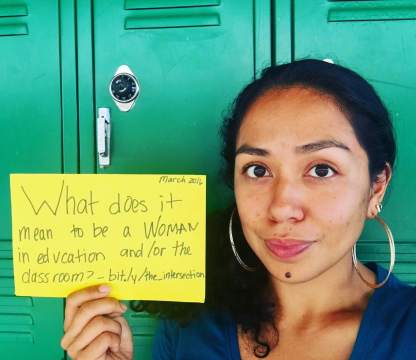
IMG_8494.JPGWhat does it mean to be a woman in education?
I asked myself on a run this morning. For all my discussion about “identity,” I realize that I have actually done very little reflection about my gender identity as a teacher. I deconstruct it occasionally in my personal life, but I haven’t really thought about what it means as an educator.

I think it’s important to remember with this month, as with all months devoted to a group of people, that simply because it’s “[_____] History Month” doesn’t mean that the conversation is only about the past. It is important to know not only where we come from, but also consider how this aspect of our identity influences the present spaces we are in with our students.

Here’s the thing I realized: I know that being a woman in education (where I am in the majority, which also has interesting implications), is important and affects the way I interact with my students and my work. I just have no. idea. how.

I am eager to keep reflecting and hopefully hearing other’s thoughts on the subject. All I have right now are a few moments from over the school year.


“WOO-woo!” A sharp, high whistle pierces the air. My students and I all instinctively turned towards the street and watch the truck slowly stop twenty feet ahead of us at a stoplight.

Back on the field, a few girls and I roll our eyes instinctively. I am surrounded by my fifteen upper-classmen drama students, and we are stretching on a field bordered by a busy street. While the whistle doesn’t surprise me, it does fill my stomach with a white-hot rage. It’s frustrating enough when I am whistled at on a street while running or merely trying to get from point A to point B. It is infuriating that someone felt it was their right to harass my underage female students.

I look back at them, then back at the truck. “Was that the car that did it?” I ask, knowing the answer– the window is still open, a man’s arm hanging out with a sly face occasionally peeking back and laughing, as though he is daring me to say something. My girls nod.

I look back at them, think for a moment, then begin moving towards the car. I briefly turn to my students and lob my room keys at one of them. “Go back to the classroom. I’m going to go have a talk with them.” The kids cheer briefly as I run over, before heading upstairs.


“I just…” she trails off. One of my ninth-graders sits above my desk on a stool, reading her paper rough draft to herself. In a paper about love, she has revealed an emotionally abusive relationship she was in. She wants to finish the paper by writing about how she learned to love herself.

“I just… I don’t know how to write about myself. I feel weird talking about what being strong feels like,” she finally finishes.

I take a second, understanding her sentiment completely. “Why do you think it’s hard?” I ask.

“It… feels weird,” she shakes her head.

“I think a lot of times we as women are told not to write about ourselves or what we like about ourselves,” I offer. “Because, you know… the patriarchy.”

She smiles. We have often talked about “the patriarchy.”

“I think writing about yourself can fight against that,” I continue. I look at my own computer, full of open drafts that I, too have abandoned because they felt “weird.” I look back at her, “Maybe writing about ourselves can be a radical act.”

She thinks about it, then nods her head.


“Ms. Torres, do you ever wear make-up?” A student asks me towards the beginning of the year. With the exception of the first day (where I wore slacks, a button-up, and a bow-tie), I rarely go beyond combing my hair and throwing on a pair of baggy jeans before school.

My regular day-to-day wear consists of ripped jeans and UFC gym attire. I often mention to my students that I am headed to an MMA class or off for a run or to lift weights.

All of this is with purpose. At some point, I began to see traditional, stereotyped forms of femininity as weak– or, at least, as vulnerable. To be feminine and pretty meant to conform to societal norms that seemingly put me in a place of oppression.

So, I gave up those things. I rarely wore makeup. I no longer danced Salsa. Instead, I ran and punched. I decided to see how much I could lift or how fast I could run. I tried to subvert the patriarchy by showing I could mimic its forms.

I look at my student and laugh. “No, not unless I have to,” I said. Then, in a mock-conspirator’s whisper, I say “I’m a bit too busy to worry about stuff like that.”

The student laughs, and I do too. Then I catch the gaze of another female student. She is often well-dressed and wearing make-up. I don’t know if she has heard me, but I can’t help but wonder how she would feel about my comment. Would I have embarrassed her? Shamed her? Angered her?


Now, I am forced to hold up a mirror to my own ideas of femininity, power, and vulnerability. It took years to let go of the idea that my identity as a woman was tied to dressing and looking a particular way. If I am trying to subvert the patriarchy then I would hate to be complicit in the myth that femininity is somehow weak.

I am challenging myself to stand in that mirror and love the feminine, “girly” side of me as much as the one that runs marathons and talks sports with my students. I worry that to do anything less would send a detrimental and subtly misogynistic message to my students. Instead, I want to reclaim that aspect of identity as anything but weak, and see it for its full worth as wonderfully and beautifully powerful.

A Letter to My Wayward Self.

Over the past few months, I’ve been having my students write papers about love. In doing so, it made me both read and reflect on my own experiences with love and growing up– especially in my early twenties. This is where that led me.


A letter to my wayward self.

My dear girl,

I have no idea where you are running to, but I promise you none of the directions you are heading towards are “home.”

I know: you are horrible at the long game. There is no patience in your bloodstream, no chill hidden anywhere in your bones. You are all chicken skin and red hot veins. Your muscles are overrun with fast-twitch fibers. You go far beyond “starry-eyed”— your pupils dilate again and again as your mind wanders in explosive bursts with fury, unprepared for what happens in the moments after when the star has burned out and things are dark again.

You are spontaneous decisions and seeking the next high. Yours is a rabbit-heart that beats furiously, always asking questions: when? who? why how what where where where where? always searching. You race—no, bounce and sometimes tumble— down trails, so assured that the next turn will lead you to find home. You are certain that this rock or that tree is a sign, that the next moment will finally find the thing you want most: an anchor, a resting place, a haven that just might soothe the pitter-patter that runs from your heart, through your veins and into every other part of you.

The problem is, “home” is a vague X on a map without a key. There is no description or clue as to what it is. So you keep thinking you’ve found it: in the hands of one boy, in the furtive glances of a different man, the fervor of a blurred dance floor, the bottom of an empty wine glass. You hop from all these things, assured that each sip or kiss or beat is a sign that you are almost where you need to be.

It’s a confusing concept, but I promise you none of these things are where “home” is. Don’t confuse the feeling you get when you catch his eyes meeting yours with the experience of being appreciated fully in the gaze of someone who loves you. Don’t mistake a flurry of kisses for a downpour of actual caring. Don’t assume the pain-numbing warmth at the end of a long sip is the same as the soothing release of healing when you actually take care of yourself.

“Home” is not found in the temporary bliss of mind-numbingly good kisses. Don’t get me wrong— you can still have mind-numbingly good kisses, but they are merely decoration on the outside. “Home” is built by weathered boards that have been worked on and sanded. They are stained with difficult decisions and tears. Their nails are the choices you make, hammered in with mutual respect. They are painted with the laughter of jokes built over years of shared comfort. Home will wrap you in its arms when you walk into it looking like something the cat dragged in. Home will stay standing when you tear the furniture apart in rage. Home will still protect you when you can do nothing but sit there in silence.

I wish I could tell you things turn out okay.

The problem is, it’s hard to know when you have found a forever-home. Sometimes we outgrow a place, decide we need to do what’s best, move on. Or we realize the foundation isn’t solid. Or we take a job in Hawai‘i and move thousands of miles away.

Here’s the thing you will need to learn: home can never be some summit that you have to venture to. Home should never be a place that can only be entered when terms and conditions apply. Home can never truly be yours if it only exists within the happiness of another’s.

The only place you will truly find it is when you stop, close your eyes, and breathe. You will feel the ground beneath your feet, the beat of your heart in your own ears, the muscles behind your eyes relax. Then, you will realize that home was never some external site to begin with. You will realize the only real home is the quiet, still place where you both know and love yourself, exactly as you are.

And in that moment, you will finally be found.IMG_8512.JPG


For My Parents, On Their Anniversary

When I was a kid, I was scared of a lot of things. A naturally anxious child, I fretted about whether I was a good person, what I would be when I grew up, if anyone even liked me. Despite a pretty stable existence, the world often seemed like it could change so quickly that I was sure its inconsistencies would some day bop me over the head, turn my world upside down, and try and break me apart.

Then, I would see my mom and dad, and take pause. My parents, their love for us, and their love for each other are the constant, steadying force that often helps me find my center. When everything seems to be unraveling, that love pierces through as a reminder I can look at, thinking, This, this is a pure, holy, true thing.

That’s not to say I think it has been easy. My parents have gotten through things that, as kids, we just assumed they would handle. Health issues and long commutes to LA so we could live in a nice area and go to great schools. Jobs that were emotionally taxing and kids that didn’t always understand that (mostly me). My parents love is a love of perseverance and tough choices, of looking at problems and finding a way to joyfully move forward, however difficult. Theirs is the kind of love that faces challenges head on and can look back after and laugh about how they got over that hump or out of that hole. 

At a time when, honestly, I know two-parent households weren’t necessarily the norm, I marvel that I was so blessed to have not only that, but a childhood filled to the brim with this joyful, consistent, lasting love. I know it is the kind of love that, now, helps me face my own problems head on, and look back after and smile, because I was able to make it through.

So, thanks Mommy and Daddy. Your love story is one that teaches me more than any Disney movie or fairy tale ever could, because it’s one that I get to live through and witness every single day.

Screen Shot 2016-01-07 at 7.12.32 AM

Cross That Line – On Viola Davis and Representation

When I was sixteen, I was sure I was going to be an actress.

I ended up initially getting admitted into USC as a theater student. There are lots of reasons I didn’t continue with a career in acting, the biggest being I realized I didn’t actually love it. It was also clear from my first few years in “the industry” just how few stories there were for people who looked like me. The ones that did exist were only showing in then-small theaters like CASA0101.

It also felt like the stories that did exist would never let someone like me in them. “You’d make it a ‘Latina story’ if I cast you,” one person told me, apparently meaning it wouldn’t be marketable. I was asked if I could have a more “cholo” or “ghetto” accent. This is what it means to be Brown in Hollywood (and I’m sure it was far worse for those who pursued the career more seriously).

I have no doubt these structural issues continue. This is why seeing Viola Davis’s Emmy Acceptance Speech last night warmed me so much:

Davis is… amazing. She not only wins, but she uses her platform to call out systemic racism in Hollywood. Davis quotes Harriet Tubman and provides historical context for her speech, and she shares the win with other Black women.

There is still so far to go, but the sixteen-year-old actress in me smiled. Her speech is a source of strength and light for all young actresses and women of color out there. Viola Davis’s win and her subsequent speech show us that change can and must happen, because we will keep demanding it. Stories from people of color matter, and we deserve to play roles in those stories.  As Davis points out, these stories have the power to “redefined what it means to be beautiful, to be sexy, to be a leading woman, to be Black.” Her win confirms that the power of representation to expand the mindsets we can have about ourselves (and that white media will have about us).

Her speech also reminds us of this important truth: the work continues, and we win when we call out tough truths and support each other along the way. Bravo.

This is Rage. This is Joy. This is My Classroom.

I commented recently that I “have no chill and rage often,” about things, especially when it come to race, privilege, and especially when it comes to those things in education. I think it matters, a lot.

I’ve sometimes wondered if I should tone it down, but at the end I am surrounded by folks who remind me that I shouldn’t. That the work has to continue. W. Kamau Bell’s piece on This American Life only drove that home, when the father he interviewed said that he doesn’t let anything go, because, as Bell noted, “you can’t just keep letting your boundary get pushed.”

I’ve come to terms with the fact that some people don’t like that. That’s fair. I’m not a particularly aggressive person, but I am fairly persistent.

Still, “rage” isn’t normally a positive term applied to teachers, and I don’t want to give this perception that to be attuned to how racism plays out means that my classroom is filled with out-of-place anger or a place where my students don’t find joy.

So, just in case, here’s what Rage means for my classroom, and the educator I try to be.


Rage is asking tough questions, and refusing easy answers.

Rage is a refusal to shy away from “the controversial,” or “too tough” discussions.

Rage is refusing to assume their innocence to support my complicity. Rage is accepting that the tough topics and the controversial discussions might be my job.

Rage is making space for the texts overlooked, the activists ignored, the history erased. It is refusing to give up when there’s no pre-made curriculum for the texts kids should read. Rage insists we create the curriculum we never had.

Rage is refusing stagnant practice, it is the internal insistence to create for them, innovate for them, change the game for them, push my boundaries for them. Rage is also knowing that sometimes they need to do that instead.

Rage is honesty. Rage is letting them know as many sides as possible. Rage is baring the burden of their shock and hurt, and sharing yours. Rage is letting them have space to be angry, to grieve, to be frustrated. Rage teaches Ferguson even when it doesn’t “fit” the lesson plan. Rage pulls up the #CharlestonSyllabus to create the lesson, makes kids question where they get their food and why it matters. Rage explains “I Can’t Breathe” t-shirts during warm ups and sets aside “social justice Fridays.”

This is what Rage looks like in my room.

Rage lets them question the “why” and the “how” and pushes them to question more. Rage affirms their emotions. Rage lets them be angry, sad, and empowered. Rage loves them in their youth, their growth, their malleable opinions, and doesn’t necessarily create more Rage, just more questions.

Rage creates space for them to glow. It insists on lifting them up. It insists on creating spaces for them to shine. Rage insists that they create their own holidays, celebrate their culture, tell their stories. It is a joyous Rage that giggles when they begin to subvert the norm, just be being their marvelous selves.

Rage cheers them on, laughs with them, grows more with them, delights in them. Rage sees their light and begs them to “rage, rage against the dying light.”


Joy comes too. Joy is the deep heaving sigh at the end of a sprint. Joy is the letter full of fifteen photos from a student. She hopes your summer is “a hit,” and she wanted to let you know she got her aunt to go 50 miles to the farm we read about and she met the farmer and she talked all about the book you read in class.

Joy is seeing the fruits of Rage. It’s not always more Rage. Sometimes, it’s just light. It’s the strength to keep raging.

Screen Shot 2015-07-29 at 5.31.39 PM

Week 2 – Wrap Up

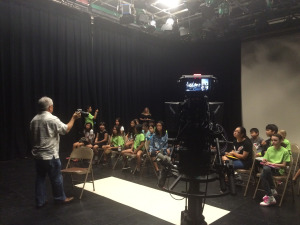
My little journalists had an action-packed week last week!

ctorrescrdg's avatarCRDG Summer Journalists

This past week, we did all sorts of exciting things!

We had a visit from Mr. Cliff Hahn, of Honolulu Civil Beat, who shared stories of youth journalism around the world.

IMG_8591

Then, we went to PBS Hawaii and learned how they put up their news program, and about their Hiki Nō program.

IMG_8613

We also put together our Week 2 newsletter! (Download full version here)

View original post

A Random Blog Update

I know, I just posted something, but I also realize it’s been quite a bit of time since I wrote here.

So here are some life-update things too, just because:

– I went to my love friend Stuti’s wedding in Kauai! (some photos)

The EduColor Site is amazing and y’all should get on that stat.

– While the school year finished strong, I still have many things to do this summer, including a number of side jobs and fellowships.

– I have many things– family, friends, my guy– to be grateful for.

– I’ve been writing a lot! A piece for Teaching Tolerance and another for Honolulu Civil Beat.

Alright, that’s all for now. Here’s to a busy, eventful, and hopefully fun summer.