We Are The Adventurers: Thoughts on May the 4th

We have always been a family of dreamers.

My brother and I like to joke that growing up in our house set us up to be nerds. From a  young age, images of space, aliens, and other worlds were as much a part of my life as the introduction music to Reading Rainbow (and when the show visited the set of Star Trek: TNG, I nearly wept with joy).

My father loved science fiction, and I would often walk downstairs to find him watching an episode of The X-Files or Star Trek (TNG, then Voyager later). Sometimes, he would even pop in 2001: A Space Odyssey just for fun.

So, it should come as no surprise that Star Wars was, like many, a seminal part of my childhood. Empire Strikes Back was actually my parents’ second date. I can’t even remember the first time  I watched it. We had (and still have) a VHS gold box edition of the original trilogy that my brother and I would put on anytime our parents worked late or we were just looking for something to do. Our first “pets,” two tadpoles fished out of a grimy stream, were named “Luke” and “Leia.”

When I think, now, of why science fiction was such an important part of my upbringing it was because there was consistently a sense that magic was possible in our household. Growing up one of the few Latino-Filipino families in our upper-middle-class suburb, it would have been easy for our parents to err on the side of pragmatism. They had worked hard to ensure that my brother and I didn’t want for anything, and I have no doubt they wanted us to be successful and be able to take care of ourselves financially as well.

What they also did, though, was ensure that a drive for success never outweighed our ability to dream. When I wrote Star Wars fan fiction (no, you can’t see it, because I burned it) or we spent hours playing and collecting Star Wars cards, my parents never scolded us for wasting our time. When we poured over books to learn the mechanical and tactical differences between an X-Wing and  TIE fighter, they didn’t tell us to do something “better.”  When we devoured Star Wars novels to continue the stories in our head, they didn’t grab the pulp novels out of our hands, shoving “real” literature into them. They asked what we liked about the books.

My parents encouraged our imaginations, enabled our passions, and gave us space to think about other galaxies and imagine what it would be like to pilot the Millenium Falcon. When we watched Return of the Jedi together, my mom said she could understand the Ewoks (and since Lucas borrowed heavily from Tagalog, she could), and my brother and I looked at her with wonder in our eyes.

We were allowed to be weird, mind-adventurers because we lived in a household that fully supported not just the existence of magic, but also the discussion of what could be out there that was much, much bigger than us. 

So, when I hear John Williams’s opening credits, I still feel that sense of childhood wonder. My heart squeezes a little, and I can’t help but feel a smile spread across my face. Sure, in some ways it’s because I’m excited to see the familiar faces of Luke, Leia, Han, and Chewie come on screen.

Even more affecting, though, is the memory of my magical family. When I hear the opening credits of Star Wars, I instantly remember the feeling of my family curled up in the living room watching with wonder, dreaming together, and imagining what it would be like to live in a galaxy far, far away.

Are You Any Better Off?

Stop. Breathe. Again.

Good.

I am looking out on the ocean at Diamond Head, wiggling my toes in the sand. It is near sunset, and the tide has come up to my ankles. I look down towards surfers leaving the water and couples taking sunset-selfies. This is a nice beach. I think to myself.


Four years ago to the day, I stood on a beach one bright May morning not far from Diamond Head and thought the exact same thing, this is a nice beach. It was my first morning in Hawai‘i, and I had woken up early to go for a run. I explored my new surroundings, amazed that I had actually made the jump and moved here.

When I came to Honolulu in 2012, I had a whole host of reasons why I chose to leave Southern California:

  • I had never lived more than an hour from where I grew up, now was the time to leave.
  • I had never “adventured” after college the way I had wanted to.
  • I was young and figured,”if not now, when?”
  • It was time to ~let go of my stuff~

All of these things were true, in some form or another. Still, none of them were at the true root of why I left: at the time, I hated who I had become.

I don’t mean that in a terribly self-deprecating way, but I had made choices that were actively against the kind of woman I wanted to be. I stayed in relationships that left me feeling hurt, disrespected and jealous. I was selfish and deceitful, with the justification that I “deserved” certain moments of happiness in my life. I drank too much. I partied too hard. I was reacting moment-to-moment only seeking the next high of happiness or excitement because I was a “twentysomething” and that was my right, dammit.

So, I ran. It’s what I’m best at, after all. I didn’t ghost; I found a job and made plans and tried to make a place for myself, but I packed up my life and ran as far as I could. I stood on that beach, the morning of May 1st, 2012, hoping– as cheesy as it was– that it was also the dawn of some, elusive, better version of myself.

Four years later, to the day,  I am standing on a beach looking out at the ocean, facing that question head-on: Am I better off now than I was four years ago?


The tide tickles my calves as it comes up further. A breeze wraps itself around me and reminds me of the mantra I used a moment ago. I close my eyes.

Stop.

I think about the girl I was at twenty-four. I moved here and grew. What I didn’t fully realize was how much growth can and will sting. That it still involved choices I would come to shake my head at. Becoming “better” doesn’t protect you from getting hurt sometimes. It also doesn’t prevent you from hurting others. What I see now is that the depth we can hurt each other is matched only by our depth to love each other as well.

Breathe.

Four years later, I have a longer lens with which to look back on my life. Amid the tense and exciting moments, I take stock of the pauses, the silence. Sometimes all we need is a moment to move past our initial, irrational response.

On the cusp of reactionary implosion, our brain can kick in if we let it. It can read the situation, triage, and clarify what needs to happen next to move past this. The silence isn’t complacency. It’s the time where our mind took a moment to cement in the lesson or the story or the power we would need. It stores it deep inside ourselves, a reserve of strength and wisdom saved for the next time we need it.

Again.

The way we learn is cyclical. We come to understand something, we face it in a different context, and all we can hope is that we handle it with a little more grace than we did before

If anything, the scars we had from the last time should serve as a map we can read as we navigate through this current struggle. ‘I have been here before,’ we remind ourselves, ‘I will come out on the other side. I know what I need to do to get through this.’ We begin the familiar rituals we do to heal. We try to learn. We try to get better. We don’t always succeed, but maybe, just maybe, this time, it’s a little easier.

Good. 

I open my eyes. I look back at the ocean. I have run Diamond Head many times, but rarely stop to come down to the beach and take a moment to breathe. I look at my legs and feet in the water.

I see the scars on my body, I see the parts of myself that have already stretched like new skin over healing hurts. I see where I have grown. I see the wounds and the dark parts of myself that still need to heal. Maybe the difference, now, is that I see the shape and color of the work that will go into that growth.

In some ways, not much has changed. And yet, everything has changed.


An initial version of this included the following passage from Cheryl Strayed’s Wild, and I felt compelled to share it still. It’s one of my favorite books. I highly recommend it. 

But as I wrote his name now, I knew I was doing it for the last time. I didn’t want to hurt for him anymore, to wonder whether in leaving him I’d made a mistake, to torment myself with all the ways I’d wronged him.

What if I forgave myself? I thought. What if I forgave myself even though I’d done something I shouldn’t  have? What if I was a liar and a cheat and there was no excuse for what I’d done other than because it was what I wanted and needed to do? What if I was sorry, but if I could go back in time I wouldn’t do anything differently than I had done? What if I’d actually wanted to fuck every one of those men? What if heroin taught me something? What if yes was the right answer instead of no? What if what made me do all those things everyone thought I shouldn’t have done was what also had got me here? What if I was never redeemed? What if I already was?

– Strayed, Cheryl (2012-03-20). Wild: From Lost to Found on the Pacific Crest Trail (Oprah’s Book Club 2.0 1) (p. 258). Knopf Doubleday Publishing Group. Kindle Edition.

The Lies I Unlearned When I Chose Love

Little known fact about me: my parents and older brother call me “baby,” ensuring I will be some Filipina child’s “Tita Baby” some day. 

Anyway, this is a letter to myself– now, myself in the past, and myself going forward.


Baby,

The world will tell you that you need to guard  your heart and only give love to people  that “deserve” it.

Maybe they’re right.

And they wouldn’t be the first. “If love be rough with you,” a poetic but hot-headed man once said, “then be rough with love.”

Another man once wrote, though, that if you lead a loving life, it is natural— if not essential— that you will fall in love. You will tumble head first into vats of it. Love will be gooey, messy and unpredictable. It will get in your eyes and under your nails, and you will find it dried behind your ears days after you thought you had finally scrubbed yourself clean of it.

And that’s beautiful, but it’s terrifying. It will scald you. It will go up your nose and make you cough in that painful way that rips open your throat. It screws up your clothes, staining in a way and no amount of bleach will get it out. This love shit will seriously fuck you up.

But stop running from it, baby. Stop running from love because you’re scared that you’ll never be able to scrub it away. You’re right. You won’t. It will leave a permanent mark. It’ll burn you in ways you weren’t ready for.

But stop running.

Here’s the lie you must let go: the belief that love only looks like one thing. To choose love is to understand that love comes to us in so many forms.

Love is not just kisses and rainbows. Love is bigger than presents and the person who holds you when you cry. Love is not only the arms of someone else. It is not always soft. It is not always simple. It is not always laid out and easy to reach. Sometimes you think you’re there only to learn that love is at the top of an impossibly long, climb.

Sometimes, love is the brutal, honest truth laid out on the table, looking at all the parts of that truth and making the choice. It sees all the shaky, scary bits and says, “Yes. I’m in.

Sometimes you have that conversation with a partner.

Sometimes with a friend.

Sometimes with yourself.

Still, that’s not the only way love manifests. It’s the text chain with a friend reminding you of your own strength. It’s the head tilt and the quiet question, “Are you okay? What do you need?” It’s the kid who puts everything on the field for you and for them. It’s the moment you hear your own heartbeat and feel joy.

Here’s the other lie: they have been trying to convince you that your heart will only produce so much love. They are convinced that you will meet your quota. That someone will see your secret stash of it and steal it and not give you any in return. That will happen. It will fucking hurt like hell. It will make you feel frustrated and sad.

But it won’t mean you don’t have any more love to give.

So, even when it’s difficult, choose love. Even when you know you might get hurt, run towards love.

Well, don’t run. Walk. Stroll. Take your time. Know what it really means to give and receive it. Sit with the knowledge that you will hurt other people. Love doesn’t guarantee constant happiness, but it does create joy.

But choose love. Walk towards it even when it annoys the shit out of you. Choose love even when it is ripping you at the seams. There is a fine line between DEconstruction and REconstruction, and the two are not mutually exclusive.

You will get burnt. You will be betrayed. You will realize that what you thought was love was actually something else, or that it became something else. You will cry and feel sadness and be hurt.

But you are no fool. Don’t believe that choosing love makes you naive or a dupe. You are not unworthy. Just because love transforms or leaves or isn’t enough doesn’t mean you were weak or wrong. Your ability to give love was never a weakness. In reality, it’s the greatest strength you possess.

So, stop running FROM something, and move towards love. When you see it at the top of an impossibly long rope, climb it and ring the bell for youself. Even if you fall after, you got there in the first place, the echoed ringing a reminder of how powerful you really are.

2016-01-19 10.25.47-1.jpg

Everything is on Fire (and That’s Okay)

It’s been over three weeks since I’ve written anything that is both personal and publishable. I keep opening the page, seeing the white box and the blinking cursor and drawing  a blank.

How do I put down what it means to systematically dismantle a life?

Not in an overly-dramatic way. Unlike my early twenties, it lacks the flair of simply setting the thing on fire and watching the flames dance in the sky. No, this has been a slow, methodical sort of burn. It’s the kind you chose to set aflame to save everything else.

It’s understanding that you need to set down your armor– there is no fight to win now. It’s removing and reimagining the parts of yourself you were so sure you knew, then realized had become foreign when you looked in the mirror. It’s knowing that you can’t use tape and glue anymore, you simply have to appreciate what was built and move on. It’s seeing that everything is on fire, but maybe that’s okay. Sometimes you have to let things burn so new things can grow.

What does it mean to rebuild a body?

How do I explain what it signified to stand alone in my room and hear only my own heartbeat? Is there a name for the tension that exists at the corner of “absolutely terrified” and “utterly excited”? I haven’t yet found language to explain what it means to know that the next few steps of your life will be frightening and difficult, but that you don’t regret them for a moment. It’s unstitching the parts of yourself you were sure were dead, only to find there is still life there and that it is blooming in spades.

There is a unique mixture of grief, fear, joy, terror, and wonder that comes from running your hands down your own body, grabbing the flesh of your hips beneath your own hands and being able to whisper, “This is mine now, only mine now,” in small, sanctified breaths; the prayer of your own newfound path ritually running through your mind.

How do you talk about rediscovery?

IMG_9688Not in the pop-queen-country-belle-diva sort of way, but within the small, undefined moments you had forgotten too. The moments where you realized  you were at the mercy of only your own whims; the simple, everyday decisions where you only have to ask, “What do I want?” I am searching for the couplets that could explain the simple pleasures of small choices. I am seeking stanzas that explain the joy of newfound agency.
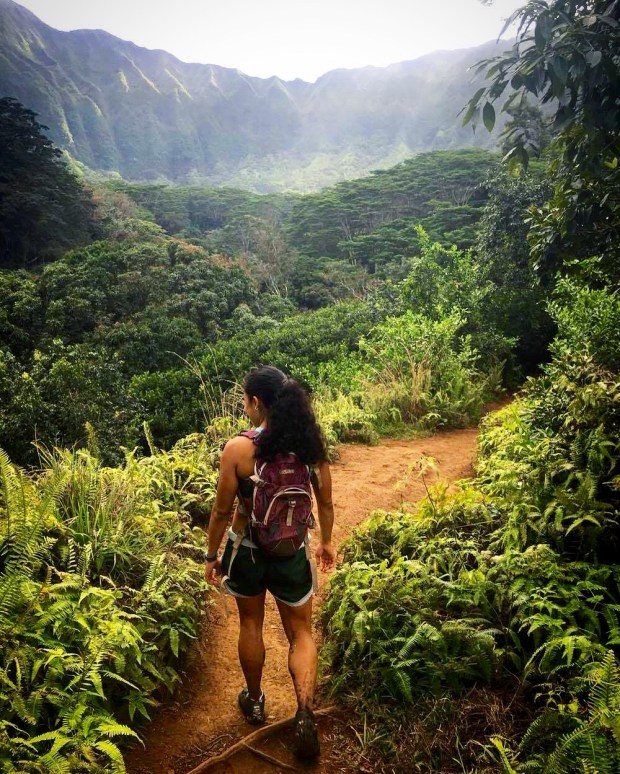
The discovery is a montage, flashes of light shot through my heart: bursting into laughter on a hike, catching my breath in open ocean,  a heavy sigh of satisfied relief at the end of a long day; all the images reveal the mini-epiphany of, “Oh! That’s who I am!” and are full of a sense of wonder I thought I had lost long ago.

Is there a word for the moment between falling and flying?

I haven’t found one yet, something that properly captures the silver second where the sheer ridiculousness of what you are doing becomes perfectly clear. It’s elation and fear. It’s passionate and sensual and make-your-stomach-drop terrifying. It’s the silence in your ears before going down the big hill on a roller coaster; it’s sharp intake of breath before you hit the water from the cliff you just jumped off of.

It’s the knowledge that you cannot go back, that what lies forward is completely unknown, but that the horizon out there is full so much potential you can’t help but just start giggling like a kid seeing the ocean for the first time.

It is wild and unfettered and chaotic and perfect.


The Miracle Is That We Are Beloved

The worst part of death is the terrible silence. It is absolute– a void so empty it is rich in its darkness.

Be it of a loved one, a relationship, or a period of our life, there is always still the silence. The pause after the final breath. The moment when any denial we had about what was happening is stripped away. We can only look down at our hands and know, ‘This is my reality now.’ I heard that silence when I hung up the phone with my grandfather after telling him goodbye, knowing I wouldn’t be able to see him before he passed. I felt it when I returned home from an ex’s, with three years of my life reduced to a few garbage bags in a now empty-feeling apartment. There is nothing we can do but look down at our hands and realize that our previous reality has shattered, and that there is a looming darkness we can only face.

It is easy to feel unworthy in those moments. Everything we held dear has been stripped from us, it seems, and we realize just how fragile we are, how human and imperfect we are as we stumble through life. It is easy to look in the mirror, see nothing but the pain and darkness of that death and feel like we will never find the love or joy or happiness we are certain has left forever with death.

And yet.

Growing up, I had a priest who once reminded us that the renewal of God’s love at Easter didn’t, you know, have to take place on Easter. “If not today,” Fr. Fred told us, “Easter will come.” Even if it was not that Sunday morning, we were reminded that at the end of it all God’s love renews, heals, saves. Even after we have beaten, spit on, and ridiculed Christ, God still decides we are worthy of His love and forgiveness. 

I am reminded of this now, on an Easter Sunday where I am in the process of rebuilding. The darkness we face after a death isn’t a completely false one. Often times, it is an important reminder of our own humanity and imperfections, of the places we faltered and failed.

The darkness isn’t the lie; the lie is that we will never find that joy again.

I know that the miracle of God’s love is not that the world is perfect or that everything is good. The miracle is that, with those imperfections, we are still beloved. The miracle is that even when we are sure we are horrible and hopeless creatures, God reminds us that we are still worthy of love and grace. If we allow them, we still have people and moments that move us to uproarious laughter and countless joy.

This morning, I send a friend of mine a quick Easter message saying, “Rejoice! His is Risen!” He replied in kind and mentioned how blessed we were that we looked inside the tomb and see that is empty.

There, too, is the miracle. The story of Easter does not run away from the notion of death itself. Christ is still crucified on Good Friday and mourned for those three days. We all have parts of ourselves that die as we seek renewal. God’s love doesn’t make death disappear. The resurrection is not a wiping-the-slate-clean reaction of naivety. When Christ looked down and showed us His hands after the resurrection, they weren’t magically devoid of scars. Christ still bore the wounds of His past and crucifixion, even after He rose.

Easter is not about easy fixes or magic healings. It is when we acknowledge both death and the imperfections that came before it but do not stay in the darkness with the decaying forms of our past. The tomb is empty. We don’t have to cling onto those parts of ourselves anymore. Instead, we decide to walk out of the darkness with Christ and rise up better than before.

So, as this Easter comes, I am eager to walk forward in the miracle of God’s love. I look down at my hands and see the reality that they are still weathered and broken from the last part of my life.

This is my reality now, and that is okay. It is good. It is blessed. I have no need to dwell in these past pieces of my life. Instead, I stand up and walk forward out of the tomb and towards light.

FullSizeRender.jpg

I, Woman, Teacher.

This post originally appeared in Education Week.


This week marks the beginning of Women’s History Month. I am interested in hearing from other female teachers about how their gender identity affects their practice in the classroom. Please contact me if you’d like to share some of your thoughts.


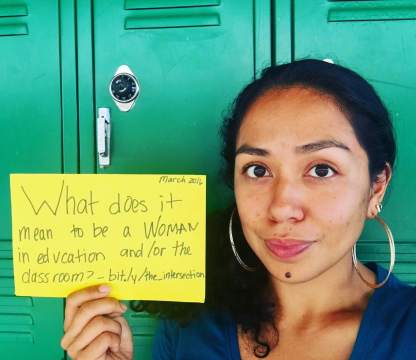
IMG_8494.JPGWhat does it mean to be a woman in education?
I asked myself on a run this morning. For all my discussion about “identity,” I realize that I have actually done very little reflection about my gender identity as a teacher. I deconstruct it occasionally in my personal life, but I haven’t really thought about what it means as an educator.

I think it’s important to remember with this month, as with all months devoted to a group of people, that simply because it’s “[_____] History Month” doesn’t mean that the conversation is only about the past. It is important to know not only where we come from, but also consider how this aspect of our identity influences the present spaces we are in with our students.

Here’s the thing I realized: I know that being a woman in education (where I am in the majority, which also has interesting implications), is important and affects the way I interact with my students and my work. I just have no. idea. how.

I am eager to keep reflecting and hopefully hearing other’s thoughts on the subject. All I have right now are a few moments from over the school year.


“WOO-woo!” A sharp, high whistle pierces the air. My students and I all instinctively turned towards the street and watch the truck slowly stop twenty feet ahead of us at a stoplight.

Back on the field, a few girls and I roll our eyes instinctively. I am surrounded by my fifteen upper-classmen drama students, and we are stretching on a field bordered by a busy street. While the whistle doesn’t surprise me, it does fill my stomach with a white-hot rage. It’s frustrating enough when I am whistled at on a street while running or merely trying to get from point A to point B. It is infuriating that someone felt it was their right to harass my underage female students.

I look back at them, then back at the truck. “Was that the car that did it?” I ask, knowing the answer– the window is still open, a man’s arm hanging out with a sly face occasionally peeking back and laughing, as though he is daring me to say something. My girls nod.

I look back at them, think for a moment, then begin moving towards the car. I briefly turn to my students and lob my room keys at one of them. “Go back to the classroom. I’m going to go have a talk with them.” The kids cheer briefly as I run over, before heading upstairs.


“I just…” she trails off. One of my ninth-graders sits above my desk on a stool, reading her paper rough draft to herself. In a paper about love, she has revealed an emotionally abusive relationship she was in. She wants to finish the paper by writing about how she learned to love herself.

“I just… I don’t know how to write about myself. I feel weird talking about what being strong feels like,” she finally finishes.

I take a second, understanding her sentiment completely. “Why do you think it’s hard?” I ask.

“It… feels weird,” she shakes her head.

“I think a lot of times we as women are told not to write about ourselves or what we like about ourselves,” I offer. “Because, you know… the patriarchy.”

She smiles. We have often talked about “the patriarchy.”

“I think writing about yourself can fight against that,” I continue. I look at my own computer, full of open drafts that I, too have abandoned because they felt “weird.” I look back at her, “Maybe writing about ourselves can be a radical act.”

She thinks about it, then nods her head.


“Ms. Torres, do you ever wear make-up?” A student asks me towards the beginning of the year. With the exception of the first day (where I wore slacks, a button-up, and a bow-tie), I rarely go beyond combing my hair and throwing on a pair of baggy jeans before school.

My regular day-to-day wear consists of ripped jeans and UFC gym attire. I often mention to my students that I am headed to an MMA class or off for a run or to lift weights.

All of this is with purpose. At some point, I began to see traditional, stereotyped forms of femininity as weak– or, at least, as vulnerable. To be feminine and pretty meant to conform to societal norms that seemingly put me in a place of oppression.

So, I gave up those things. I rarely wore makeup. I no longer danced Salsa. Instead, I ran and punched. I decided to see how much I could lift or how fast I could run. I tried to subvert the patriarchy by showing I could mimic its forms.

I look at my student and laugh. “No, not unless I have to,” I said. Then, in a mock-conspirator’s whisper, I say “I’m a bit too busy to worry about stuff like that.”

The student laughs, and I do too. Then I catch the gaze of another female student. She is often well-dressed and wearing make-up. I don’t know if she has heard me, but I can’t help but wonder how she would feel about my comment. Would I have embarrassed her? Shamed her? Angered her?


Now, I am forced to hold up a mirror to my own ideas of femininity, power, and vulnerability. It took years to let go of the idea that my identity as a woman was tied to dressing and looking a particular way. If I am trying to subvert the patriarchy then I would hate to be complicit in the myth that femininity is somehow weak.

I am challenging myself to stand in that mirror and love the feminine, “girly” side of me as much as the one that runs marathons and talks sports with my students. I worry that to do anything less would send a detrimental and subtly misogynistic message to my students. Instead, I want to reclaim that aspect of identity as anything but weak, and see it for its full worth as wonderfully and beautifully powerful.

A Letter to My Wayward Self.

Over the past few months, I’ve been having my students write papers about love. In doing so, it made me both read and reflect on my own experiences with love and growing up– especially in my early twenties. This is where that led me.


A letter to my wayward self.

My dear girl,

I have no idea where you are running to, but I promise you none of the directions you are heading towards are “home.”

I know: you are horrible at the long game. There is no patience in your bloodstream, no chill hidden anywhere in your bones. You are all chicken skin and red hot veins. Your muscles are overrun with fast-twitch fibers. You go far beyond “starry-eyed”— your pupils dilate again and again as your mind wanders in explosive bursts with fury, unprepared for what happens in the moments after when the star has burned out and things are dark again.

You are spontaneous decisions and seeking the next high. Yours is a rabbit-heart that beats furiously, always asking questions: when? who? why how what where where where where? always searching. You race—no, bounce and sometimes tumble— down trails, so assured that the next turn will lead you to find home. You are certain that this rock or that tree is a sign, that the next moment will finally find the thing you want most: an anchor, a resting place, a haven that just might soothe the pitter-patter that runs from your heart, through your veins and into every other part of you.

The problem is, “home” is a vague X on a map without a key. There is no description or clue as to what it is. So you keep thinking you’ve found it: in the hands of one boy, in the furtive glances of a different man, the fervor of a blurred dance floor, the bottom of an empty wine glass. You hop from all these things, assured that each sip or kiss or beat is a sign that you are almost where you need to be.

It’s a confusing concept, but I promise you none of these things are where “home” is. Don’t confuse the feeling you get when you catch his eyes meeting yours with the experience of being appreciated fully in the gaze of someone who loves you. Don’t mistake a flurry of kisses for a downpour of actual caring. Don’t assume the pain-numbing warmth at the end of a long sip is the same as the soothing release of healing when you actually take care of yourself.

“Home” is not found in the temporary bliss of mind-numbingly good kisses. Don’t get me wrong— you can still have mind-numbingly good kisses, but they are merely decoration on the outside. “Home” is built by weathered boards that have been worked on and sanded. They are stained with difficult decisions and tears. Their nails are the choices you make, hammered in with mutual respect. They are painted with the laughter of jokes built over years of shared comfort. Home will wrap you in its arms when you walk into it looking like something the cat dragged in. Home will stay standing when you tear the furniture apart in rage. Home will still protect you when you can do nothing but sit there in silence.

I wish I could tell you things turn out okay.

The problem is, it’s hard to know when you have found a forever-home. Sometimes we outgrow a place, decide we need to do what’s best, move on. Or we realize the foundation isn’t solid. Or we take a job in Hawai‘i and move thousands of miles away.

Here’s the thing you will need to learn: home can never be some summit that you have to venture to. Home should never be a place that can only be entered when terms and conditions apply. Home can never truly be yours if it only exists within the happiness of another’s.

The only place you will truly find it is when you stop, close your eyes, and breathe. You will feel the ground beneath your feet, the beat of your heart in your own ears, the muscles behind your eyes relax. Then, you will realize that home was never some external site to begin with. You will realize the only real home is the quiet, still place where you both know and love yourself, exactly as you are.

And in that moment, you will finally be found.IMG_8512.JPG


For My Parents, On Their Anniversary

When I was a kid, I was scared of a lot of things. A naturally anxious child, I fretted about whether I was a good person, what I would be when I grew up, if anyone even liked me. Despite a pretty stable existence, the world often seemed like it could change so quickly that I was sure its inconsistencies would some day bop me over the head, turn my world upside down, and try and break me apart.

Then, I would see my mom and dad, and take pause. My parents, their love for us, and their love for each other are the constant, steadying force that often helps me find my center. When everything seems to be unraveling, that love pierces through as a reminder I can look at, thinking, This, this is a pure, holy, true thing.

That’s not to say I think it has been easy. My parents have gotten through things that, as kids, we just assumed they would handle. Health issues and long commutes to LA so we could live in a nice area and go to great schools. Jobs that were emotionally taxing and kids that didn’t always understand that (mostly me). My parents love is a love of perseverance and tough choices, of looking at problems and finding a way to joyfully move forward, however difficult. Theirs is the kind of love that faces challenges head on and can look back after and laugh about how they got over that hump or out of that hole. 

At a time when, honestly, I know two-parent households weren’t necessarily the norm, I marvel that I was so blessed to have not only that, but a childhood filled to the brim with this joyful, consistent, lasting love. I know it is the kind of love that, now, helps me face my own problems head on, and look back after and smile, because I was able to make it through.

So, thanks Mommy and Daddy. Your love story is one that teaches me more than any Disney movie or fairy tale ever could, because it’s one that I get to live through and witness every single day.

Screen Shot 2016-01-07 at 7.12.32 AM

Bad Writing and Broken Hearts

Below is a piece I’m working on. I don’t know how it’s going, but I’m having a hard time working on anything. 


I like telling stories.

That doesn’t make me special. I’m a sometimes-writer and full-time English teacher. I have spent years fitting events into narrative structures: dynamic characters, dramatic tension, nuanced relationships wind through conflict and still end with a neat resolution. My world, most days, is spent somehow trying to craft something that fits into a narrative.

I thought this was just craft, something I did on paper or in the classroom until someone reminded of a small, white lie I had written about them. When I apologized, they simply said, “You like making things fit your story.” It wasn’t mean, they were just making an observation. At that moment, it clicked.

I have been telling myself stories for years.

Nearly every relationship I’ve had is subjected to hours in the tumble-dry cycle of day-dreams. I take the smallest tidbits, find the narrative and fill it with so much hot air it floats away with the rest of my imagination.

My narrative habit has been curling its way through my brain, around my heart, and into my actions since childhood. A gossamer string, my desire to adapt my perception of reality– then manipulate that reality to my perception– has been woven into my life since long before I could understand it.

It’s in adolescent journal entries describing, in excruciating detail, the real meaning behind my crush putting his hand briefly on the back of my chair as he talked to someone else. It’s being sure that, when his “ocean blue eyes, like a stormy sea” (a line, no doubt, purloined from some bad fanfic I had read on the internet) locked with mine, it was because he was seeing something deeper in me. It’s embedded into the fabric of time I’d spend skulking around corners at school, hoping to “accidentally” run into some guy.

When, somehow, I would convince that crush to actually date me– with obvious flirtation, with praises and pretty words– I was still creating storylines for them that would, eventually, end.

Storyline: A young Mormon missionary falls in love with a Catholic girl. He proposes. She says yes. He goes on his mission and, somehow, when he returns, they find a way to work through their religious issues and have a happy life.

In reality, six months after he left, the heady high of my first kiss and first love had worn off. I was sixteen when he gave me a ring. I was seventeen when I sent my missionary a Dear-John-email (we weren’t allowed to call or see them in person, or I swear I would have). He begged me to accept his God into my heart and make things work. I overlooked his messages. I returned his ring and most other gifts he left me. 

He’s married now, I think. He blocked me on Facebook.

I did this a few more times in high school: the track star who tutored me in math and left me when he realized our time was up. I threw a fit (this was not part of my story) and sobbed, though deep down I agreed. The fellow thespian, who I badgered to go out with me my senior year. He wrote some nasty things about me, we made peace and parted ways. He recently married man in San Francisco

This, of course, is natural for many high schoolers. As a teacher now, I see myself in so many sixteen-year-olds skulking around corners, hoping to bump into someone. I see the students hoping to find validation in me as their teacher or their friends or some relationship, and sigh and tilt my head and wonder how anyone put up with me at that age.

What is more difficult to realize is that I didn’t leave the practice behind in my school like I thought I did. I see now that I have been weaving webs of stories and heartaches long past my graduation.

We Are Complete Within Ourselves: Stories and Spaces

“Do you and your boyfriend tweet at each other a lot? I see some couples do that and I can’t help but laugh.” I am at a wedding, and making small talk with dozens of people, the only attendees I know being the bride and my boyfriend. I have just shared my love of all things “new media” with someone.

“I do too!” I share a laugh, “but no. He’s not really into social media. He’s more private than me.”

“Oh…” she trails off, nodding. “Well, it’s a good fit then, you two together?”

I think, and nod as I say, “Yes, yes it is.”


When I was a young, like most moon-eyed teenagers, I assumed that whoever I ended up with would be just like me. We would like all the same movies, we would have the same hobbies. We would agree on everything, and love would be easy. It shouldn’t be too much work, right? When you loved someone enough? “Love is all you need,” yes?

Most of us who have been in a serious relationship now laugh at those starry-eyed dreams. We know now that love takes hard work, effort, tough choices, a deep commitment to stand by someone, even when they are at their lowest.

Still sometimes, in those low points, I used to try and measure my relationships based on those initial affections and mutual interests, worried they would somehow be “not enough.” Did it matter that we didn’t share all our hobbies? Did we “fit” right?

And sometimes, things aren’t enough, and they end. I used to think of all my breakups, in aggregate, as all cases of “all the things he would never be able to give me, or me to him.” I used to see my failed relationships as these long tapestries filled with rips and patches that just showed how we never quite fit into each other correctly, the fabrics and thread never really working out. Eventually, the piece was so threadbare, the thing unraveled.

I realize, now, that deficit thinking of not only myself, but others, has been more hurtful than helpful.

Now, I know that it isn’t about fitting INTO each other so much as BEING with each other. I never needed someone to complete me, nor did my exes, nor do any of us.

Instead, what we need is the ability to navigate the world in similar spaces alongside each other, even when it is hard. We need someone who sees us as our complete selves, and shares space with that identity, instead of trying to fill in false notions of “gaps.” In the end, no matter how many spools of thread you try and wrap around each other, you cannot force very different people to share very different spaces.


I see this now so clearly.

Other men have treated me well, but what I have now is more than just mutual respect and caring. What I needed is someone who stands right next to me in those difficult spaces. There is a deep, cultural, gut understanding of who I am not just in likes or dislikes, but as a person.

Yes, I could probably find someone who treats me well and/or likes all the things I do, but how many people in the world are going to see every part of you– marvelous and terrible in its humanity– hold your hand, and say, “I’m here. I got you. I love you,”? How often do you find the person who not only sees who you are, but can see past it to all the other stories that created the space you now inhabit? How rare is it to find the person that can read and understand those past stories as well as you do?


I am a firm believer that I better understand my present by reflecting on my past. I have long forgiven and forgotten frustrations I had with past relationships. I don’t regret most things; they don’t hurt. They read like old chapters building to the next part of the story.

I understand I don’t know the future, but what I do know is how learning from this past makes me feel so lucky to have the present. I see how much the universe has worked to push me to this place where the only person I am asking to complete me is me. Where the question I ask my partner (who, yes, is the bees’ knees) every day is not ‘am I enough?’ but one that I feel confident gets me the answers I need:

Will you share this space this me, even when it’s hard? Can we share our stories? Do they matter to you?

That sounds like a good place to begin.